

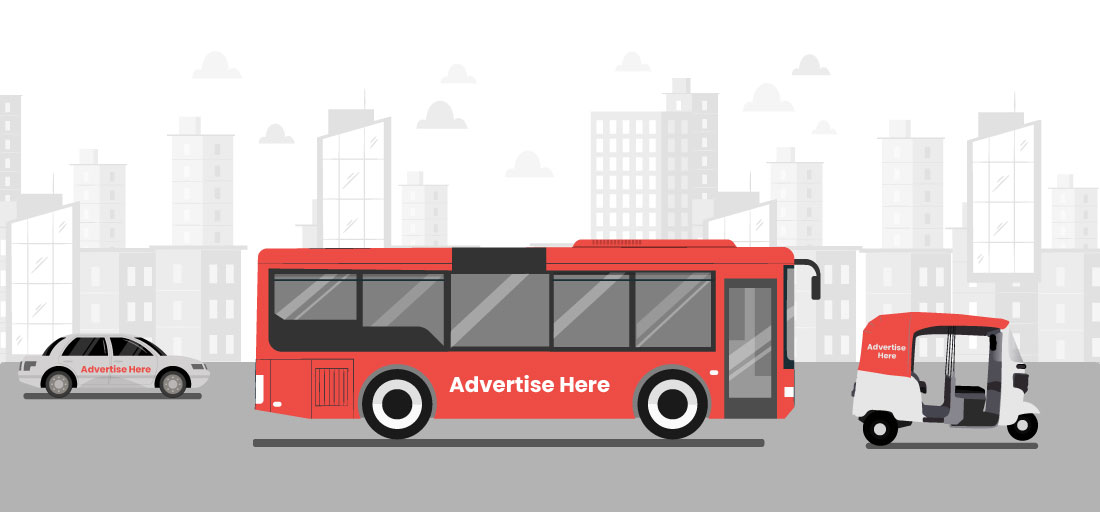

Your advertisement is very creative, but it still fails if there is no strategic placement, repeated exposure and eventually no brand recall. Transit advertising solves this problem very effectively; it puts your brand in front of millions of commuters on the routes they travel every day, generating repeated impressions that compound into genuine brand recognition.
The numbers are clear: businesses that run transit advertising in India report up to 90% increases in brand awareness. Transit media's share of the Indian OOH market has grown from 25% to 35% in recent years and is projected to hit 40% by 2026, making it the fastest-growing segment of outdoor advertising in the country.
This guide covers everything: what makes transit advertising work, its core benefits, a media cost comparison, the 2026 trends reshaping the channel, and how to measure ROI like a performance marketer.
What Is Transit Advertising?
Transit advertising is an out-of-home (OOH) advertising medium that allows brands to promote their products or services through transportation networks. Advertisements are placed on vehicles such as buses, metro trains, auto rickshaws, cabs, and mobile vans, as well as on transit spaces like metro stations, railway stations, and airports.
What makes transit advertising unique is its ability to move with the audience. Instead of remaining in a single location, transit ads travel across different routes and areas, helping brands gain exposure among a broad range of consumers throughout the day.
Transit advertising includes:
- Bus branding - exterior wraps, rear panels, interior cards
- Metro train branding - coach wraps, platform displays, digital screens
- Auto hood branding - hyper-local neighbourhood coverage
- Cab branding - premium urban audiences, in-car screens
- Mobile van branding - event-driven, route-flexible campaigns
- Airport and railway station advertising - premium and national-scale placements
According to industry research, transit advertising helps brands increase their visibility by 20–60%, making it one of the highest-reach formats in the Indian OOH landscape.
Why Transit Advertising Remains a Powerful Marketing Channel?
| Factor | Transit Advertising | Static Billboard |
|---|---|---|
| Mobility | Moves across the city | Fixed location |
| Daily reach | 30,000–50,000+ per vehicle | Location-dependent |
| Cost per impression | Very low | Low–medium |
| Geographic flexibility | High — route-selectable | Fixed |
| Audience diversity | Broad cross-section | Commuters passing one spot |
| Campaign adjustability | High | Low |
| Static billboard monthly cost | ₹20,000–₹10,00,000+ | |
| Transit equivalent | ₹10,000–₹1,50,000/vehicle | |
| Frequency potential | 20+ exposures/commuter/month | 1–3 per day |
Transit advertising consistently delivers more impressions per rupee than comparable static OOH formats, and unlike billboards, the audience is captive. A commuter in an auto rickshaw or metro coach is naturally present with the brand message, without the distractions of a scroll feed or a skip button.
Why Do Transit Ads Work Specifically in India?
India's urban structure is built around transit. Over 1.4 billion transit journeys happen daily across buses, metro trains, auto rickshaws, railways, and ride-hailing platforms. In major cities, 60–90% of the working population uses public or shared transport in a typical week, with 3–7 repeated exposures per commuter on the same routes.
7 Core Benefits of Transit Advertising
After learning about transit advertising, it is now time to look at the benefits of transit advertising:
1. High Visibility Across Urban Corridors
Transit ads travel through the busiest routes in every city, market areas, office corridors, residential zones, and educational hubs, generating continuous exposure throughout the day. Research shows transit ads can generate more than 25 million impressions annually in major metropolitan areas. With 22 hours of average daily visibility, transit formats turn out to be one of the best advertising formats.
2. Massive Reach Across All Demographics
Whether it's a city-wide bus network, metro system, or cab fleet, transit advertising cuts across income levels, age groups, and lifestyle segments. Studies show transit advertising reaches 94% of the target audience in a given market every week, a penetration rate that no digital or print medium can match in urban India.
3. High Frequency Builds Genuine Brand Recall
A commuter who takes the same bus route five days a week sees the same transit ad 20+ times per month. This compounding frequency is the engine of brand recall. Research confirms transit advertising campaigns increase brand recognition by up to 40% among regular commuters, a figure that reflects accumulated exposure, not single-encounter impact.
4. Hyper-Local and Contextual Targeting
Transit advertising enables route-level targeting. Auto hood branding in a specific neighbourhood, bus branding on routes serving a business district, or metro advertising concentrated around tech parks- each placement is a deliberate audience choice. According to research, 77% of consumers have discovered new products or services through transit advertising in their local market, underscoring how local relevance amplifies impact.
5. Cost Efficiency vs. TV and Digital
Today, transit advertising is fully measurable. GPS tracking, QR integration, and brand lift tools give marketers clear visibility into reach, frequency, and audience response. So every rupee spent on transit is as accountable as any other channel in the mix.
6. Creative Freedom at Scale
Transit vehicles offer large, unavoidable creative canvases, full bus exteriors, metro coach wraps, and floor-to-ceiling station installations. Brands can use the vehicle itself as a prop, extending the creative concept into the physical environment.
A survey by Kantar Media found that 63% of consumers find transit advertising eye-catching and memorable, higher than most other OOH formats. Excellent Publicity's creative and execution teams have delivered campaigns that have generated organic social media sharing purely based on creative impact.
7. Offline-to-Online Conversion Bridge
Modern transit advertising integrates QR codes, NFC triggers, and short URLs to convert outdoor impressions into digital actions. Research shows 46% of consumers search for a brand online after seeing it on an outdoor ad. With QR codes embedded in cab branding, bus interiors, or metro platform displays, brands can directly attribute app downloads, website visits, and lead form fills to specific transit placements.
2026 Emerging Trends in Transit Advertising
Let us look in detail at the trends in transit advertising that make your advertisement a huge success.
1. Programmatic DOOH: Buying Transit Like Digital
Digital Out-of-Home (DOOH) screens in transit environments, metro platforms, bus terminals, airport concourses, and in-vehicle screens now support programmatic buying. This means transit ad placements can be purchased and optimised in real-time based on audience data, time of day, and campaign performance.
India's DOOH market is projected to grow at a 20–25% CAGR, reaching ₹1,000 crore by 2026. By 2026, 20% of all DOOH ad spend in India is expected to be programmatic, enabling transit advertising to compete directly with digital display on measurability and targeting precision.
2. 5G-Powered Dynamic Creative
5G connectivity is enabling live data feeds on transit displays, real-time weather integration, dynamic pricing, live sports scores, and location-triggered content changes as buses move through different zones. Smart transit OOH ads powered by 5G deliver measurable improvements in brand recall compared to static equivalents, and allow creatives to be updated without production lead times.
3. AR and QR Hybrid Campaigns
Hybrid transit ads combining augmented reality (AR) and QR codes are transforming commuter engagement in 2026. A scan of a bus ad can trigger a product demonstration in AR, a brand experience, or an instant purchase flow. This offline-to-online bridge is particularly powerful in metro and cab formats where passenger dwell time is sufficient for multi-step engagement.
4. AI-Driven Audience Targeting and Route Optimisation
AI analytics platforms now analyse passenger flow data, mobile signals, and historical route performance to recommend optimal transit placements for specific audience profiles. Rather than selecting routes by intuition, campaign planners at Excellent Publicity use data to identify which bus routes, auto zones, or metro stations deliver the highest concentration of the target demographic.
5. Sustainability-Led Creative
As Indian consumers increasingly prioritise environmental responsibility, brands are using transit advertising to signal their sustainability credentials, featuring eco-friendly messaging on electric bus wraps, using biodegradable vinyl materials, and incorporating green messaging into transit creatives. This trend aligns particularly well with EV and FMCG brands.
6. Artistic and Cultural Integration
Transit advertising that reflects local language, cultural references, and regional identity consistently outperforms generic national creatives in recall and positive brand association. In a market as culturally diverse as India, localising creative to each city's identity- Mumbai's spirit, Delhi's energy, Bangalore's tech culture- is now a standard practice for sophisticated transit campaigns.
7. Omni-Channel Transit Integration
Transit advertising no longer operates in isolation. Leading campaigns run transit as the "anchor" medium, generating broad awareness at scale, while coordinating digital retargeting to reach the same audience on their phones after they've seen the brand on a bus or metro platform. This omni-channel approach has been shown to lift campaign effectiveness by 40% compared to single-channel outdoor buys.
How to Measure Transit Advertising ROI?
Transit advertising has moved far beyond "unmeasurable." Here are the four primary methods used in 2026:
GPS impression tracking
Every branded vehicle carries a GPS tracker logging its exact route, dwell time, and distance covered. This data generates verified impression counts based on actual traffic density, transforming estimated reach into reported reach.
QR code and promo URL attribution
Unique codes per placement allow direct measurement of digital actions (website visits, app downloads, lead forms) triggered by specific transit ads. One fintech brand tracked 8,000+ new user sign-ups directly to bus-ad QR code scans in a 4-week campaign.
Brand lift surveys
Pre- and post-campaign surveys measuring unaided awareness, aided recall, and purchase intent. Transit campaigns consistently show 20–40% uplift in brand recognition among commuters exposed to the campaign vs. a control group.
Offline-to-online signal monitoring
Tracking branded search volume, direct website traffic, and app activity during campaign flight periods reveals the halo effect of transit exposure on digital behaviour. Brands typically see a 15–25% spike in branded search during active transit campaigns.
How to Plan an Effective Transit OOH Campaign
For a great transit OOH campaign, creatives, mode of advertisement, location, and factors like these come secondary. The whole process starts with effective planning:
Step 1: Set clear objectives
Brand awareness campaigns prioritise reach and frequency. Performance campaigns prioritise measurable digital actions (QR scans, sign-ups, downloads). Choose channels and formats based on the primary objective.
Step 2: Select the right channel mix
Mass awareness → bus fleet. Premium audience → metro + cab. Hyper-local → auto fleet. National reach → railway stations. Event-driven → mobile vans. Combining two channels typically improves campaign performance significantly over single-channel buys.
Step 3: Design for the medium
Transit creative must communicate the core message in 3–5 seconds. Bold visuals, high contrast, minimal text (under 7 words for moving vehicle formats), and a single clear call to action. Interior formats (metro coach, bus interior) allow slightly more message depth.
Step 4: Plan for 4–12 weeks
According to the experts' timeline, it should be: Two to three weeks to build initial awareness. Four to six weeks establishes recall. Eight to twelve weeks creates a sustained brand presence. Campaign duration directly determines frequency, the compounding driver of transit advertising effectiveness.
Step 5: Integrate tracking from day one
Unique QR codes per placement, vanity URLs per city, and brand search monitoring set up before launch. Measurement infrastructure should be in place before a single vehicle goes live.
Transit Advertising vs. Other OOH Formats: Full Comparison
| Metric | Transit Advertising | Static Billboard | Digital OOH | Radio |
|---|---|---|---|---|
| Audience captivity | High (commuters) | Low (passing glance) | Medium | High |
| Geographic flexibility | High | None | Medium | City-wide |
| Frequency potential | Very high (daily routes) | Medium | High | High |
| Creative canvas size | Large (full vehicle) | Large (fixed format) | Flexible | Audio only |
| Cost vs. TV | 60% lower | 40–50% lower | 30–40% lower | 20–30% lower |
| Measurability | High (GPS + QR) | Low | High | Medium |
| DOOH integration | Yes | No | Native | No |
| Tier-2/3 city availability | Yes | Yes | Limited | Yes |
Why Choose Excellent Publicity for Transit Advertising in India?
Excellent Publicity is India's leading full-service transit advertising agency, executing campaigns across the complete range of transit media, bus branding, metro train branding, auto hood branding, cab branding, mobile van branding, and airport advertising, across Tier-1, Tier-2, and Tier-3 cities pan-India.
From strategy and creative to permissions, installation, and performance reporting, Excellent Publicity delivers end-to-end transit campaign management that turns brand budgets into measurable market impact.
Contact Excellent Publicity today and let our transit media specialists design a campaign built around your audience, your objectives, and your budget.
Transit advertising is a subset of out-of-home (OOH) advertising that places brand messages on or within public and private vehicles, buses, metro trains, auto rickshaws, cabs, and at transit hubs like metro stations, airports, and railway platforms. Its defining advantage over static OOH is mobility: the ad travels with the vehicle, generating repeated impressions across multiple geographies in a single day.
Yes, transit advertising is highly effective in India. Businesses that run transit advertising in India report up to 90% increases in brand awareness. Transit ads reach 94% of the target audience every week in urban markets, achieve an average of 22 hours of daily visibility per vehicle, and generate 20–40% brand recall uplift among regular commuters. Transit media's share of India's OOH market has grown from 25% to 35% and is projected to hit 40% by 2026.
Transit advertising outperforms static billboards on mobility (ads travel vs. fixed location), frequency (commuters see the same ad 20+ times/month vs. once at a fixed point), geographic flexibility (route-selectable vs. fixed location), and cost-per-impression. Transit campaigns also integrate with digital tracking (QR codes, GPS) more naturally than static billboards.
The major 2026 trends are: programmatic DOOH buying for transit screens, 5G-powered dynamic creative, AR+QR hybrid campaigns, AI-driven route optimisation, sustainability-aligned creative on electric vehicle fleets, cultural/regional creative integration, and omnichannel transit + digital retargeting strategies.
ROI is measured through: GPS-based impression tracking (verified route coverage), unique QR code or promo URL conversion data, brand lift surveys (pre/post awareness measurement), and offline-to-online signal monitoring (branded search volume and website traffic spikes during campaign periods). Modern transit agencies like Excellent Publicity provide full campaign dashboards.
Auto rickshaw fleet campaigns start from ₹10,000. Bus panel ads range from ₹15,000–₹1,50,000 per bus. Metro station branding ranges from ₹50,000 to several lakhs. Cab branding runs ₹20,000–₹80,000. Airport advertising is premium-priced. Transit advertising costs 60% less than comparable TV advertising and delivers lower CPM than most digital display formats.
Minimum 4 weeks for initial awareness. 6–8 weeks for recall building. 10–12 weeks for sustained brand presence. Campaign duration determines frequency, the primary driver of transit advertising effectiveness. Brands that run campaigns for 8+ weeks consistently see the strongest recall and sales lift outcomes.
For large-scale brand building: full bus exterior wraps (city-wide saturation) combined with metro station branding (premium audience, extended dwell). For local brand building: auto rickshaw fleet campaigns (hyper-local, high frequency, low cost). For premium positioning: cab branding and airport advertising.