
Performance marketing is advertising where you pay for a measurable result, a click, a lead, an install or a sale, instead of paying only for space or impressions. Because every rupee is tied to an action, you can see what each part of the campaign returns and move budget toward what works. This guide explains what performance marketing means, the channels it runs on, how a campaign is built, and the metrics that decide its ROI.
What performance marketing means
In a traditional booking you pay for the placement: a hoarding for a month, a newspaper slot on a given day. You reach people, but the link between that spend and a sale is hard to prove.
Performance marketing flips that. You pay against an outcome, and every step is tracked. A search ad charges you per click. A lead campaign is measured by cost per enquiry. A sales campaign is measured by return on ad spend. Nothing is assumed, because the numbers are visible while the campaign runs. That is the real difference: it is accountable by design, and it can be corrected mid-flight instead of only reviewed at the end.
This does not make brand advertising less useful. Awareness media and performance media do different jobs. One makes people know and trust you, the other turns that intent into a measurable action. Most strong plans use both.
The channels performance marketing runs on
Performance marketing is not one channel, it is a way of buying across several:
Search ads (PPC). You appear when someone searches for what you sell, and pay per click. This captures existing demand and usually carries the clearest intent.
Social media ads. Meta, Instagram, LinkedIn and others, used to generate demand by targeting audiences who are not searching yet.
Display and programmatic. Banner and native placements bought by audience and behaviour, often for retargeting people who already visited you.
Video ads. YouTube and in-feed video, strong for both reach and direct response when the creative is built for it.
Shopping and app ads. Product listings and app-install campaigns measured directly by sales or installs.
Affiliate and partnerships. You pay a partner only when they deliver a sale or a lead.
The right mix depends on where your audience is and whether the goal is to capture demand that already exists, which favours search, or to create new demand, which favours social and video.
How a performance campaign is built
A good campaign follows the same order every time. Skipping a step is where budget leaks.
Set one clear objective. Leads, sales, installs, or booked calls. The objective decides the channel, the creative and the metric.
Pick the channels for that objective. Demand capture leans on search; demand generation leans on social and video. Retargeting supports both.
Build the offer and creative. The ad and the landing page have to match the promise. A strong ad sending traffic to a weak page wastes the click.
Set up tracking before launch. Conversion tracking, call tracking, a clean landing page and CRM fields have to be ready on day one, or the data is lost.
Launch small, then optimise. Start with a controlled budget, read the early numbers, cut what does not work and scale what does.
Report against the objective. The report should answer what it cost to get a result, not just how many clicks were served.
The metrics that decide ROI
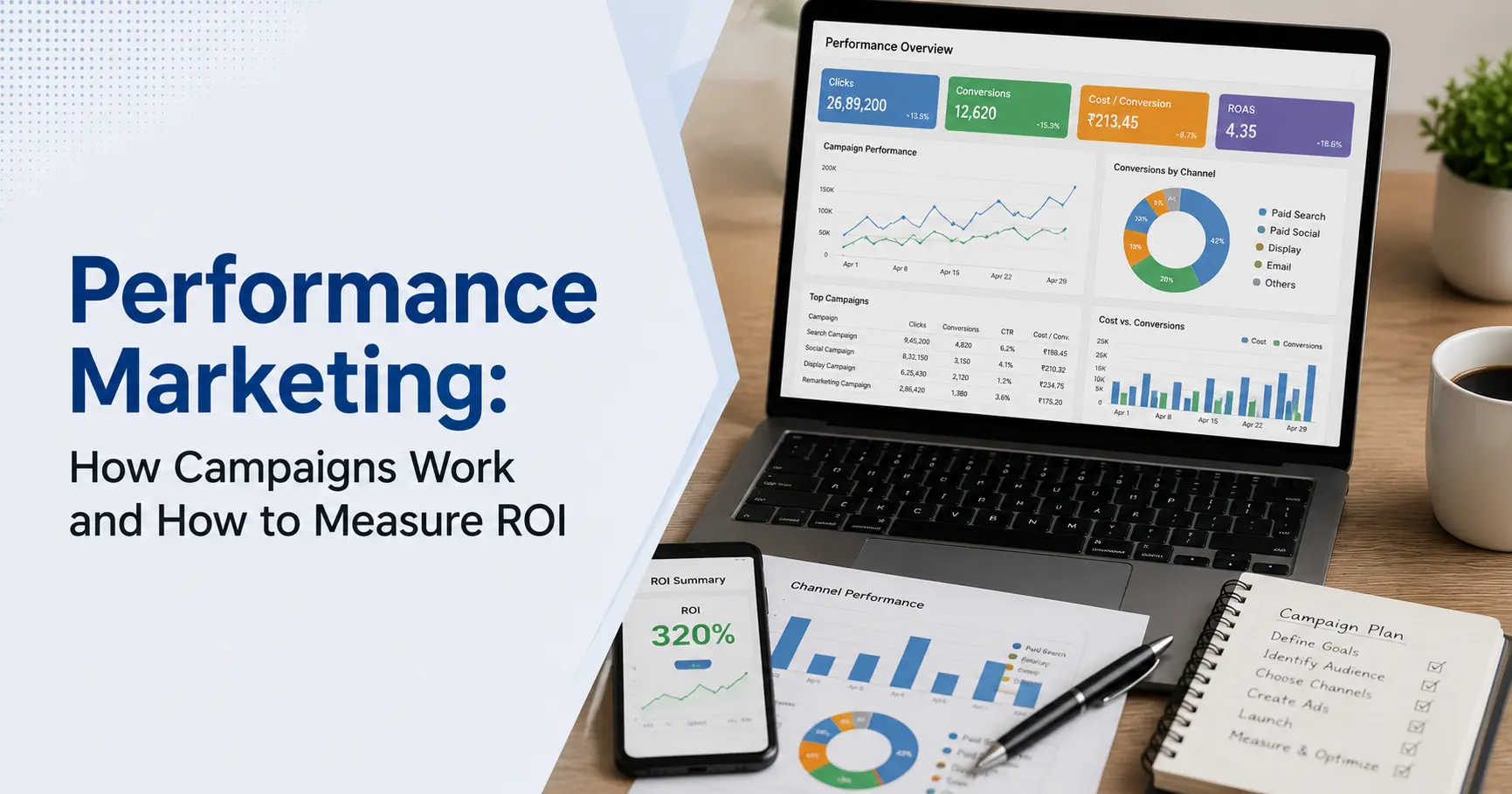
Performance marketing gives you a lot of numbers. The ones that matter are the ones tied to your objective. Agree on them before launch.
| Campaign objective | The metric that matters |
|---|---|
| Traffic and reach | Cost per click, click-through rate |
| Lead generation | Cost per lead, lead quality, lead-to-sale ratio |
| Online sales | Cost per acquisition, return on ad spend |
| App installs | Cost per install, cost per active user |
| Calls and enquiries | Cost per tracked call, enquiry quality |
Two numbers are often confused. Return on ad spend compares revenue against media spend. True ROI goes further and counts media, creative, management fees and, where it applies, the profit on the sale. A campaign can show a healthy ROAS while its real ROI is thinner once discounts and costs are included, so it is worth tracking both.
How to get more from the same budget
Once tracking is in place, most ROI gains come from a few practical moves:
Tighten the targeting. A smaller, better-matched audience usually beats a broad one on cost per result.
Fix the landing page. Faster load, a clear offer and a simple form often lift conversions more than raising the budget.
Feed the channel your own data. Uploading customer and lead lists helps the platforms find people who look like your best buyers.
Optimise while it runs. Shift budget to the winning ad, audience and channel every week rather than waiting for the campaign to end.
Connect it to your other media. A brand that people have already seen on outdoor, cinema or print converts better when a performance ad reaches them later.
That last point is where an agency running both offline and digital has an edge. When your advertising agency plans your hoardings, print and performance ads together, the awareness built by one lowers the cost of the other.
Where performance marketing fits for your business
Performance marketing suits any business that wants measurable returns and can define a clear action: an enquiry, a booking, a sale, an install. It works on its own for direct-response goals, and it works even harder alongside brand media for a launch or a new-market push. For practical planning ideas, our note on digital marketing strategies for small businesses is a useful starting point.
If you want a team that plans performance campaigns and measures them properly, explore Excellent Publicity's performance marketing services and wider digital advertising, delivered through offices in Ahmedabad, Pune, Bengaluru and Dubai.
Ready to run campaigns you can actually measure? Talk to Excellent Publicity and we will build the plan around one clear objective and the metric that proves it.