

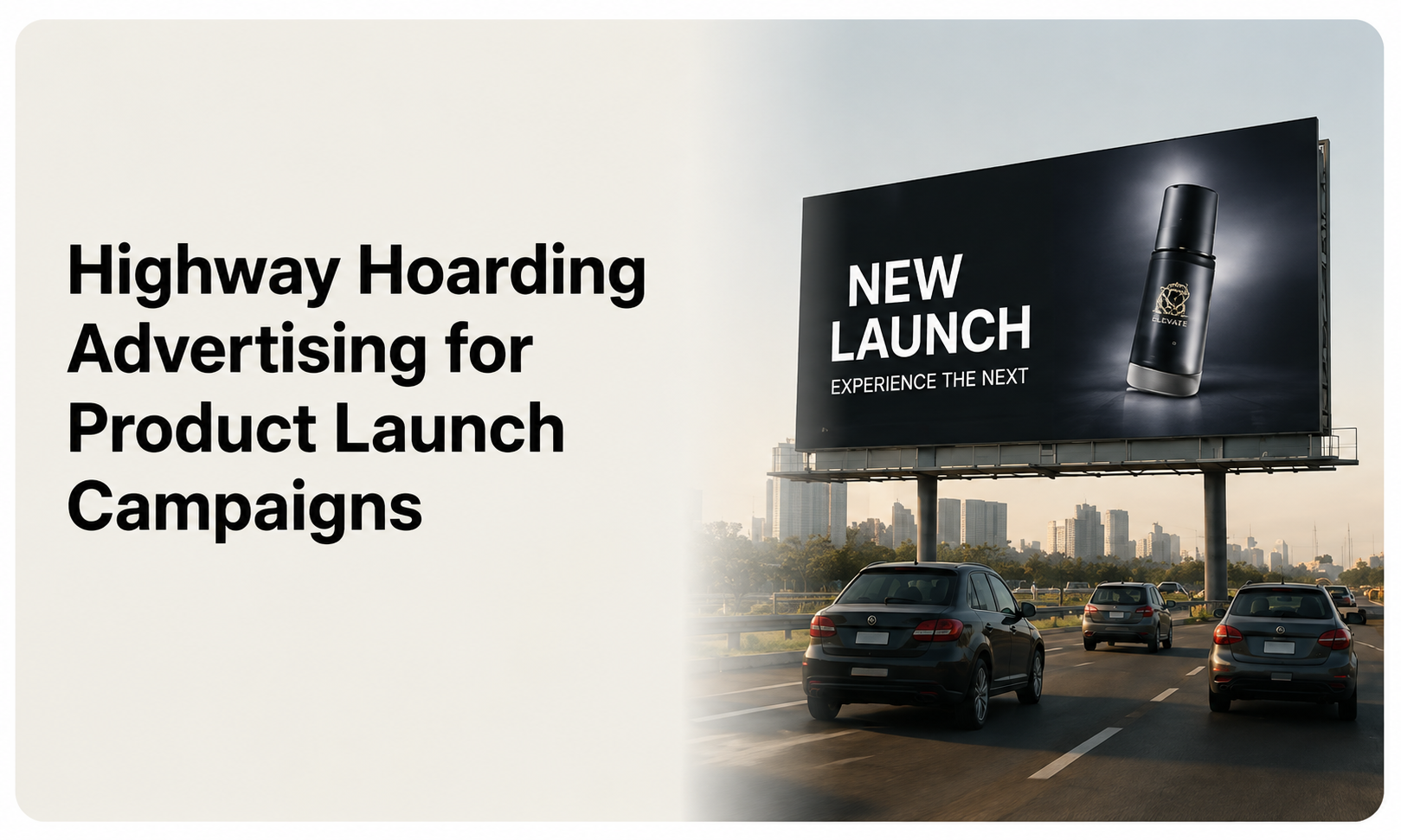

A product launch lives or dies on how quickly it builds awareness. Digital can target people who are already searching, but a launch needs to reach people who do not yet know the product exists. Highway hoardings do exactly that. They sit in front of thousands of commuters a day, in a format nobody can skip, mute, or scroll past, making them one of the most effective ways to announce something new at scale.
This guide covers how to plan a highway hoarding campaign specifically for a product launch: choosing locations, designing creative that works at speed, timing the campaign around a launch calendar, budgeting realistically, and combining hoardings with the rest of a launch media plan.
What Makes Highway Hoardings Suitable for New Product Campaigns?
A product launch needs scale and unavoidability, and highway hoardings deliver both. Every vehicle that passes sees it, day and night, without the audience choosing to engage the way they would with a search ad or social post. For a new product with zero awareness, reach matters more than precise targeting, the goal is simply making sure enough people know the product exists.
Highway traffic also moves slower than free-flowing city roads, especially near toll plazas, junctions, and peak-hour congestion points. That extra dwell time gives commuters longer to register the message, which is why the format delivers strong recall for launch campaigns.
The other advantage is repetition without extra media spend. A commuter driving the same stretch daily sees the same message through the booking period, reinforcing it far more than a single digital impression could. That makes hoarding advertising a practical choice for building awareness fast during a launch.
How to Choose Highway Locations Based on Your Product Launch
Location selection should follow the shape of the launch itself, not just the busiest available highway stretch.
Match the route to the launch audience: Corridors near IT parks suit electronics and premium categories, residential routes suit FMCG and household launches, and airport routes reach travellers and affluent commuters.
Use traffic data rather than guesswork: Average daily traffic counts from mobility and GPS analytics reveal which stretches genuinely deliver exposure, instead of assuming the most famous highway performs best.
Prioritise proximity to the point of purchase: A hoarding on the approach to a retail cluster or dealership zone reaches commuters who may be minutes from where the product is actually available.
Consider entry and exit points to a city: Hoardings at junctions where traffic enters or exits a metro area capture local commuters and visitors together.
Time your location choice around festival and event calendars: Traffic volumes spike around Diwali, regional festivals, and events like the IPL, stretching the same media spend further.
Designing Highway Hoardings for a New Product
A highway hoarding has a few seconds to land its message, so design discipline matters more here than in almost any other advertising format.
Keep the message to a handful of words: Highway hoardings are read at speed, so a headline of five to seven words, in large, bold, sans-serif type, performs better than anything more detailed. If the concept cannot be reduced to a short phrase, it needs to be simplified further, not squeezed onto the board.
Use one dominant visual: A single, clear product image or brand symbol reads faster than a busy composition with multiple elements competing for attention. For a launch specifically, showing the product itself, rather than an abstract lifestyle scene, tends to build stronger product recognition.
Choose high-contrast colours: Combinations like dark text on a light background or a bold single colour against white remain legible from a distance and in bright daylight, which is when most highway traffic passes.
Make the brand name and logo unmissable: For a new product, the brand identity needs to be large enough to register even for a viewer who only catches the hoarding for a second or two, since brand recognition is often the real objective in the earliest phase of a launch.
Design for the specific site: A hoarding facing a toll plaza where traffic slows down can carry marginally more detail than one on a high-speed open stretch, so creative elements should be checked against the actual viewing conditions of each site before finalising.
What Should a Product Launch Hoarding Say?
A launch hoarding has one job: make the viewer aware that something new exists and give them a reason to care, in as few words as possible.
The strongest launch messages follow a simple structure: what the product is, in a phrase, followed by one reason it matters, whether that is a standout feature, a price point, or a launch date. Crowding multiple features, offers, and calls to action onto one board dilutes all of them, and a viewer moving at speed absorbs none of it.
A minimal call to action works best: a short, searchable brand name, a launch date, or a phrase like "Coming Soon" or "Now Available." That gives the message a clear next step without asking drivers to process a phone number or long URL. QR codes suit slower locations like toll plazas and signals, but should never carry the primary message on a fast moving stretch.
Should Your Highway Hoarding Creative Change During the Launch?
Yes, and this is one of the details that separates a well-run launch campaign from a static booking. A product launch typically moves through distinct phases, as mentioned below:
- Teaser phase: In the weeks before launch, the creative elements build curiosity without revealing the full product, using phrases like "Something New Is Coming" alongside the brand name, designed to make repeat viewers notice a change and start anticipating what follows.
- Reveal phase: Once the product is public, creative shifts to show the product clearly, along with the core message and launch date or availability.
- Sustain phase: After the initial reveal, creative can shift again to reinforce the product's key benefit or a specific offer, keeping the message fresh for commuters who have already seen the earlier versions multiple times.
This kind of phased rotation works particularly well on formats built for message changes, such as tri-vision hoardings that rotate between multiple static creatives, or digital LED boards that can update content remotely without any reprinting or reinstallation. For a static flex hoarding, phasing still works, but requires planning the reprint and reinstallation schedule into the campaign timeline from the start.
How Long Should Highway Hoardings Run for a Product Launch?
Most effective launch campaigns run four to eight weeks, structured across the teaser, reveal, and sustain phases described above, though the right duration depends on the scale and category of the launch.
Two to three weeks can work for a promotional or limited-time product where urgency matters more than sustained recall. Six to eight weeks or longer suits a flagship launch that needs lasting recall.
Running a hoarding for only a few days rarely justifies the production cost, since recall builds through repeated exposure to the same commuters, not a single viewing. As a rule, book long enough for a regular commuter on that route to see the message several times, roughly a month at minimum, for the brand and product name to genuinely stick.
How Much Does Highway Hoarding Advertising Cost for a Product Launch?
Highway hoarding costs in India vary by city tier, site quality, size, and format. Indicative monthly rates look roughly like this:
| City Tier | Static Hoarding | Digital/LED Hoarding |
|---|---|---|
| Metro (Mumbai, Delhi NCR, Bengaluru) | Rs 2,00,000 to Rs 8,00,000 | Rs 2,50,000 to Rs 10,00,000 |
| Tier 2 (Pune, Ahmedabad, Lucknow) | Rs 55,000 to Rs 2,50,000 | Rs 60,000 to Rs 3,00,000 |
| Tier 3 towns and highways | Rs 15,000 to Rs 60,000 | Priced on request |
Some vendors price highway hoardings on a per-day basis rather than monthly, particularly for shorter bookings, with rates often starting from around Rs 1,000 per day for space, plus separate printing charges of roughly Rs 10 per square foot and mounting charges of around Rs 4 per square foot. Digital hoardings typically carry a premium of 30 to 60 percent over an equivalent static site, reflecting the flexibility to update creative without reprinting.
A few factors move these numbers for a launch campaign specifically:
- Location and visibility: High-traffic junctions, toll plazas, and airport approach roads command the highest rates, but also deliver the strongest exposure for a launch that needs maximum reach quickly.
- Size and format: Larger boards and illuminated or digital displays cost more but extend visibility into evening and night hours, which matters for a launch running continuously across the full campaign window.
- Duration: Longer bookings generally secure better effective monthly rates than short, one-off bookings, which is worth factoring in if the launch is likely to extend into a sustain phase.
For more details on pricing, you can also read our guide covering outdoor advertising costs across Indian cities and formats.
How to Plan Your Highway Hoarding Budget?
A launch hoarding budget needs to account for more than the monthly site rental.
Space cost: The core rental for the site itself, billed monthly or per day, based on city tier and location quality.
Production cost: Printing and mounting charges, budgeted separately from space and repeated each time the creative changes.
Multiple sites for frequency: Four to eight sites across a city's key routes usually build stronger recall than one premium location for the same total spend.
Phasing costs: If the campaign runs through teaser, reveal, and sustain creatives, plan reprint and reinstallation costs from the outset.
Contingency for extension: Hold back 10 to 15 percent for a possible extension if early performance is strong or the rollout is delayed.
A workable split for a mid-scale, multi-city launch: 60 to 70 percent on space, 15 to 20 percent on production, the rest as contingency.
Combining Highway Hoardings With Other Product Launch Media
Highway hoardings work best as the anchor of a launch media plan, not the entirety of it. Brands can combine them with other outdoor advertising formats to create multiple touchpoints across the customer's daily journey.
- Digital extensions: QR codes and short URLs on hoardings at slower-moving locations like toll plazas give commuters a direct path to a landing page or app download. Geo-targeted retargeting then reinforces the same message on the phones and laptops of people who drove past the site.
- Broadcast and social amplification: Regional television builds mass awareness beyond a single highway corridor, while photos or videos of the hoarding itself can travel far past the commuter audience, especially when the creative is striking enough to be shared organically.
- Other OOH formats: Metro station branding, bus shelters, and transit media near the same corridor put the launch in front of the same audience repeatedly, building the frequency a single hoarding cannot deliver alone.
Which Products Can Benefit From Highway Hoarding Launch Campaigns?
Highway hoarding launches work particularly well for categories where mass, repeated visibility genuinely moves the needle on awareness and consideration.
- Automotive: New model launches reach an audience already engaged with driving, often placed near dealership clusters to link visibility with a nearby point of purchase.
- Real estate: Developers announce new residential and commercial projects on routes leading toward the site, where the hoarding doubles as directional signage.
- FMCG and consumer goods: New or reformulated product lines needing rapid, citywide awareness among a broad consumer base.
- E-commerce and apps: Paired with QR codes, hoardings drive downloads while lending a digital-first brand the credibility that large-scale outdoor advertising confers.
- Entertainment and OTT: Film and show launches suit the format's visual impact and citywide reach across a short, high-intensity promotional window.
Turning Highway Visibility Into Product Launch Momentum
A highway hoarding does one thing extremely well for a product launch: it puts the same message in front of the same commuters, repeatedly, in a format they cannot skip or block. What separates a campaign that builds real momentum from one that simply occupies space is the planning around that strength, choosing routes that match the launch audience, phasing creative through teaser, reveal, and sustain stages, and pairing the hoarding with digital media so the impression has somewhere to go. Working with an experienced advertising agency helps build the citywide familiarity that makes every other part of a launch work harder.
Frequently Asked Questions
How far in advance should highway hoardings be booked for a product launch?
Premium highway sites, particularly in metro cities, are often booked several weeks to a few months in advance, especially around festival seasons when demand and rates both rise. Planning the hoarding booking as part of the overall launch timeline, rather than as a late addition, helps secure better sites and rates.
Should a product launch use one large hoarding or several smaller ones?
Several well-placed hoardings across key routes generally build stronger recall than a single premium site, since frequency across a commuter's regular route matters more for launch awareness than the size of any one board.
Can highway hoarding creative be updated during the campaign?
Yes. Static hoardings can be reprinted and reinstalled at planned intervals to move through teaser, reveal, and sustain phases, while digital or tri-vision hoardings can rotate messages without any physical reinstallation.
Is highway hoarding advertising effective for a small business launch?
Yes, particularly at the tier 2 and tier 3 city level, where rates are considerably lower than metro pricing. A focused launch on one or two well-chosen highway stretches can be effective even on a modest budget.
How is the success of a highway hoarding launch campaign measured?
Common measurement methods include estimated reach based on traffic data, QR code scan rates where used, brand search volume increases during the campaign period, and geo-tagged photographic proof of the installation for verification.
Do highway hoardings require special permissions?
Yes. Highway hoardings require permission from the relevant municipal or highway authority and compliance with local outdoor advertising regulations. Most experienced hoarding vendors and agencies handle this documentation as part of the booking process.
What is the minimum budget for a highway hoarding product launch campaign?
A focused campaign in a tier 2 or tier 3 city can start from roughly Rs 15,000 to Rs 60,000 per month per site, while a metro city campaign across multiple premium sites typically requires a budget in the several lakhs range for meaningful multi-site coverage.