
How Much Does Outdoor Advertising Cost in India? A City Wise Pricing Guide for 2026

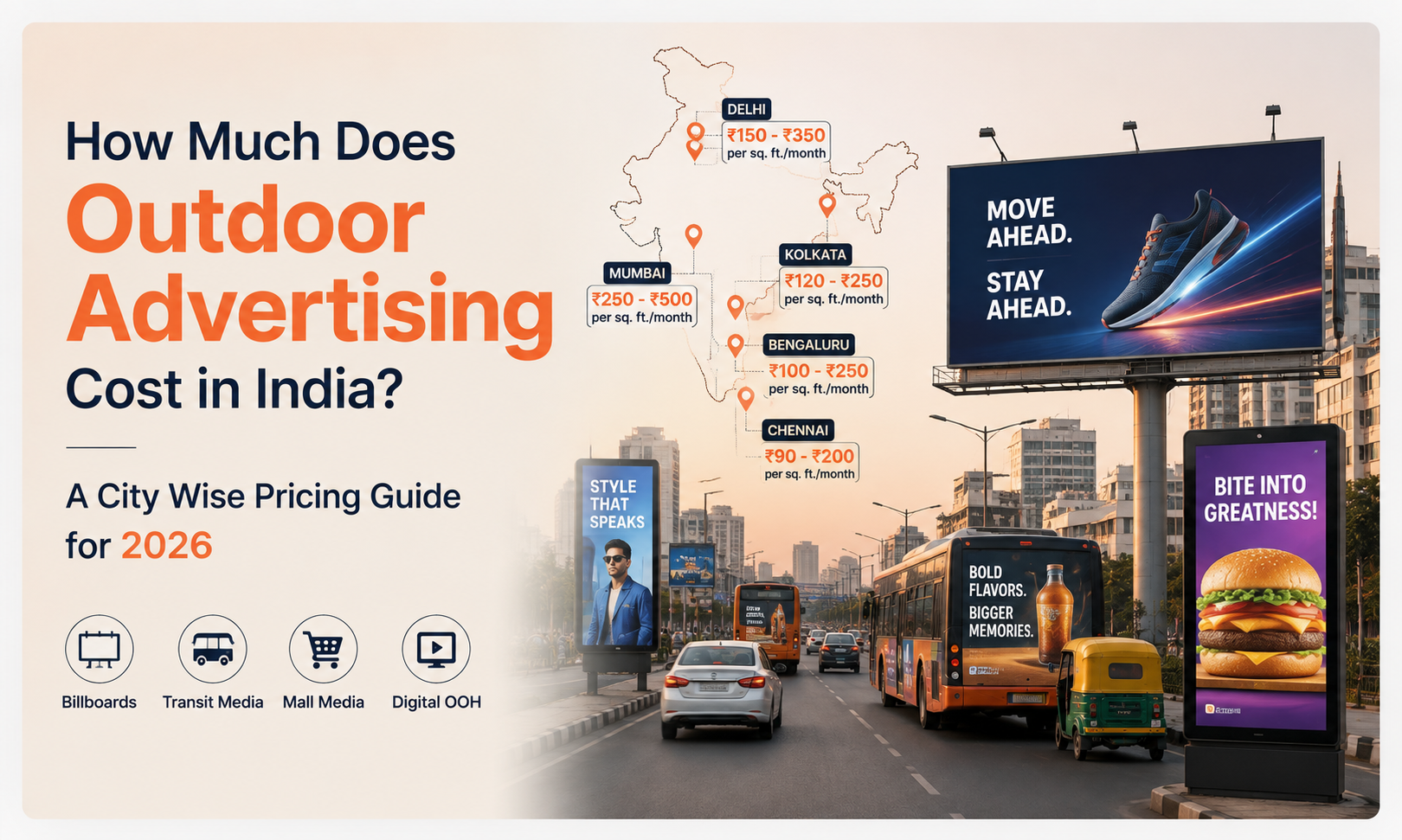

Outdoor advertising, being one of the best advertising formats for brands that need audience engagement and awareness, especially for existing products or newly launched ones, varies in pricing based on location and the advertising agency you choose.
This guide breaks down what brands can realistically expect to pay across formats and cities in 2026, so you can plan a budget with confidence rather than guesswork.
Understanding Outdoor Advertising Costs in India
Outdoor advertising, often called OOH or Out of Home advertising, does not follow a fixed rate card the way print or television does. A single hoarding in South Mumbai can cost more in a month than an entire quarter of advertising in a Tier 2 city.
Things that matter are understanding the variables, format, location, city tier, and duration that actually move the price, so you know what a fair quote looks like before you start negotiating.
Outdoor Advertising Rates by Format
Different formats come with very different price points and audiences. Here is a realistic breakdown of what each one typically costs.
Billboard and Hoarding Advertising Costs
Traditional hoardings remain the anchor of most outdoor campaigns. Here is the pricing of billboards and hoardings in different places:
- Prime unipole hoardings on highways or major junctions in metro cities generally range from 2 lakh to 6 lakh rupees per month.
- At the same time, smaller boards in secondary locations can start at around 60,000 to 80,000 rupees.
- In Tier 2 and Tier 3 towns, a standard hoarding can be booked for as little as 15,000 to 40,000 rupees monthly.
Transit Advertising Costs (Bus, Auto, Cab, and Metro)
Transit media is where affordability really stands out. Here is a price distribution of different transit advertising costs:
- Auto rickshaw branding typically costs between 700 and 900 rupees per vehicle per month, depending on the city and format.
- Cab branding usually falls in a comparable range. At the same time, metro advertising, spanning train wraps, is priced higher, often starting from 1 lakh rupees a month, depending on the city and format chosen.
Street Furniture Advertising Costs (Bus Shelters, Kiosks, and Public Utilities)
Bus shelters and pole kiosks offer a budget-friendly middle ground between transit and billboard advertising. Bus shelter ads typically range from 5,000 to 60,000 rupees per month, depending on the city and location. In comparison, backlit kiosks in busy market areas or metro-adjacent spots usually cost between 5,000 and 25,000 rupees per unit monthly.
Place-Based Advertising Costs (Airports, Malls, Cinema, and Retail Spaces)
Place-based formats reach a captive, high-dwell-time audience, and pricing reflects that premium. Cinema advertising can range from a few thousand rupees per screen per week in single-screen theatres to 1.5 lakh to 8 lakh rupees a month for premium multiplex packages. Airport and mall advertising tends to sit even higher, given the affluent, largely business audience these spaces attract.
Digital Out-of-Home (DOOH) Advertising Costs
DOOH screens let you buy rotating time slots rather than an entire board, which keeps entry costs lower. Rates generally start around 15,000 to 25,000 rupees a month for modest placements. They can climb past 10 lakh rupees for premium digital sites in metro cities, reflecting the flexibility of updating creative instantly.
City-Wise Outdoor Advertising Pricing Guide
| City/Region |
Typical Monthly Hoarding Rates |
Key Highlights |
|---|---|---|
| Mumbai | ₹1.5 lakh – ₹20+ lakh | India’s most expensive outdoor advertising market. Premium locations such as the Western Express Highway and BKC command the highest rates. |
| Delhi NCR | ₹1.2 lakh – ₹7.5 lakh | One of the country’s largest OOH markets, offering high visibility across major commercial and commuter corridors. |
| Bengaluru | ₹60,000 – ₹6 lakh | Rates vary based on the location and traffic density, with premium corridors attracting higher pricing. |
| Pune | ₹60,000 – ₹6 lakh | Offers competitive pricing, with costs depending on the corridor and audience reach. |
| Hyderabad | Varies by location | Generally provides strong visibility at more moderate rates compared to Mumbai and Delhi NCR. |
| Chennai | Varies by location | Delivers cost-effective outdoor advertising opportunities across key urban corridors. |
| Kolkata | Varies by location | Offers comparatively affordable hoarding options while maintaining good urban reach. |
| Tier 2 & Tier 3 Cities | Typically lower than metro cities | The most cost-effective option, enabling brands to achieve strong local market dominance at a fraction of metro city pricing. |
Why do Outdoor Advertising Costs Vary from One City to Another?
Here are a few of the reasons outdoor advertising costs vary from city to city:
- Audience Density & Reach: High-footfall cities like Mumbai deliver significantly larger and more diverse audience volumes at the most important junctions compared to smaller towns, directly driving up ad space value.
- Commercial Activity Levels: Cities with thriving business districts and higher commercial activity command premium pricing since brands compete for visibility in economically active zones.
- Local Competition Among Vendors: The number of media owners operating in a city affects pricing; more competition can either drive prices higher (prime spots) or create pricing variations across similar formats.
- Real Estate Costs: Prime outdoor advertising locations are tied to real estate value, so cities with expensive real estate naturally see higher hoarding and billboard costs.
- Municipal Permissions & Infrastructure: Local civic body fees, licensing costs, and the quality of infrastructure (roads, traffic systems, visibility standards) vary from city to city. This adds up another layer of cost difference even for visually similar ad formats.
Key Factors That Influence Outdoor Advertising Costs
Beyond city and format, several variables affect your final quote.
- Location quality, whether a site sits on a highway, a market road, or a residential lane, is the single biggest driver.
- Size and illumination- lit boards typically cost more than non-lit ones- also matter, as does campaign duration, since longer bookings usually unlock meaningful discounts.
- Seasonality plays a role too, with rates often rising 20 to 40 percent around festivals, elections, and major sporting events like the IPL.
Outdoor Advertising Cost Comparison Across Popular OOH Formats
When compared side by side, auto and e-rickshaw branding remain the most affordable entry points, followed by bus shelters and kiosks, then transit formats like bus and metro advertising, with billboards and premium place-based formats such as airports and malls at the top of the pricing ladder.
Outdoor advertising overall still delivers one of the lowest costs per thousand impressions among major media, which is why it remains a staple even as budgets shift toward digital.
Hidden Costs Brands Often Overlook
The quoted rental rarely tells the whole story. Printing and production for a standard hoarding can add anywhere from 10,000 to 25,000 rupees, installation adds a few thousand more, and municipal permissions or NOCs can range widely depending on the city. GST at 18 percent applies on top of everything. Brands that skip budgeting for these extras are often surprised when the final invoice arrives.
How to Plan Your Outdoor Advertising Budget?
Start with your campaign goal rather than a list of available sites, since a brand awareness push and a store launch activation call for very different site selections.
Fix your target cities and campaign duration early, since committing to three months or more typically unlocks 15 to 30 percent in savings. A simple way to estimate your budget is the number of sites multiplied by the monthly rate multiplied by the campaign duration, plus production and permission costs.
Which Outdoor Advertising Format Is Right for Your Brand?
A national brand chasing mass awareness in a metro city may lean toward highway hoardings or bus branding, while a business targeting a specific neighbourhood or launch will often see better returns from auto, e-rickshaw, or kiosk advertising.
Brands wanting flexibility and rapid creative changes increasingly turn to DOOH, while those chasing a premium, working professional audience often choose metro or airport advertising.
How to Maximize ROI from Your Outdoor Advertising Spend?
Here are the steps to maximize the ROI from outdoor advertising spend:
- Track results using unique phone numbers, QR codes, or dedicated landing pages tied to each format or city, so you know exactly what is working.
- Negotiate on duration and volume, since most vendors offer meaningful discounts for longer bookings or multiple sites.
- Finally, avoid spreading your budget too thin across too many formats.
- A concentrated presence across two or three well-chosen formats usually outperforms a scattered campaign across every option available.
Why Understanding Outdoor Advertising Costs Helps You Plan Better Campaigns
Outdoor advertising pricing in India will always vary by city, format, and season, but understanding the ranges behind that variation puts you in a far stronger position to plan and negotiate.
Whether you are booking a single hoarding or a multi-city transit campaign, knowing what a fair price looks like protects your budget and helps you focus on formats that genuinely fit your goals.
If you would like an accurate, city-specific quote for your next campaign, get in touch with our outdoor advertising team, and we will help you build a plan that fits your budget.