

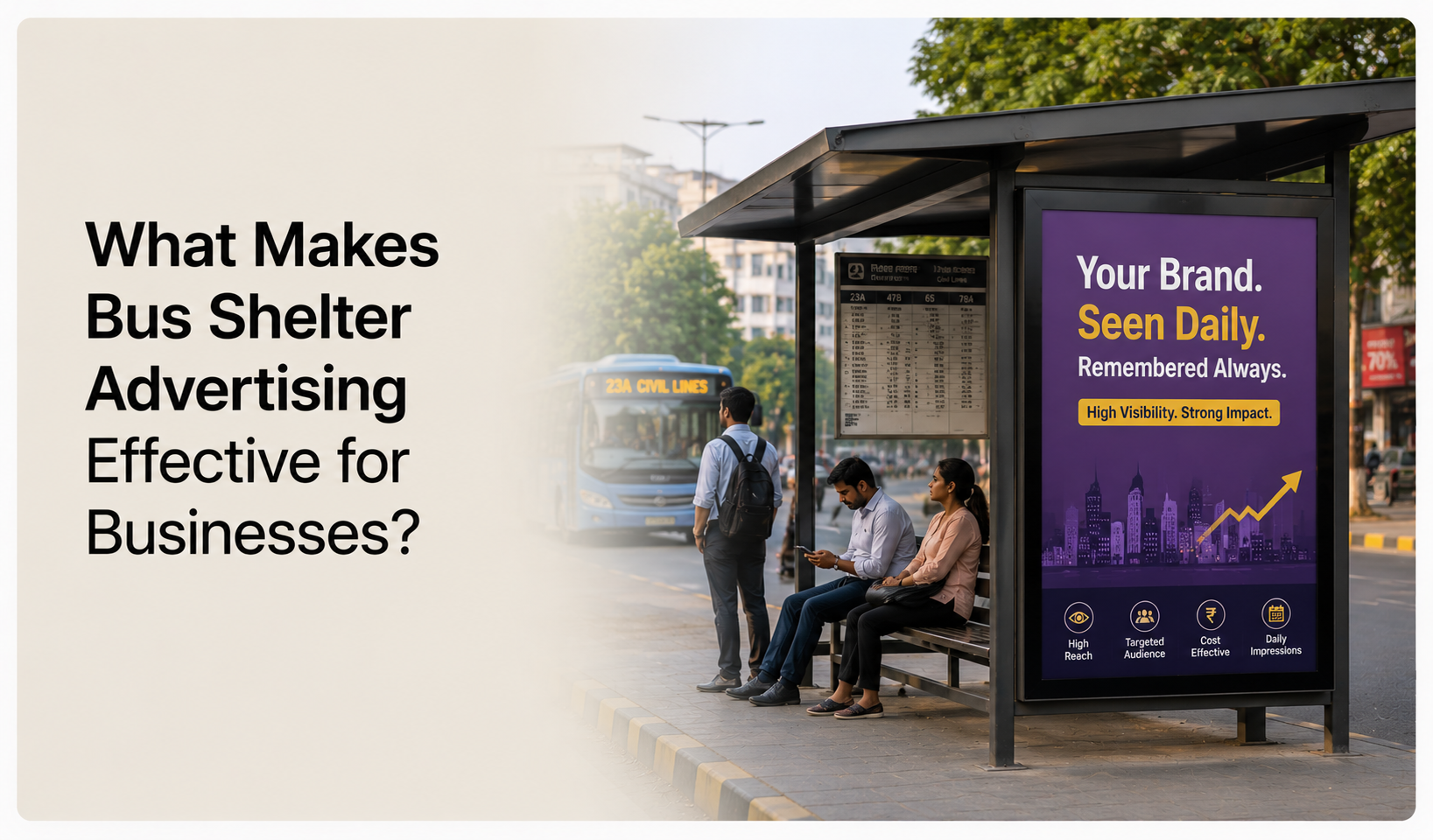

Bus shelter advertising is often described as highly visible and cost-effective. Both are true, and there is a deeper reason the format performs so well. The real answer lies in the few minutes before a bus arrives, and in why that window of time is unlike almost any other advertising moment available to a business.
This piece looks at the mechanics behind bus shelter advertising's effectiveness, how location and creative shape results, and how to plan a campaign that gets the most from the format.
What Makes Bus Shelter Advertising Different from Other OOH Formats?
Every out-of-home format offers visibility. What sets a bus shelter apart is what the audience is doing while they look at it. Bus shelter advertising benefits from the fact that the audience is already stationary and has time to notice and process the message.
A commuter standing at a bus shelter is waiting, often for several minutes during peak commuting hours. That is enough time to read a headline, notice the logo, absorb a call to action, and read it again. The ad does more than get seen; it gets processed, because the audience is settled in one place with their attention free.
The second point of difference is structural. A printed or backlit panel in a bus shelter is part of the physical space the commuter already occupies. It sits at street level, where the audience already is, and it works around the clock, staying in view for the whole wait and for everyone who passes by.
7 Reasons Bus Shelter Advertising Is Effective for Businesses
1. Attention, not just visibility: The time commuters spend waiting is the single biggest structural advantage of the format. A bus shelter ad is read, and often read again.
2. Always in view: The message stays in the physical space the commuter already occupies, on display for the full length of the wait and for every person who walks past.
3. Strong recall: Because the same people see the same message during their daily commute, bus shelter campaigns build the kind of familiarity that brings a brand to mind later, at the moment of purchase.
4. Efficient reach for the budget: A single panel is seen by a steady stream of commuters, pedestrians, and road users every day, so each booking delivers a large number of impressions over the campaign period.
5. Hyperlocal relevance that compounds recall: A shelter outside a university reaches students. A shelter outside a business district reaches office workers during two predictable windows a day. A shelter in a residential pocket reaches the same set of neighbours, repeatedly, week after week. An ad seen by the right audience in the right physical context, a lunch offer outside an office park, a student discount outside a college gate, a clinic ad near a residential cluster, performs even better. The location becomes part of the message itself.
6. Frequency built into the route: The same commuters pass the same shelters on the same routes, often daily. That repetition is what drives recall. A shelter near a metro interchange captures footfall from several transit modes converging in one place, multiplying effective frequency without multiplying media cost.
7. It works alongside every other channel: Bus shelter advertising is frequently paired with moving bus advertising to combine fixed, repeated exposure with wider geographic reach as the vehicle travels. A shelter ad can also prompt people to search for a brand online or visit its website after seeing it, so a well-placed shelter campaign supports every other channel running alongside it.
How Location Determines the Effectiveness of Bus Shelter Advertising
Location is close to the entire decision in bus shelter advertising. The best sites are the ones that match the audience and the campaign's objective.
Useful factors to weigh when shortlisting sites include proximity to relevant retail or venues, commuter routes, schools, universities, or office clusters, residential density, and traffic flow and pedestrian visibility. For a local campaign, shelters near shops, gyms, colleges, or event venues tend to perform particularly well. For a broader regional push, it is usually better to build a site list around repeated exposure across several neighbourhoods or commuter routes rather than concentrating on one large location.
Context matters as much as footfall. A shelter near a gym suits a fitness brand. A shelter near a school suits an educational or family product. A shelter near a food court suits an F&B promotion. Localising the message itself, referencing a nearby landmark or a neighbourhood-specific offer, lifts engagement further, since the audience registers the ad as relevant to where they already are. For more on planning reach across a network of sites, see our guide to maximising reach and impact with bus shelter advertising.
How Creative Design Affects Bus Shelter Advertising Performance
Format choice is the first creative decision, and it shapes what "effective" means for a given campaign. Static six-sheet posters remain the traditional format: durable, practical, and well suited to a single clear message held over several weeks. Because there is no motion or rotation, the message is designed to work on the first read and every read after it. Digital screens allow content to rotate, update by time of day, or respond to conditions like weather, which suits time-sensitive offers, multiple creative variants, or campaigns that speak differently to a morning commuter and an evening one. Bus stop takeovers, combining multiple panels or formats at a single high-value location, work best where a brand wants to own a specific spot, typically retail streets, transit interchanges, or university areas with concentrated footfall.
Within any of these formats, the same creative discipline applies. The strongest bus shelter ads share a consistent formula: one main message, a clear and prominent brand logo, high-contrast visuals that read at a distance, minimal body text, and a single obvious call to action, whether that is visiting a store, scanning a QR code, or searching for the brand name. A headline of seven words or fewer tends to work best. Because the format is close-up and personal, the copy can read like a conversation with one waiting commuter.
Which Businesses Can Benefit from Bus Shelter Advertising?
The format performs best when a business can answer yes to most of the following: the target audience is a specific local group, such as commuters, students, shoppers, or residents; the goal is awareness, recall, or local footfall, carried by one clear message; the campaign can run across sustained weeks, since recall builds through repeated exposure; and there is a real, physical destination, a store, a clinic, an event, that benefits from being close to the ad.
Categories that consistently see strong results include FMCG, retail, education, property, food and beverage, financial services, and local service businesses of nearly every kind. It suits brand awareness campaigns, store openings, app downloads, event promotion, local launches, retail sales pushes, and recruitment and university marketing, where the goal is to reach a defined audience repeatedly. It is equally accessible to a national brand running a citywide network of shelters and to a small business booking a single site near its own storefront.
The best results come from matching the format to the goal. A shelter ad delivers one idea absorbed over a few minutes, so a detailed multi-feature product story pairs well with a channel that carries more detail alongside the shelter. Site selection follows the routes your customers actually travel, and a run of several weeks gives the message the repetition that builds recall. Where an audience is spread across many routes and modes, a combined plan of shelters with other outdoor and transit formats extends reach further.
How to Make a Bus Shelter Advertising Campaign More Effective
Start with a clear objective before booking anything. Brand awareness, store visits, app downloads, event promotion, and local launches each call for different site selection, format, and creative choices, and the clearer the objective, the easier it becomes to choose sites that fit.
Plan the campaign duration around that objective. Shorter runs work well for events, store openings, flash offers, and seasonal launches, while longer campaigns, generally several weeks at minimum, suit brand awareness, local recognition, and always-on visibility. Because so many people pass the same shelters on the same routes repeatedly, a sustained run turns a passing glance into genuine familiarity.
Connect the campaign to a clear next step. Whether that is visiting a store, searching the brand name, scanning a QR code, downloading an app, or using a promo code, the desired action should be obvious on the creative itself. Pairing bus shelter advertising with wider media, paid social, search, radio, and other OOH formats compounds its effect further, since a commuter who sees the shelter ad on the way to work may search for the brand later and then encounter a retargeted ad before converting.
Finally, check rules, approvals, and production requirements before launch. Most bus shelter sites are already approved for media use, and artwork still needs to meet content, safety, and technical standards. Certain formats or locations may require additional advertising consent depending on size, illumination, and placement. Building this into the planning timeline keeps the campaign on schedule once it is ready to go live.
Is Bus Shelter Advertising Cost-Effective for Businesses?
Yes. Bus shelter advertising is one of the more accessible options in outdoor media, offering broad local exposure with straightforward production.
Its scalability is part of what makes it work for businesses of very different sizes. A local business can start with a single shelter near its storefront and see a meaningful footfall impact, while a national brand can build a citywide or multi-market network using the same underlying format. Campaigns can scale smoothly from hyperlocal to citywide. Backlit and digital panels add further value: they remain visible around the clock, which maximises the number of impressions generated across the booking period.
Frequently Asked Questions
Why is bus shelter advertising more effective than many people expect?
Because the audience is waiting in one place with their attention free, the ad receives several minutes of attention rather than a passing glance.
Is bus shelter advertising only effective for local businesses?
No, though it is strongest for goals tied to a physical location or a defined local audience. National brands use shelters too, typically as part of a wider network spanning many cities and routes.
How long should a bus shelter campaign run to be effective?
Recall builds through repetition, so campaigns of several weeks generally deliver the strongest results. Shorter runs work well for time-bound events, offers, or launches.
Is digital or static bus shelter advertising more effective?
Each suits a different goal. Static formats suit a single, stable message held over time, while digital formats suit campaigns that need flexibility, rotation, or time-sensitive updates.
Does bus shelter advertising work well alongside other channels?
Yes. It is frequently paired with bus wraps or vehicle advertising for wider geographic reach, and with digital channels like search or social to capture the online action it tends to prompt.
How do I choose the right bus shelter sites?
Start from where your audience travels. Shortlist shelters near the stores, colleges, offices, or residential areas your customers use, check traffic flow and pedestrian visibility, and spread sites across several routes when the goal is repeated exposure.
Can bus shelter advertising be measured?
Yes. Useful indicators include reach and frequency estimates based on footfall and traffic data, recall lift measured through pre- and post-campaign surveys, response signals like QR code scans or branded search uplift, and, where available, footfall attribution comparing store visits before and after the campaign launched.
Ready to put your brand where your customers wait? Get in touch with us and we will help you plan bus shelter sites on the routes your audience uses.