
Vande Bharat Train Advertising in 2026: Complete Guide to Costs, Formats, Routes & ROI

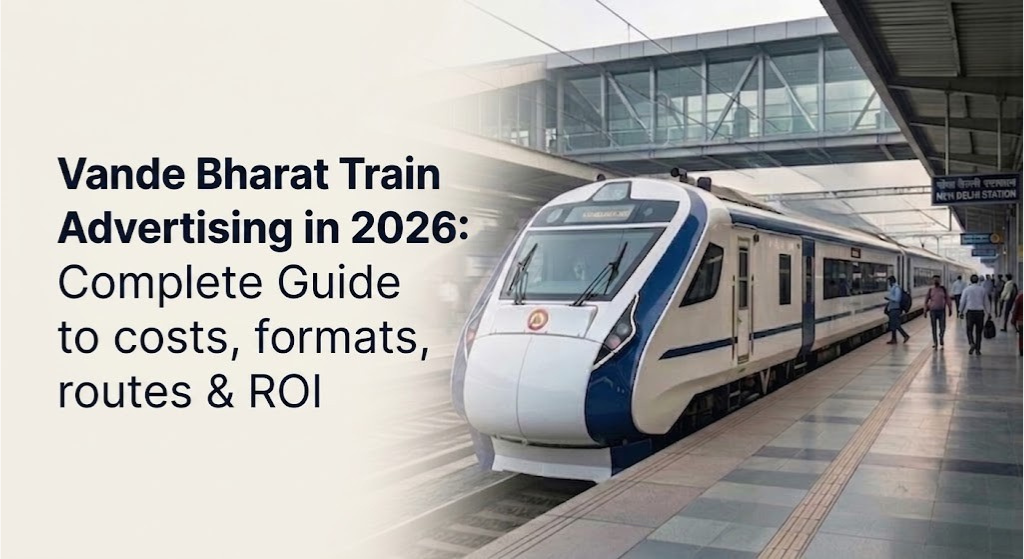

When India launched Vande Bharat Express in 2019, it changed how the country thinks about train travel. Cut to 2026, and it has changed how smart brands think about out-of-home advertising. With 79+ trains running across the country as of February 2026, a Sleeper variant that began commercial operations in January 2026, and an ambitious target of 800 trains by 2030, Vande Bharat is no longer just a railway story; it is one of India's most powerful and fastest-growing advertising mediums.
This guide covers everything a brand, marketing manager, or media planner needs to know: what advertising on Vande Bharat actually looks like, how much it costs, which routes give the best reach, who your audience really is, and how to book a campaign that delivers real results. Whether you are exploring this medium for the first time or comparing it against other OOH options, this is the most complete resource available in 2026.
MetricValueDetails / SignificanceActive Trains79+Operational Vande Bharat trains across India (as of Feb 2026).Campaign Cost Range₹9L – ₹1.5CrApproximate investment required depending on route, format, and campaign duration.Average Passenger Dwell Time3–8 HoursExtended exposure time provides high advertising visibility and engagement.Routes Covered50+Network spans major cities and high-traffic corridors across India.Target Trains by 2030800Planned expansion significantly increases future advertising inventory.Sleeper Variant LaunchJanuary 2026Introduction of sleeper trains creates additional branding opportunities. What Is Vande Bharat Train Advertising?
Vande Bharat train advertising refers to brand promotions placed across interior surfaces of India's flagship semi-high-speed express trains, including interior seat-back and tray table branding, digital screen placements, and experiential activations onboard.
But understanding what it is requires understanding what makes it fundamentally different from every other form of railway advertising in India.
How Vande Bharat Differs from Regular Indian Railways Advertising
Regular train advertising banners, wall stickers, and window decals on general or sleeper coaches reach a broad, heterogeneous audience in often cluttered, low-quality environments. The ad recall is limited because passengers are moving through the space, not sitting in it for hours.
Vande Bharat flips this entirely. Every seat is reserved and air-conditioned. The interiors are modern, clean, and well-lit. Passengers are predominantly urban, working professionals or leisure travellers who have actively chosen a premium ticketed product. And they stay in that environment for three to eight hours with nothing to do but travel. This is the closest India's railway network gets to the captive premium audience of an airline cabin.
The "Make in India" Brand Halo Effect for Advertisers
Vande Bharat is not just a train; it is a national symbol. Manufactured indigenously under the Make in India initiative, it carries strong associations with modernity, speed, innovation, and government-backed quality. When a brand appears on Vande Bharat train, it benefits from a credibility transfer the train's premium perception extends to the advertiser. This is a brand-building dimension that no highway billboard or metro poster can replicate.
Vande Bharat Sleeper (2026) A Brand New Advertising Frontier
The most significant development for advertisers in 2026 is the launch of the Vande Bharat Sleeper. Commercial services began in January 2026 with the Howrah–Kamakhya route, covering long-distance overnight corridors exceeding 800 km. The Railway Ministry has announced a target of 12 operational sleeper trains by December 2026.
For advertisers, this opens an entirely new inventory type: overnight, long-haul advertising reaching passengers across 10–14-hour journeys. Dwell time doubles. Audience exposure per impression increases dramatically. And because the advertising category on Sleeper is barely explored yet, early movers face almost zero competitive clutter.
The Excellent Publicity Insight: The Vande Bharat Sleeper represents the single biggest untapped advertising opportunity in India's OOH landscape right now. Brands that move first on Sleeper route branding in 2026 will own a zero-clutter environment that competitors haven't discovered yet.
Why Do Brands Choose Vande Bharat for Advertising?
The case for Vande Bharat advertising rests on four pillars that, taken together, make it one of the most compelling offline media buys in India today.
Premium Audience That Is Hard to Reach Elsewhere
Vande Bharat ticket prices range from ₹800 to ₹2,500+, depending on the route and class. This fare structure self-selects for upper-middle-class and affluent travellers, the demographic that most premium brands struggle to reach efficiently through mass media. These are people with significant disposable incomes, active purchase intent, and a documented appetite for quality products and services. Reaching them in a non-working, relaxed, and receptive environment is something digital advertising cannot reliably replicate.
Unmatched Dwell Time in OOH Advertising
A typical outdoor hoarding gives a brand 2–3 seconds of attention as a vehicle passes by. A metro poster gets 20–40 seconds per boarding journey. A Vande Bharat interior placement gets 3 to 8 hours of proximity to the same passenger on a single trip. This is not just more time; it is a fundamentally different quality of exposure. The brand becomes part of the passenger's journey experience, not an interruption to it.
Pan-India Presence with a Rapidly Expanding Network
With 50+ active routes as of April 2026 connecting metros, tier-2 cities, tourist destinations, and pilgrimage circuits, a Vande Bharat campaign can simultaneously target Delhi, Mumbai, Bengaluru, Kolkata, Varanasi, Katra, and Mysuru. As the network expands toward its 800-train target by 2030, geographic coverage will only grow.
Trust Transfer Through Brand Placement
There is a well-documented psychological principle in advertising: the environment in which a brand appears shapes how audiences perceive that brand. Appearing on India's most modern, government-backed premium train communicates quality, ambition, and scale even before the ad content itself is processed. This "medium as message" effect is a significant, often undervalued component of the Vande Bharat advertising proposition.
Vande Bharat Advertising Formats: Every Option Explained
Vande Bharat offers multiple ad formats, each with a distinct visibility profile, cost range, and ideal use case. Here is a comprehensive breakdown of every format available.
1. Seat-Back Branding Unavoidable, Up-Close Placement
The back of every seat in a Vande Bharat train is at eye level for the passenger sitting behind it. For the entire duration of the journey, whether that is three hours or eight, the seat-back ad is the most consistently visible object in the passenger's forward field of view. This is as close to inescapable advertising as a physical medium can get.
Seat-back branding excels for products and services that benefit from detailed messaging, QR-code-driven engagement, or storytelling. Because the passenger is not moving past the ad, you have time to communicate beyond a single visual.
2. Tray Table Branding
Tray tables are opened by almost every passenger on a longer journey for meals, laptops, or simply resting. The inner surface of the tray table is a premium close-range advertising surface, physically handled by the passenger. Studies across airline tray table advertising (the closest comparable medium) consistently show above-average recall rates due to this tactile interaction.
3. Overhead Luggage Rack Panels & End-of-Coach Panels
The overhead panels above the luggage racks and the bulkhead walls at the end of each coach offer large-format interior display space. These are visible from long distances within the coach and are particularly effective for brand-name and logo awareness campaigns.
4. Digital Screen Advertising Onboard Infotainment
Vande Bharat trains are equipped with digital infotainment screens, and brands can place short video ads or branded content slides within this system. Digital placements allow for dynamic, time-of-day relevant messaging, rotating creatives, and video storytelling, which static formats cannot accommodate. Thermocool Home Appliances, for instance, ran a real-time Navratri digital campaign on the Delhi–Katra Vande Bharat Express in early 2026, delivering devotional-themed content relevant to passengers heading to the Vaishno Devi shrine.
5. QR Code Activations & Experiential Sampling
Given Vande Bharat's tech-savvy passenger base, QR-enabled formats perform exceptionally well. A seat-back or tray table ad with a scannable code can drive app downloads, product trials, discount redemptions, or survey completions, bridging the gap between offline awareness and measurable digital conversion. FMCG and wellness brands can additionally arrange physical product sampling on board, creating a multi-sensory brand interaction.
FormatVisibility ReachDwell TimeCost Range (Approx.)Best ForSeat-Back BrandingCaptive passengers3–8 hours₹9L – ₹30LRecall, engagement, QR activation Tray Table BrandingCaptive passengers3–8 hours₹12L – ₹35LFMCG, fintech, lifestyle brands Overhead / End PanelsFull coach visibilityJourney duration₹15L – ₹40LLogo/brand name awareness Digital Screen AdsCaptive passengersVideo length₹20L – ₹60LStorytelling, seasonal campaigns QR / SamplingCaptive passengersInteractive₹10L – ₹25L+App installs, trial, conversion * Prices are indicative ranges for a single train per month. Actual quotes depend on route, duration, exclusivity, and market conditions. Contact The Excellent Publicity for a custom campaign estimate.
Vande Bharat Train Advertising Cost in 2026: Full Breakdown
The most-asked question from brands exploring this medium is simple: how much does it cost? Here is a transparent, honest breakdown.
Overall Cost Range: ₹9 Lakhs to ₹1.5 Crores
Vande Bharat train advertising campaigns typically range from ₹9 lakhs at the entry level (interior placements on a single train for one month) to ₹1.5 crores or more on a premium, high-traffic route over an extended period. This range reflects the diversity of formats, route prestige, and campaign duration, not a single standardised rate card.
What Drives the Price Up or Down?
- Format: The pricing depends on the viability the format provides. The more visible and exclusive the format, the higher the cost.
- Route prestige: Business-heavy corridors like Delhi–Mumbai or Delhi–Varanasi command a premium over less-trafficked routes, because advertiser demand exceeds available inventory.
- Season: Festive season (October–January) and summer holidays see peak demand and price surges of 15–30% above off-peak rates. Book early for these windows.
- Campaign duration: Monthly bookings are standard, but longer commitments (3–6 months) often come with negotiated discounts.
- Exclusivity: Some brands opt for a complete takeover that prevents competing brands from appearing in the same space at a premium that significantly raises the rate.
Cost Per Impression: How Vande Bharat Compares
While absolute costs appear high, the cost-per-impression and cost-per-qualified-contact of Vande Bharat advertising are very competitive when benchmarked against the quality of the audience. A ₹20L seat-back campaign on a busy route reaching 90,000+ passengers per month works out to approximately ₹22 per passenger contact, a figure that compares favourably to premium digital advertising targeting the same income bracket.
Is the Investment Worth It? An ROI Perspective
ROI on Vande Bharat advertising is strongest for brands where a single conversion or customer acquisition has significant lifetime value in financial products, real estate, high-end consumer electronics, tourism packages, and healthcare services. For FMCG brands, the value lies primarily in brand recall and purchase intent uplift rather than direct conversion. The SanDisk campaign executed on Vande Bharat interior placements is a documented example of strong brand recall among tech-savvy frequent travellers, precisely the buyers SanDisk needed to reach.
Budget Planning Tip: Start with a single train, single route, interior-only campaign to benchmark recall and engagement before scaling to multi-train formats. Excellent Publicity can help structure a phased campaign approach that grows with your results.
Top Vande Bharat Routes for Advertising Where Your Brand Gets Maximum Eyeballs
Not all routes are created equal. The right route for your campaign depends on your target audience, brand objective, and the cities you want to penetrate. Here is how the key routes break down.
Premium Business Corridor Routes
These routes connect India's major commercial hubs and carry a high concentration of business travellers, working professionals, and urban decision-makers.
Route Advertising OpportunitiesRoutePrimary AudienceBest IndustriesDemand LevelDelhi – VaranasiBusiness + pilgrimsFinance, FMCG, TourismVery High Mumbai – AhmedabadBusiness, SME ownersBanking, Real Estate, AutoVery High Delhi – JaipurTourists, businessLuxury, Tourism, HospitalityHigh Hyderabad – BengaluruTech professionalsElectronics, Fintech, SaaSHigh Chennai – MysuruTourists, professionalsTourism, FMCG, AutoHigh Kolkata – SiliguriBusiness + touristsTea, Tourism, LogisticsModerate–High
Premium Tourist & Pilgrimage Routes
Tourism and pilgrimage routes attract a distinct, emotionally engaged traveller who is receptive to hospitality, wellness, travel, and lifestyle brands. The Delhi–Katra route (serving Vaishno Devi pilgrims) and the Mumbai–Shirdi route are among the most emotionally resonant advertising environments in India. Passengers on these trains are in a positive, aspirational mindset that increases brand receptivity.
Emerging Routes to Watch in 2026: Vande Bharat Sleeper
The inauguration of the Sleeper variant opens entirely new corridors for overnight advertising. The Howrah–Kamakhya route (Kolkata to Guwahati) and the upcoming Patna–Delhi Sleeper route represent long-haul overnight advertising environments where passengers are in a closed environment for 10–14 hours. For brands willing to pioneer this space in 2026, the competitive advantage is substantial.
How to Choose the Right Route for Your Brand
The route selection should be driven by audience fit, not just traffic volume. A fintech brand targeting salaried professionals in Tier-1 cities should prioritise Delhi–Varanasi or Hyderabad–Bengaluru. A luxury hospitality brand seeking to reach high-net-worth leisure travellers should look at Delhi–Jaipur or Mumbai–Goa. A healthcare or diagnostics brand with national awareness goals can take a multi-route approach. The Excellent Publicity team can map your target audience profile against Vande Bharat passenger data to recommend the optimal route mix.
Who Travels on Vande Bharat? Audience Profile & Targeting Insights
Demographics: Age, Income & Occupation
The Vande Bharat passenger skews 25–55 years old, predominantly urban, with household incomes above ₹8–10 lakhs per annum. The ticket price point (₹800–₹2,500+) acts as a natural income filter. Occupationally, the split broadly follows: business travellers and corporate executives (roughly 35–40%), leisure and family tourists (30–35%), and pilgrimage travellers (20–25%), with the remainder comprising students, NRIs, and government officials.
Three Distinct Buyer Personas on Every Train
The Business Traveller: Frequent, often solo, time-conscious, and tech-savvy. Travels Delhi–Mumbai, Hyderabad–Bengaluru, or similar corridors 2–4 times a month. High disposable income, decision-maker profile, responsive to finance, insurance, electronics, and B2B-adjacent brands.
The Leisure Tourist: Often in groups or families. Planning or already on a holiday. Emotionally elevated and in spending mode. Responsive to hospitality, experiences, FMCG, and lifestyle brands. Routes: Delhi–Jaipur, Chennai–Mysuru, Kolkata–Darjeeling corridor.
The Pilgrimage Traveller: Spiritually motivated, often older demographic, community-oriented. High brand loyalty and positive brand association propensity. Routes: Delhi–Katra, Mumbai–Shirdi. Responsive to healthcare, FMCG, home goods, and financial security products.
Why Captive Audiences Convert Better
Advertising research consistently shows that people in transit, particularly on long journeys, exhibit significantly higher ad attention and recall than audiences in their home, office, or urban environments. They have fewer distractions, lower ambient stimuli, and are psychologically in a receptive, exploratory mode. A Vande Bharat passenger spending three hours looking at a seat-back ad has 90 times more exposure to that brand message than a driver passing a highway hoarding. The quality of that attention, not just its duration, is what drives the Vande Bharat recall advantage.
Best Industries & Brands for Vande Bharat Advertising
Some sectors consistently outperform others on this medium, based on audience fit, product category relevance, and campaign objectives.
Banking, Fintech & Insurance: High-income earners in transit are prime targets for wealth management, credit cards, and insurance products. Trust-building through premium placement aligns perfectly.
Electronics & Smartphones: Tech-literate passengers engage strongly with electronics brands, as proven by SanDisk's successful interior branding campaign targeting frequent business commuters.
FMCG & Consumer Goods: Long dwell time makes this ideal for product trial sampling and awareness. Beverages, personal care, and packaged food brands benefit from the captive format.
Tourism & Hospitality: Travellers are already in a travel mindset. Hotel chains, travel apps, and destination brands reach an audience at the exact moment travel decisions are being considered.
Healthcare & Diagnostics: National hospital chains, diagnostic labs, and pharma brands benefit from the pan-India, premium profile reach, particularly on pilgrimage routes with older travellers.
Real Estate & Infrastructure: Aspirational buyers travelling between cities, often evaluating property in both origin and destination, are an ideal audience for residential and commercial real estate brands.
E-commerce & Apps: QR-enabled placements drive direct app installs and first purchases from a digitally active audience. Coupled with an onboarding offer, the conversion economics are strong.
Government & PSU Campaigns: Public awareness campaigns on health, education, financial inclusion, and infrastructure reach a broad, nationally distributed audience across routes and geographies.
How to Book Vande Bharat Train Advertising Step-by-Step Process
Understanding the booking process avoids common pitfalls around timeline, approval, and creative requirements.
Define Your Campaign Objective & Budget
Start with a clear answer to: are you building brand awareness, driving consideration, or pushing direct response? Your objective determines which format and route combination makes sense. Establish a realistic budget range before approaching an agency. This helps the team recommend a campaign architecture that fits, rather than an aspirational one that doesn't.
Select Your Format, Route & Duration
Based on your audience profile and campaign goal, shortlist 2–3 format options and 2–3 route preferences. Factor in your target audience's travel corridor. Decide whether you need a one-month brand burst or a sustained 3–6 month presence campaign.
Engage a Specialist Railway Advertising Agency
Vande Bharat advertising is not booked like a digital ad; it requires a specialist agency with existing relationships with the Indian Railways' advertising division. Excellent Publicity has extensive experience navigating the approval and execution process for railway media campaigns across multiple formats and zones.
Creative Production & Railways Approval
All creative content must comply with Indian Railways' content guidelines and receive formal approval before production and installation. This process typically takes 2–4 weeks, depending on the zone and format. Creative that is not compliant will be rejected, causing delays in work with an agency that knows the guidelines upfront.
Installation, Monitoring & Reporting
Post-approval, physical installation is coordinated with railway schedules, typically during maintenance windows. During the campaign, periodic site visits and photo documentation confirm placement compliance. Post-campaign, request a structured report covering installation proof, reach estimates, and any qualitative feedback gathered.
Timeline Reality: Plan for a minimum of 4–8 weeks from brief to live campaign. For festive season placements (Diwali, Christmas, Republic Day), begin planning at least 10–12 weeks in advance. Inventory on premium routes fills fast, and Railways approval timelines do not compress for late requests.
Vande Bharat Advertising vs. Other OOH Media: How Does It Stack Up?
Brands evaluating their OOH media mix often compare Vande Bharat against airports, metro rail, and highway hoardings. Here is an honest comparison.
| Medium | Audience Quality | Dwell Time | Cost Index | Clutter Level | Recall Strength |
|---|---|---|---|---|---|
| Vande Bharat Train | Premium ✔ | 3–8 hours ✔ | Medium-High | Very Low ✔ | Very High ✔ |
| Airport Advertising | Premium ✔ | 30–90 mins | Very High | Medium | High |
| Metro Rail Advertising | Mixed | 8–25 mins | Medium ✔ | High | Moderate |
| Highway Hoardings | Broad / Mass | 2–4 seconds | Low–Medium ✔ | Very High | Low |
| Cinema Advertising | Mixed–Urban | 20–30 mins | Medium | Low ✔ | High |
The key insight from this comparison: Vande Bharat sits in a unique sweet spot. It offers airport-level audience quality without airport-level costs, and metro-level physical proximity with dramatically longer dwell time. For brands seeking premium-audience OOH at a defensible CPM, it is the strongest option currently available in India outside of airline cabin advertising.
Challenges & Limitations to Know Before You Advertise
Any responsible guide to this medium must cover the real challenges. Here is what to prepare for and how to mitigate each one.
Limited Inventory on Premium Routes:
High-demand corridors like Delhi–Varanasi and Mumbai–Ahmedabad have limited advertising slots. Popular formats get booked months in advance.
✓ Plan 8–12 weeks ahead. Engage the agency early for waitlist access.
Long Railways Approval Timeline
Indian Railways' approval process for ad creatives and installation can take 2–6 weeks. Late submissions miss launch windows.
✓ Submit creatives before finalising the go-live date.
Peak Season Price Surges
Festive season (Oct–Jan) and summer holidays can push rates 15–30% above off-peak. Budget planning needs to account for this.
✓ Lock rates with a confirmed booking, not an inquiry.
Measurement & Attribution Gaps
Like most OOH, Vande Bharat lacks real-time impression tracking. Proving direct ROI requires brand lift studies or QR tracking.
✓ Incorporate QR codes and unique landing page UTMs for measurable activation.
Creative Content Restrictions
Indian Railways has content guidelines that disallow certain categories of advertising. Non-compliant creatives get rejected, adding 2–3 weeks to timelines.
✓ Brief a specialist agency that knows the guidelines before production begins.
✓ Schedule campaigns for dry seasons. Negotiate maintenance checks in the contract.
Conclusion: Why 2026 Is the Right Year to Advertise on Vande Bharat
Vande Bharat train advertising has crossed the threshold from emerging opportunity to established premium medium. With 79+ trains running nationally, a Sleeper variant that just launched, and an expansion trajectory that points to hundreds more trains over the next four years, the network is only going to become more valuable as an advertising platform.
What makes 2026 particularly interesting for advertisers is the combination of scale and relative undiscovery. The Vande Bharat Sleeper advertising category is effectively unclaimed.
Multi-train, multi-route campaigns are still accessible without the competition that will eventually emerge. The quality of the audience, premium, captive, and engaged for hours, is genuinely difficult to reach through any other single offline channel at comparable cost-per-contact.
For brands that want to build meaningful, lasting recall among India's aspirational urban consumers, there are very few media options that combine the audience quality, dwell time, national reach, and brand-credibility transfer that Vande Bharat offers. The brands that invest now will look very smart when this inventory is fully priced at its real market value in 2027 and beyond.
Vande Bharat train advertising costs range from ₹9 lakhs to ₹1.5 crores per campaign, depending on format, route, and duration. Interior placements such as seat-back branding start at the lower end, while premium routes command the higher range. Contact The Excellent Publicity for a custom quote based on your specific campaign goals and target geography.
Brands targeting upper-middle-class and affluent urban audiences, including banking and fintech, electronics, real estate, FMCG, tourism, healthcare, and e-commerce, are the strongest fit. The premium passenger profile (household income ₹8L+) and long dwell time (3–8 hours) make it ideal for both awareness and recall-driven campaigns. Government and PSU campaigns seeking a broad national reach also find strong value in the Vande Bharat network.
Vande Bharat is a premium advertising medium. Entry-level interior placements begin around ₹9 lakhs per campaign per train per month, making it most suitable for mid-sized and growth-stage businesses. Very small businesses with limited advertising budgets would find better value in other OOH formats. However, for businesses in the right categories, particularly those where a single customer has high lifetime value, the cost-per-qualified-contact is competitive even at entry-level budgets.
Several critical differences set Vande Bharat apart. The audience is significantly more affluent and urban, self-selected by a premium fare structure. The environment is modern, clean, and well-maintained, providing a premium context for brand association. Dwell time (3–8 hours) massively exceeds regular train advertising. And the Vande Bharat brand itself associated with modernity, speed, and Make in India innovation transfers positive credibility to advertisers, which conventional railway advertising cannot offer.
Yes. The Vande Bharat Sleeper, which began commercial operations in January 2026 with the Howrah–Kamakhya route, opens advertising inventory on long-distance overnight routes (800 km+) with dwell times of 10–14 hours. This is largely unexplored territory for advertisers in 2026, making it a significant early-mover opportunity for brands willing to pioneer the format. The Railway Ministry has announced a target of 12 operational Sleeper trains by December 2026, with further expansion in subsequent years.
Plan for a minimum of 4–8 weeks from brief to live campaign. This includes creative development, Indian Railways content approval (2–4 weeks), production, and installation coordination. For the festive season, placements from October through January start planning at least 10–12 weeks in advance, as inventory on premium routes fills early, and approval slots are limited. Working with a specialist agency like The Excellent Publicity significantly smooths the approval and coordination process.