

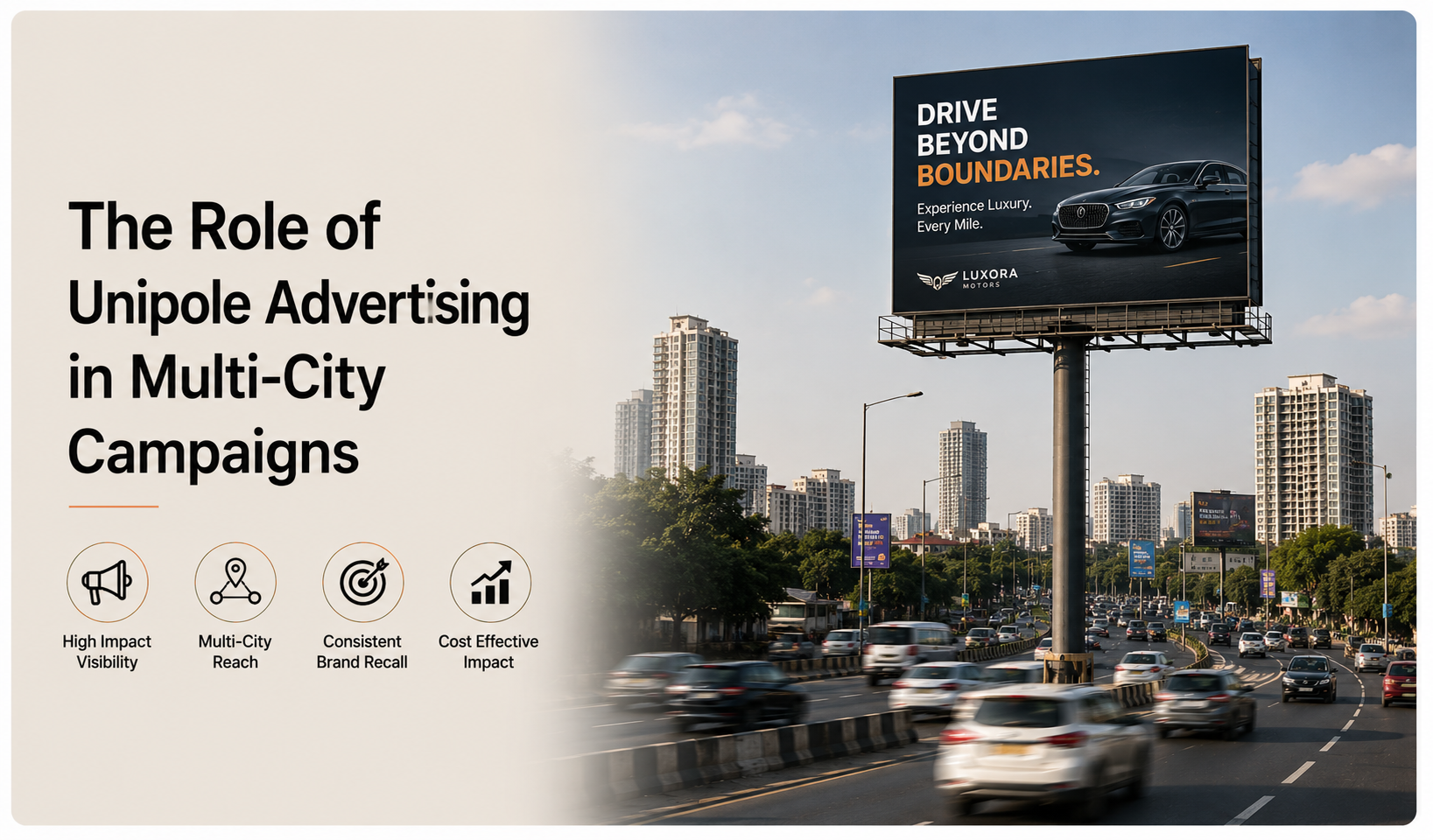

When a brand expands beyond a single city, it needs a media format that can scale without losing impact. Unipoles, the tall, single-pole hoardings that rise above highways and major junctions, are one of the few outdoor formats built for exactly that kind of expansion. A structure that dominates a highway approach in Mumbai can be replicated on a ring road in Jaipur or a bypass in Coimbatore, giving a brand the same commanding presence in every market it enters.
This piece looks specifically at unipole advertising as a tool for multi-city campaigns in India: why brands choose it when expanding across markets, how to plan a rollout across several cities at once, and where multi-city campaigns typically go wrong.
What Makes Unipole Advertising Suited to Multi-City Campaigns?
A unipole works on a different visual logic than most outdoor formats. Standing alone at heights of roughly 20 to 60 feet, with no competing panel nearby, it creates a share-of-voice effect that a cluster of hoardings on a gantry cannot match. That isolation, combined with dwell times of several seconds at highway speed, gives a unipole an outsized ability to build recall from a single, well-placed structure.
What makes this format especially useful for multi-city campaigns is that this effect is repeatable. The same structural logic, height, isolation, and placement at high-traffic corridors work whether the site is on the Mumbai-Pune Expressway or a ring road in Indore. A brand can plan a consistent media strategy across many cities using unipole advertising, rather than adapting to a different medium in every market.
Unipoles also come in several structural variations that suit different multi-city needs. Conventional double-sided unipoles display messages to traffic moving in both directions, V-shaped unipoles angle two panels toward each other for junctions and multi-directional traffic, and tri-vision unipoles rotate between up to three messages on a single structure, useful when a campaign needs to vary its message by city or by daypart without booking additional sites. Digital LED unipoles, increasingly available in metros like Bengaluru, Hyderabad, and Pune, add the flexibility to update creative centrally across a multi-city network without reprinting.
Why Brands Run Unipole Campaigns Across Multiple Cities
Consistent Brand Presence During Expansion
When a brand enters new cities, whether through new stores, dealerships, or service areas, a unipole at key entry points and commercial corridors signals scale and permanence before the brand has built local recognition through other means.
Category Leadership and Share of Voice
Brands aiming to dominate a category, particularly in real estate, automotive, and financial services, use synchronized unipole placements across cities to project the impression of being everywhere at once, which is difficult to achieve through hyperlocal formats alone.
Cost Efficiency at Scale
A multi-city unipole booking, negotiated through a single agency relationship, typically brings meaningfully better rates than booking each city separately, since agencies with established vendor relationships across markets can negotiate below published card rates.
Complementing Digital Campaigns Across Markets
Digital-first brands, particularly in fintech, edtech, and quick commerce, increasingly use multi-city unipole campaigns to build offline legitimacy in markets where their brand exists primarily online, then retarget the same audience digitally using mobile location data tied to the unipole sites.
Efficiency in Underpriced Markets
Multi-city campaigns give brands the flexibility to allocate budget toward tier 2 cities where traffic volumes have grown faster than unipole inventory pricing has caught up; cities like Surat, Rajkot, Visakhapatnam, and Ludhiana often deliver a stronger cost per impression than an equivalent metro placement.
Choosing Cities and Sites for a Multi-City Unipole Rollout
Site selection within each city matters as much as which cities are chosen. A useful framework is what planners sometimes call the three corridor types: highway and expressway entry points, commercial district arterials, and transit-adjacent stretches near railway stations or bus terminals. These three location types consistently outperform residential area sites on both impressions and recall, making them valuable considerations when planning a multi-city outdoor advertising campaign. Applying the same framework in every city keeps a multi-city campaign structurally consistent even as the specific streets and landmarks change.
For city selection itself, most multi-city campaigns follow one of two logics. A metro-first approach concentrates spend in Delhi, Mumbai, Bengaluru, and Hyderabad, where traffic volumes and audience scale are highest, at a correspondingly higher cost per site. An efficiency-led approach blends a smaller number of metro sites with a larger footprint across tier 2 cities, where unipole rates have not risen as fast as underlying traffic growth, often producing a lower blended cost per thousand impressions across the campaign as a whole.
Neither approach is universally correct. A national brand seeking maximum share of voice in the largest markets will lean metro-first. A brand expanding into new regional markets, or one sensitive to budget efficiency, often gets better overall reach by weighting the plan toward tier 2 cities and using metro sites more selectively.
Structure Types and Formats to Standardize Across Cities
Multi-city campaigns benefit from choosing one or two structure types and applying them consistently, rather than mixing formats city by city without reason.
| Format | Best Use in a Multi-City Plan |
|---|---|
| Conventional double-sided unipole | Standard choice for highway and arterial sites, visible to traffic in both directions |
| V-shape unipole | Junctions and multi-directional traffic are useful at city entry points where roads split |
| Tri-vision unipole | Campaigns needing to rotate two or three messages, or share a structure across markets with different messaging needs |
| Digital LED unipole | Metro markets where centralized creative updates across the network add real value |
Structural specifications also matter across regions. Coastal cities and high-wind corridors require structures engineered for higher wind loads, commonly rated up to 150 kmph in Indian markets, while inland sites may not need the same specification. Keeping a consistent engineering standard across a multi-city network, rather than the minimum required in each individual city, reduces the risk of structural issues during monsoon season or high-wind events.
Budget Planning for Multi-City Unipole Campaigns
Unipole rates in India vary significantly by city tier, site quality, and format. Indicative monthly rates per site look roughly like this:
| City Tier | Approximate Monthly Rate (per face) |
|---|---|
| Metro (Delhi, Mumbai, Bengaluru, Hyderabad) | Rs 75,000 to Rs 4,00,000 |
| Tier 2 (Jaipur, Indore, Coimbatore, Bhubaneswar) | Rs 25,000 to Rs 1,00,000 |
| Tier 3 and highway sites | Rs 8,000 to Rs 50,000 |
Production is a separate cost line that multi-city budgets need to account for clearly. Flex printing for a standard face typically costs between Rs 8,000 and Rs 25,000 depending on material and size, with backlit or vinyl options costing more but holding up better across a longer campaign. As a general planning rule, production is often budgeted at roughly 10 to 15 percent of total space cost for a 30-day campaign, with that proportion falling on longer bookings since the same creative does not need reprinting.
For a multi-city rollout, the biggest budget lever is usually negotiation leverage. Rates secured through an established agency relationship, with vendor connections across the specific cities in the plan, commonly come in meaningfully below published rates, particularly on campaigns spanning six or more cities where the total spend gives the agency real negotiating weight with each local vendor.
Working with an experienced agency can make this process more efficient. Excellent Publicity helps brands plan multi-city unipole campaigns by coordinating site selection, rate negotiations, production, installation, and campaign execution across different markets. This allows brands to manage multiple city-level requirements through a single campaign partner rather than coordinating with separate vendors in every location.
Regulatory and Permission Challenges Across Cities
This is where multi-city campaigns differ most from a single-city booking, and where inexperienced planning most often causes delays. Unipole structures are governed by municipal corporation regulations that vary by city and state, meaning a permission process that works smoothly in one market may look completely different in the next.
A few points that matter specifically for multi-city planning:
Municipal licensing is local: Each city's local body issues its own hoarding or display licenses, and some cities restrict or ban unipoles within certain zones entirely while permitting them freely on highways just outside city limits.
Highway sites fall under NHAI: Structures on national highways are subject to National Highways Authority of India regulations, including setback and height rules that differ from municipal rules governing city-arterial sites.
Content compliance is national but consistent: Regardless of city, creative content must comply with Advertising Standards Council of India guidelines, which at least give multi-city campaigns one layer of consistency across an otherwise fragmented regulatory landscape.
Enforcement varies: Cities like Bengaluru and Pune have periodically run enforcement drives against unlicensed hoardings, which makes verified vendor documentation particularly important in these markets to avoid a mid-campaign takedown.
The practical implication for multi-city planning is to treat permissions as a city-by-city workstream rather than a single national process, and to confirm that vendors in every market can provide documented display licenses before committing to sites.
Creative Strategy: Consistency vs Localization
A recurring tension in multi-city campaigns is how much creativity should stay identical across cities versus how much should adapt locally. The right balance depends on the brand's stage and objective.
Keep consistent across every city: brand logo, color palette, core message hierarchy, and the fundamental value proposition. This is what builds a coherent brand impression as the same person potentially encounters the brand while traveling between cities, and what allows a media buyer to plan creative production once rather than city by city.
Adapt by city or region where it earns attention: language mix (a Hindi-English blend performs differently across regions than a purely English message), festival and seasonal references that vary by state, and directional or route-specific messaging tied to what the audience is doing at that particular site; for example, morning commute messaging differs from evening commute messaging.
Regardless of how much is localized, the underlying creative discipline should stay constant across every city in the plan: a small number of words, ideally under seven, a single dominant visual, a logo large enough to read from roughly 200 metres, and color contrast that holds up against the specific sky and background conditions at each site. A creative that works on screen can wash out against a bright sky in one city and disappear against dense tree cover in another, which is why site-level review before finalizing artwork matters even more in a multi-city rollout than in a single-site booking.
Timeline for Planning a Multi-City Unipole Campaign
A single-city unipole campaign typically takes four to six weeks from brief to live creative. A multi-city rollout generally needs six to ten weeks, and compressing that timeline usually results in site compromises or rushed production that undermines the campaign.
The general sequence looks like this:
1. Market and site selection: Cross-referencing traffic data, brand distribution or expansion maps, and competitive OOH presence across each target city before approaching vendors.
2. Rate negotiation: Conducted market by market, since vendor relationships and rate flexibility differ from city to city.
3. Creative production: Run in parallel once sites are confirmed, with flex printing typically taking three to five working days per batch.
4. Installation: Usually one to two days per site, depending on access and vendor crew availability, staggered across cities based on local vendor scheduling.
5. Monitoring: Photographic confirmation of installation, periodic site checks, and end-of-campaign documentation across every city, since unmonitored sites in any single market can develop issues that go unreported without active oversight.
Premium sites in top metro corridors are often booked three to six months in advance, particularly for the October to March period that coincides with the festive season and the peak advertising quarter. Tier 2 and tier 3 markets are generally more forgiving, with four to six weeks of lead time typically sufficient.
Measuring Multi-City Campaign Performance
Measuring a multi-city unipole campaign requires tracking performance both within each city and in aggregate across the whole plan.
- Pre- and post-campaign brand tracking surveys in each city's catchment area measure unaided awareness, recall, and message attribution and allow city-by-city comparison of which markets responded most strongly.
- Mobile location data, tracking anonymised device movement past specific unipole sites and correlating it with later behaviour such as store visits, website visits, or app downloads, gives a CPM and cost-per-action figure that can be compared directly across cities and against digital media benchmarks.
- City-level outcome tracking, such as showroom enquiries near automotive dealership clusters or search volume increases in specific catchment areas, helps identify which cities delivered the strongest return and should receive more weight in the next campaign cycle.
The value of measuring multi-city campaigns properly compounds over time. Data from one rollout genuinely informs city selection, site choice, and budget allocation for the next, which is a meaningful advantage over treating each city as an isolated, one-off booking.
Common Mistakes in Multi-City Unipole Campaigns
Treating every city identically: A media plan built for Mumbai rarely transfers directly to a tier 2 city with different traffic patterns, site availability, and audience behaviour. Site selection and even structure type should adapt to what each market actually offers.
Underestimating regulatory lead time: Assuming permissions will move at the same pace in every city is one of the most common causes of delayed multi-city launches, particularly when a plan includes cities with active enforcement drives or slower municipal processes.
Spreading budget too thin: A multi-city plan that books one unipole in ten cities often achieves less impact than a plan that books four to six well-placed unipoles in five cities, since a single isolated structure rarely builds the frequency needed for real recall.
Skipping site visits: A site that looks strong on a traffic data sheet may face seasonal tree cover, morning sun glare, or new construction that obstructs the view, issues that only become clear through an actual site visit before creative is finalized.
Reusing digital creative without adaptation: Artwork designed for a screen or a magazine spread rarely translates directly to a unipole face viewed at speed from a distance, and stretching or compressing existing creative to fit a new format usually reduces legibility across every city in the plan.
Unipole advertising earns its place in multi-city campaigns because the format scales in a way few other outdoor media types do. The same structural logic, height, isolation, and strategic site placement apply whether the campaign covers four metros or a mix of eight cities across metro and tier 2 markets. What separates a multi-city unipole campaign that performs from one that underdelivers is rarely the format itself. It is the quality of site selection in each city, the discipline of keeping creative consistent where it should be and localized where it earns attention, and the patience to plan permissions and production on a realistic city-by-city timeline rather than assuming one market's process will be applicable everywhere.
Planning Your Next Multi-City Campaign?
A well-planned unipole campaign can give your brand consistent visibility across markets while allowing you to balance reach, cost, and local relevance. With the right sites, formats, and execution strategy, unipole advertising can become a strong part of your wider outdoor advertising plan.
If you're planning a multi-city campaign, reach out to Excellent Publicity for customised site options, rates, and campaign planning support.
Frequently Asked Questions
How many cities should a multi-city unipole campaign cover?
This depends on budget and objective rather than a fixed number. A concentrated plan across four to six cities with well-placed sites in each typically outperforms a thinly spread plan across many cities with only one structure per market.
Are unipole rates the same across Indian cities?
No. Rates vary significantly by city tier, with metro cities like Delhi, Mumbai, Bengaluru, and Hyderabad commanding the highest rates, while tier 2 and tier 3 cities offer considerably lower costs and often a stronger cost per impression.
Do permissions need to be arranged separately for each city?
Yes. Unipole structures are governed by municipal regulations that vary by city and state, so permissions and licensing need to be confirmed in every market individually rather than assumed to carry over from one city to another.
Should creativity be the same in every city?
Core brand elements such as logo, colour palette, and central message should stay consistent, while language, festival references, and route-specific messaging can be adapted by city or region for stronger local relevance.
How long does it take to plan a multi-city unipole campaign?
Typically six to ten weeks from the initial brief to live creative across all cities, covering site selection, rate negotiation, production, and installation, though premium metro sites during the festive season may need three to six months of advance booking.
Can multi-city unipole campaigns be measured for ROI?
Yes, through a combination of pre- and post-campaign brand tracking surveys in each city, mobile location data correlating exposure with later behaviour, and city-level outcome metrics such as footfall, enquiries, or search volume, allowing city-by-city and aggregate performance comparison.