

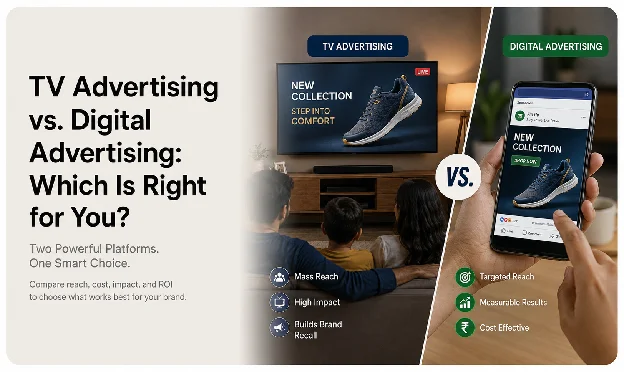

Most brands do not actually face a choice between TV and digital advertising. They face a sequencing question: which one builds the audience, and which one converts it? Treating the decision as either/or usually means underinvesting in whichever channel does the job the other cannot: television's ability to build broad awareness and trust, or digital's ability to target precisely and measure in real time.
This guide breaks down what each channel actually does well, where they differ in reach, cost, and measurement, and how to decide, for an Indian business, whether TV, digital, or a combination of both fits a specific campaign.
What Is TV Advertising?
TV advertising includes commercials and sponsorships across broadcast television, cable, connected TV, and streaming platforms. In India, it covers national, regional, news, sports, and entertainment channels, along with a growing OTT segment.
India has over 210 million television households and more than 900 million viewers across national and regional programming. This large audience gives TV advertising its key strength: the ability to deliver a single message to a large and diverse audience through one campaign.
What Is Digital Advertising?
Digital advertising covers paid promotion across online channels, including search engines, social media, display banners, video platforms, and streaming services. Unlike TV, digital advertising focuses on reaching specific audiences based on demographics, interests, location, or online behaviour.
Its key strengths are precision and measurability. Campaigns can be adjusted using real time performance data and targeted to specific cities or audience groups. Advertisers can also track clicks, conversions, and cost per acquisition, giving them clear insights into campaign performance and allowing them to optimize spending based on results.
Start With What You Want Your Advertising to Achieve
Before comparing the two channels feature by feature, it helps to be clear about the actual objective, because TV and digital are built to solve different problems.
- Building brand awareness: When the goal is reaching people unfamiliar with a brand, TV traditionally delivers stronger reach and impression quality.
- Converting existing demand: For audiences already searching or close to a decision, digital's targeting and measurability make it more efficient.
- Building trust and credibility: For newer brands or high-consideration categories like finance and healthcare, TV's association with established media lends a trust signal digital cannot easily match.
- Testing and flexibility: For quick, low-cost experimentation with messages or audiences, digital's real-time adjustability suits far better than TV's slower production and booking cycles.
Most serious growth challenges do not map cleanly onto just one of these goals, which is part of why the strongest media plans in India increasingly treat TV and digital as sequential parts of one system rather than competing options.
TV vs Digital: How the Two Channels Compare
| Factor | TV Advertising | Digital Advertising |
|---|---|---|
| Reach | Very high, single campaigns can reach tens of millions | High in aggregate, but fragmented across platforms and audiences |
| Targeting | Broad, by channel, programme, language, and daypart | Precise, by demographics, interests, location, and behaviour |
| Cost structure | High upfront production plus airtime cost | Flexible, scalable from small to large budgets |
| Measurement | Indirect, brand recall, search uplift, tracking studies | Direct, clicks, conversions, cost per acquisition, real time |
| Creative format | Full sight, sound, and motion in a focused viewing environment | Varied, banner, video, search text, often viewed briefly or with sound off |
| Trust signal | High, associated with credibility and established brands | Lower by default, though builds with consistent, quality presence |
| Speed to results | Slower, weeks to build measurable brand effects | Fast, results visible within days |
| Flexibility to change creative | Limited, reprinting or re-shooting required | High creativity can be swapped instantly |
Which Medium Reaches More People?
Television still reaches more people simultaneously than any single digital platform. One spot on a major national channel or a high-viewership cricket match can reach tens of millions of Indian households in one airing, a scale no individual digital platform matches in a single placement.
Digital reach is real but structured differently, aggregated across platforms and sessions rather than delivered as one mass exposure. A campaign spanning search, social, and video can reach a similarly large audience over time, but that reach is fragmented; two people in the same city may see entirely different ads based on targeting, limiting the shared cultural impact a single broadcast creates.
For brands targeting audiences beyond major metros and the digitally active urban population, television, especially regional language channels, remains one of the few channels reaching deep into tier 2, tier 3, and rural India cost-effectively.
Which One Lets You Target Audiences More Precisely?
Digital advertising wins decisively on targeting precision. A digital campaign can be aimed at a specific age group, income bracket, location down to a pin code, past purchase behaviour, or even device type, and adjusted in real time based on which segments are actually converting.
TV targeting works at a coarser level, choosing channels, programmes, languages, and time bands that index toward a desired audience profile rather than addressing individuals directly. A financial services brand can choose business news programming to reach a more affluent, decision-making audience, or an FMCG brand can choose daytime general entertainment to reach homemakers, but this is audience-level targeting through content choice, not individual-level targeting.
Connected TV and streaming platforms are narrowing this gap. CTV advertising delivers video content on a television screen while retaining much of digital's addressability, allowing geographic, demographic, and even household-level targeting that traditional linear TV cannot offer, effectively combining television's format with digital's precision. This is a genuinely useful middle ground for brands that want TV's impact without giving up all targeting control.
Comparing TV and Digital Advertising Costs
TV and digital follow fundamentally different cost structures, making direct comparison misleading.
TV requires significant upfront investment in production plus airtime, which varies by channel, programme popularity, and time band. Regional slots can start from a few thousand rupees, while national prime-time inventory can run into lakhs for a single placement. This makes TV less accessible for very small budgets, though regional and non-prime placements have improved reach.
Digital is far more flexible; campaigns can run on budgets from a few thousand rupees to crores, adjusted daily and paused instantly based on performance. This flexibility keeps digital the default first channel for small and early-stage businesses.
The more useful comparison, however, is cost-per-outcome. Digital costs on Google and Meta have risen substantially in competitive categories as advertiser competition grows, narrowing digital's traditional cost advantage, especially as performance spend increasingly re-engages existing customers rather than reaching new ones.
Which Is Better for Different Types of Businesses?
Here are few types of businesses and the advertising format that suits them:
- Small, hyperlocal businesses benefit most from digital's low cost, precise targeting, and fast measurement for trackable local reach.
- Regional or mid-sized brands gain from combining regional TV for local trust with digital to convert the resulting demand.
- National or category-leading brands benefit from a combined strategy, using TV for broad credibility and digital for measurable conversion.
- D2C and digital-first brands facing plateaued growth often find that adding regional TV reaches new customers more efficiently than continuing to retarget an exhausted digital audience.
TV vs Digital for National, Regional and Local Campaigns
National campaigns
National campaigns benefit from blending national TV for broad reach with digital for targeted, measurable conversion. Pure TV prime time can be expensive relative to conversions, while pure digital risks under-reaching less digitally active and rural populations.
Regional campaigns
Regional campaigns often see the strongest relative value from television in India. Regional language channels reach audiences with national campaigns addressed only indirectly, at lower cost than national prime time, with stronger cultural and linguistic connection. Pairing regional TV with geographically targeted digital works well for brands with concentrated regional business.
Local campaigns
A single city or neighbourhood generally leans more toward digital for its precision at small scale, though local cable and regional news can still add value for businesses, clinics, financial services, real estate, where trust and credibility matter as much as reach.
Can TV and Digital Advertising Work Together?
Research consistently shows this combination outperforms either channel alone. When a consumer sees a brand on TV and later encounters it digitally, through retargeting, search, or social, they engage measurably more than someone discovering the brand purely through digital.
The most consistent effect is branded search uplift: TV advertising reliably increases people searching for a brand by name during and after a campaign airs. This branded search converts at a much higher rate than generic category search, and since branded keyword costs are typically lower, this improves the efficiency of the digital budget running alongside TV. Brands running integrated campaigns in India have reported lower cost-per-acquisition across performance channels while TV is active, compared with digital running alone.
The practical implication: TV introduces a brand and builds initial trust, work digital would otherwise do at higher cost through repeated exposures, freeing digital to focus on conversion.
When Should You Choose TV Advertising?
Here are few of the cases when you should choose TV advertising:
1\. When the business has genuinely plateaued on digital-only growth, rising acquisition costs and shrinking returns from an already-saturated performance marketing audience are the clearest signals that a broader awareness channel is needed.
2\. When trust and credibility are a real barrier to conversion, categories like financial services, healthcare, or premium and considered purchases benefit disproportionately from the credibility signal television advertising provides.
3\. When the brand needs to reach beyond its existing digital-active audience, particularly into tier 2, tier 3, or regional markets where television, especially in the regional language, still holds stronger reach and trust than digital alone.
4\. During major seasonal or launch moments, festive periods like Diwali, category launches, or moments when purchase intent is elevated across a wide population, are when the incremental reach of television meaningfully differentiates a brand from competitors present only in digital.
When Should You Choose Digital Advertising?
Here are few of the case scenarios you should go for digital advertising:
1\. When the budget is limited, or the business needs to start small, digital's flexible spend and fast feedback loop make it the more practical entry point for testing what works before committing to larger, less flexible media investments.
2\. When precise, measurable performance is the priority, direct response goals, lead generation, e-commerce conversion, or any objective that needs clear, immediate attribution favour digital's built-in measurement capability.
3\. When the target audience is narrowly and specifically defined, a niche demographic, a specific professional group, or a highly localised geography is generally reached more efficiently through digital targeting than through television's broader, content-based targeting.
4\. When the campaign needs to move quickly or change frequently, time-sensitive offers, rapidly testing multiple messages, or reacting to real-time market conditions are far better suited to digital's instant creative flexibility than TV's production and booking timelines.
When Should You Use Both?
- When the goal is sustainable, long-term growth rather than a short-term spike, combining TV's brand-building with digital's conversion efficiency consistently outperforms either channel alone and is the approach most large, established Indian brands and increasingly growth-stage D2C brands are converging toward.
- When digital acquisition costs are rising faster than the business can absorb, adding even a focused, regional television presence can lower blended acquisition costs across the whole marketing mix by expanding the pool of people already aware of and receptive to the brand before they ever see a digital ad.
- When the brand competes in a category where both trust and precision genuinely matter, insurance, real estate, consumer electronics, and other considered-purchase categories benefit from television's credibility signal working alongside digital's ability to capture and convert the resulting demand efficiently.
In practice, the strongest campaigns treat the two channels as connected rather than parallel, planning digital search and retargeting capacity to absorb the branded search uplift a TV campaign generates, rather than running the two as separate, uncoordinated workstreams.
Build a Media Plan Around Your Audience, Not Just the Medium
The TV versus digital question ultimately resolves into a simpler one: where does the actual target audience spend their attention, and at what stage of awareness are they? A brand trying to reach people who have never heard of it needs a channel built for a broad, credible introduction.
A brand trying to convert people who already know what they want needs a channel built for precision and speed. Very few real businesses only face one of these problems at once, which is why the most effective Indian media plans increasingly stop asking "TV or digital" and start asking how the two channels can be sequenced, television building the audience, digital converting it, with the right advertising agency helping coordinate both to do more together than either could alone.
Frequently Asked Questions
Is TV advertising still relevant for Indian brands in the age of digital?
Yes. India's television audience remains enormous, well over 900 million viewers, and continues to deliver reach, trust, and brand-building impact that digital channels, however precise, have not replicated at comparable scale or cost, particularly outside major metros.
Is digital advertising cheaper than TV advertising?
Generally, at the entry level, yes, digital allows far smaller starting budgets and more flexible spending. However, rising competition on platforms like Google and Meta has increased digital acquisition costs substantially in many categories, narrowing the cost gap when measured on a cost-per-outcome basis rather than sticker price alone.
Can a small business afford TV advertising in India?
Yes, particularly through regional television, which is considerably more accessible than national prime time. A focused regional TV campaign combined with digital can be a realistic option even for a smaller, regionally concentrated business.
How do I measure the effectiveness of a TV campaign the way I measure digital?
Direct, click-level attribution is not available for TV, but effectiveness can be measured through branded search volume uplift, increases in direct website traffic, geographic test-and-control comparisons, and, for larger advertisers, marketing mix modelling and periodic brand health tracking studies.
Should a new brand start with TV or digital first?
Most new and smaller brands start with digital, given its lower entry cost and fast feedback, and consider adding TV once digital-only growth shows signs of plateauing, rising acquisition costs, and a shrinking pool of newly converting customers, being the clearest signal that broader awareness building is needed.
Does combining TV and digital actually improve results, or is that just conventional wisdom?
The pattern is consistently observed in practice: television advertising reliably increases branded search volume and generally lowers cost-per-acquisition across digital channels running alongside it, because TV performs the awareness-building work that digital would otherwise have to achieve at a higher cost through repeated exposure.
Is regional television advertising better value than national TV for Indian brands?
For brands with meaningful business concentration in specific states, often yes. Regional channels reach a linguistically and culturally relevant audience at considerably lower cost than national prime time and are frequently the more efficient television option for brands without a genuinely pan-India audience.