
How to Use Tricycle Advertising for a New Store Launch or Local Event Promotion in India?
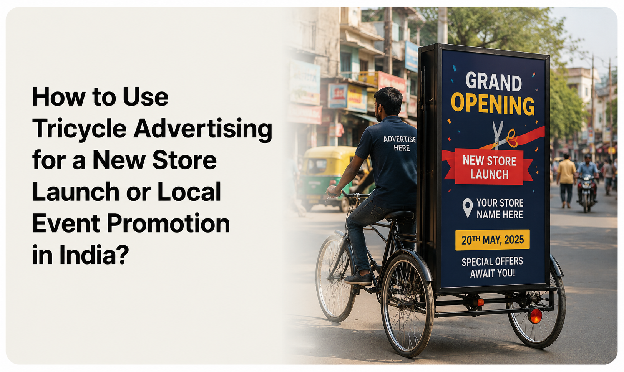

A new store opening or a local event has one real advantage over a national brand launch: the audience that matters is small, specific, and physically nearby. The challenge is reaching exactly that audience without spending a budget built for citywide reach. Tricycle advertising, branded cycle rickshaws moving through markets, residential lanes, and event zones, is built for precisely this kind of hyperlocal promotion.
This guide covers how to plan a tricycle advertising campaign specifically for a store launch or a local event: choosing routes, designing a display that works at street level, timing the campaign correctly, and avoiding the mistakes that waste a hyperlocal budget.
Why Tricycle Advertising Fits Hyperlocal Launch Campaigns?
A store launch or local event does not need citywide reach. It needs the few thousand people who live, work, or shop nearby, reached often enough that they remember to show up.
- Reaches spaces other formats cannot: Tricycles move through weekly markets, residential colonies, narrow bazaar lanes, and college or office clusters, places where cars, buses, and large hoardings either cannot go or are not permitted.
- Eye-level visibility: The display sits directly in a pedestrian's line of sight rather than overhead, which matters for a launch that depends on people walking through a door on a specific date.
- Better value than fixed premium media: A single billboard can cost several lakhs a month for one spot, while the same budget puts many tricycles across dozens of streets. That makes tricycle advertising a practical way to build strong local visibility without citywide media spend.
Using Tricycle Advertising for a New Store Launch
A store launch has a defined goal: get people who live or work nearby to visit on or shortly after opening day. Tricycle advertising should be planned entirely around that goal.
- Radius-first route planning: Rather than covering a wide area thinly, concentrate tricycles within a realistic walking or short-commute radius of the store, since a launch depends on immediate footfall more than distant brand awareness.
- Lead into opening day, then continue past it: Running tricycles for a week or so before launch builds anticipation, but stopping the campaign the moment the doors open misses the weeks immediately after, when repeat visits and word of mouth are still forming.
- Carry a genuine reason to visit: A store launch tricycle should feature the address, a clear opening offer or discount, and the date, giving a passerby a specific reason to remember the store rather than a vague brand impression.
- Pair the moving display with ground activation: Handing out flyers, sample products, or discount coupons near busy junctions along the tricycle's route converts a passing glance into an immediate visit far more effectively than the display alone.
Using Tricycle Advertising to Promote a Local Event
Event promotion has a different shape than a store launch: it is entirely time-bound, and the goal is to build enough awareness that people plan to attend on a specific date, rather than driving ongoing footfall.
- Escalate frequency as the date approaches: A tricycle campaign for an event works best when visibility increases in the final days before the event, rather than running at a flat, even pace across several weeks.
- Cover the areas people are travelling from, not just the venue: Routes should include residential areas, transit points, and commercial zones where the target audience for the event actually spends time day to day, not only the streets immediately around the venue itself.
- Keep the date and time impossible to miss: Unlike a store launch, where an address is the key detail, an event needs the date, time, and venue to be the most visually dominant elements on the display, since a passerby who forgets the date has no way to follow up later.
How to Choose the Right Routes for Different Campaign Goals?
Route planning should follow the specific goal of the campaign rather than a generic "high traffic" instruction.
| Campaign Type | Priority Routes | Reasoning |
|---|---|---|
| New store launch | Streets within walking distance of the store, nearby residential colonies, and local markets | Builds awareness among the people most likely to actually visit |
| Local event promotion | Transit points, main commercial streets, and residential areas across the target audience's home zones | Reaches people before they leave home or during their daily commute |
| Retail sale or seasonal offer | Weekly markets (haats), shopping streets, bus stops | Targets people already in a buying mindset |
| Community or NGO campaign | Residential colonies, community centres, local institutions | Builds visibility where the specific community actually gathers |
Whatever the goal, routes should be checked against actual footfall patterns rather than assumed from a map. While broader transit advertising formats can help brands reach commuters across larger routes, tricycle campaigns are better suited to streets and neighbourhoods where the target audience is concentrated.
A street that looks central on paper may see far less pedestrian traffic than a narrower market lane, so a short site visit or conversation with the tricycle operator before finalising the route is worth the time.
Designing a Tricycle Ad for Quick Street-Level Attention
A tricycle ad is read at close range and often for only a few seconds as it passes, so the design needs to prioritise instant clarity over detail.
Lead with the biggest, boldest information: The store name, event name, or brand should be the first thing a viewer registers, in large, high-contrast lettering readable from roughly 20 feet away.
Keep text to the essentials: A tricycle display works best with one primary message, the offer, the date, or the address, rather than multiple pieces of information competing for attention.
Use the local language: Printing the key details in the regional language alongside Hindi or English creates an immediate, personal connection with the local audience that an English-only display often misses.
Make the call to action concrete: A simple instruction, "Visit us at [address]," "Opening [date]," or a QR code for more details, gives the viewer something specific to act on rather than a general brand impression.
Choose lit or non-lit based on operating hours: A campaign that runs into the evening benefits from a backlit or LED display for visibility after dark, while a purely daytime campaign can use a standard flex-printed panel at a lower cost.
When Should a Store or Event Start Tricycle Advertising?
Timing differs meaningfully between a store launch and an event promotion.
For a store launch, starting seven to ten days before opening day builds local awareness without the message going stale before the doors open. Continuing for another two to four weeks after launch sustains footfall through the early weeks when repeat visits and word of mouth are still building.
For a local event, run a similar lead time of seven to fourteen days, with frequency increasing in the final few days. There is little value in continuing after the event date, so concentrate the budget in the run-up rather than spreading it evenly.
Brands wanting sustained local recall often extend campaigns to eight to twelve weeks, but a one-off launch or event rarely needs that long to hit its goal.
How Much Does Tricycle Advertising Cost in India?
Tricycle advertising costs vary by city tier, campaign duration, and the number of units booked. Indicative monthly rates look roughly like this:
| City Tier | Monthly Cost Per Tricycle | Notes |
|---|---|---|
| Metro (Mumbai, Delhi, Bengaluru) | Rs 2,500 to Rs 4,500 | Includes vinyl printing, installation, and operator compensation in most quotes |
| Tier 2 (Indore, Coimbatore, Bhubaneswar) | Rs 1,800 to Rs 3,200 | Meaningfully lower cost while still delivering strong hyperlocal reach |
| Tier 3 towns | Rs 1,200 to Rs 2,000 | Most accessible entry point for small, local budgets |
Some vendors price by unit per month with separate printing and mounting charges, commonly in the range of Rs 3,000 per unit, on top of the monthly rental. A single branded tricycle typically generates somewhere in the range of 15,000 to 25,000 impressions per day, which, for a genuinely local campaign, translates to a low cost per impression compared with most other outdoor formats.
A few factors affect the final cost for a launch or event campaign specifically:
- Number of units: A store launch or event rarely needs more than five to ten tricycles for a focused local radius, keeping total campaign cost modest even at metro city rates.
- Lit vs non-lit displays: Backlit or LED tricycles cost more than standard flex-printed panels but extend visibility into evening hours, worth the premium for an event running into the night or a store with extended opening hours.
- Permits: Most cities require a standard outdoor advertising permit, typically costing between Rs 500 and Rs 2,000 annually, with approval taking one to two weeks. Most vendors handle this as part of the campaign booking rather than leaving it to the client.
- Campaign duration: Short, targeted campaigns for a single launch or event generally cost less in absolute terms than sustained, multi-month brand visibility campaigns, since fewer weeks of rental are required.
How to Make a Tricycle Campaign More Effective
Here are few of the ways to make a tricycle campaign more effective:
Combine the moving display with direct engagement: Riders handing out flyers, samples, or discount coupons at busy junctions along the route convert passive viewing into an active response far more reliably than the display alone.
Track the route, not just the booking: Requesting GPS tracking or photographic proof of the tricycle's actual movement ensures the campaign covers the intended streets rather than concentrating in one easy, low-effort location.
Use a unique offer or code to measure response: A discount code or a specific phrase mentioned on the tricycle display, redeemable in-store or at the event, gives a concrete way to measure how many visits or attendees the campaign actually drove.
Common Mistakes to Avoid in Store and Event Tricycle Campaigns
Let us look at few of the common mistakes to avoid:
Covering too wide an area: Spreading a small number of tricycles across an entire city dilutes the hyperlocal advantage that makes this format effective for a local launch or event in the first place.
Starting too late: Booking tricycle advertising only a day or two before a launch or event leaves no time to build awareness, and a rushed campaign rarely delivers the recall a slightly earlier start would have achieved.
Overloading the display with information: A tricycle ad crowded with multiple offers, long descriptions, or several calls to action is difficult to read in the few seconds a passerby has to notice it.
Skipping the local language: An English-only display can miss a meaningful part of the local audience in markets where the regional language is the primary language of daily life.
Ending the campaign too abruptly for a store launch: Stopping tricycle advertising the moment a store opens misses the following weeks, when sustained visibility still matters for building repeat visits.
Which Businesses Can Use Tricycle Advertising for Local Promotion?
Tricycle advertising suits almost any business or organisation whose audience is genuinely local rather than citywide.
- Retail stores and showrooms launching in a specific neighbourhood benefit from the format's ability to build awareness within walking distance of the new location.
- Restaurants and food businesses use tricycle campaigns for openings, festive menus, or delivery service launches, particularly effective in residential and market areas.
- Educational institutes and coaching centres rely on tricycle advertising during admission seasons, targeting routes near colleges, schools, and residential areas with student populations.
- Healthcare providers, including clinics and diagnostic centres, use tricycle campaigns to build awareness in the specific neighbourhoods they serve.
- Event organisers, for community fairs, exhibitions, religious gatherings, and local cultural events, use the format to reach the exact residential and commercial areas their attendees come from.
- Political and social campaigns use tricycle advertising for hyperlocal outreach, particularly in ward-level or constituency-specific campaigns where the audience is defined by geography.
- NGOs and community organisations use the format for awareness drives and donation campaigns, benefiting from the trust and approachability associated with the human-powered, eco-friendly nature of tricycle branding.
A store launch or a local event does not need the scale of a citywide campaign; it needs the right few thousand people to notice, remember, and act. Tricycle advertising delivers that kind of focused, close-range visibility at a cost that fits a genuinely local budget, provided the campaign is planned around the specific goal, a store's walking radius or an event's target audience, rather than treated as a smaller version of a mass-market outdoor campaign.
Get the routes, timing, and design right, and a handful of branded tricycles moving through the right streets can do more for a local launch than a single expensive placement ever could. If you are planning a local launch or event, get in touch with our team to discuss suitable advertising options.
Frequently Asked Questions
How many tricycles are needed for a single store launch?
Most focused store launch campaigns work well with five to ten tricycles covering the streets and residential areas within a realistic walking or short-commute radius of the store, rather than a larger fleet spread across the wider city.
How far in advance should tricycle advertising start for a store opening?
Roughly seven to ten days before opening day is generally sufficient to build local awareness, with the campaign continuing for two to four weeks after launch to support ongoing footfall.
Is tricycle advertising effective for a one-day event?
Yes, particularly when frequency is increased in the final few days before the event, with routes covering the residential and transit areas the target audience travels from rather than only the venue itself.
Can tricycle ads include a QR code or discount coupon?
Yes. QR codes, unique discount codes, and printed coupons are commonly used on tricycle displays and give a concrete way to measure how many visits or responses the campaign generated.
Do tricycle advertising campaigns need government permits?
Most cities require a standard outdoor advertising permit, typically costing between Rs 500 and Rs 2,000 annually, with approval taking one to two weeks. Most tricycle advertising vendors handle this as part of the booking process.
Is tricycle advertising suitable for small, local businesses on a tight budget?
Yes. Tier 2 and tier 3 city rates typically range from Rs 1,200 to Rs 3,200 per tricycle per month, making a focused local campaign accessible even for a modest launch or event budget.
Should tricycle advertising be combined with other local marketing?
Yes. Pairing the moving display with flyer distribution, social media promotion, and consistent messaging across other local materials generally produces stronger results than the tricycle campaign running in isolation.