
Outdoor Advertising in Tier 2 and Tier 3 Cities: Opportunity, Costs, and Strategy

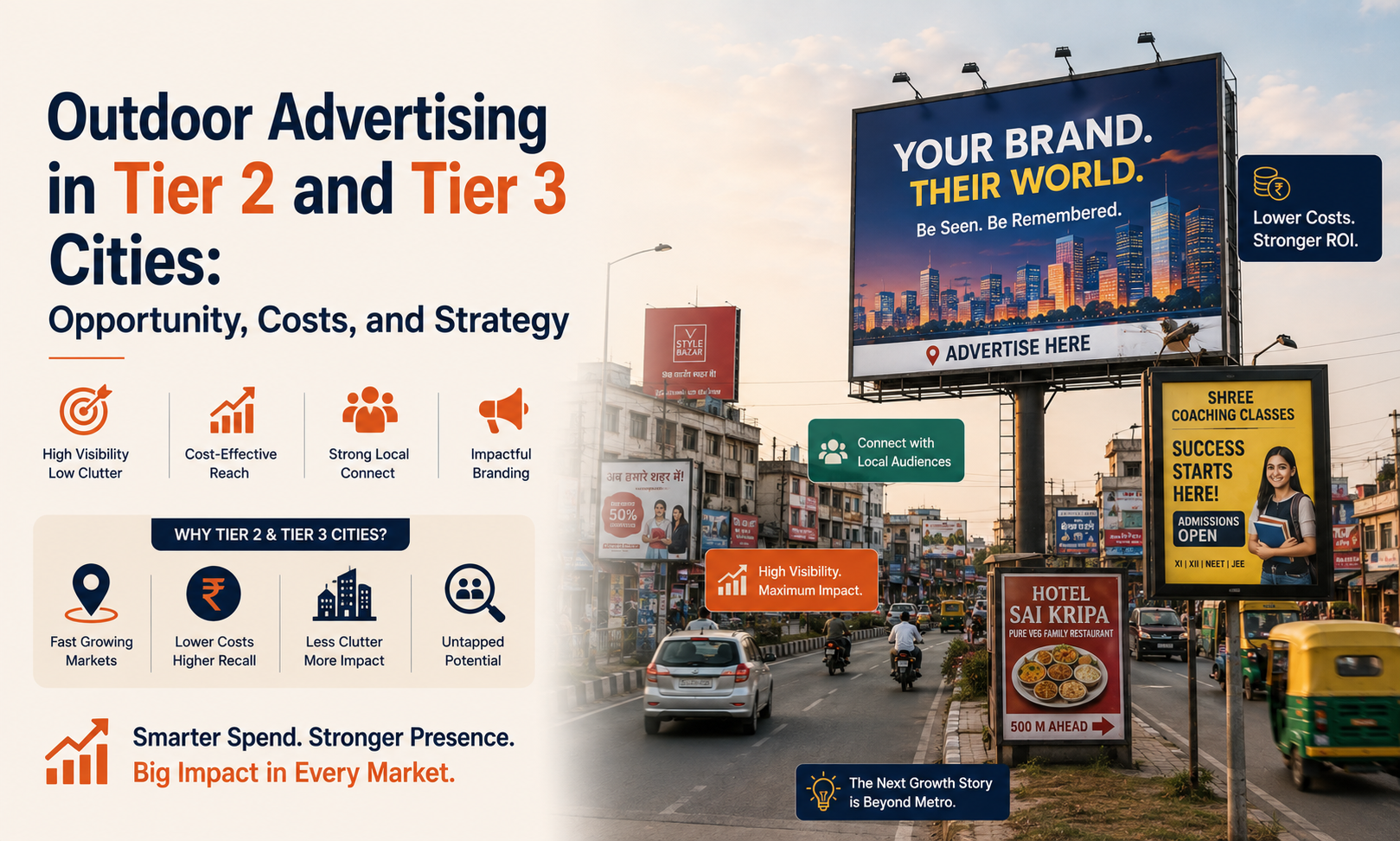

India is changing, and the major change is taking place in the tier 2 and tier 3 cities. With the rapid urbanisation around these cities, it is a potential opportunity to advertise your brand across these cities.
With the communication system across the cities becoming stronger day-by-day, people are moving across different parts of tier 2 and tier 3 cities every day. This is a huge opportunity to capture your growth audience.
This blog helps you discover the audience base for your brand in tier 2 and tier 3 cities. You get an idea about your real audience, their locations, and an idea of the total advertising cost in this blog. Let us begin.
Understanding Tier 2 and Tier 3 Cities in India
Tier 2 cities generally include growing urban centres such as Pune, Jaipur, Lucknow, Indore, and Surat. In contrast, Tier 3 covers smaller but rapidly developing towns with populations under a million.
These markets differ from metros in one key way: lower media costs.
Just implement the right settings, in the right way at the right time, and your campaign turns out to be a generator of a new audience segment till the time your outdoor advertisement runs.
Why Are Tier 2 and Tier 3 Cities the Next Big Opportunity for Outdoor Advertising?
India's organised OOH industry is valued at over 4,700 crore rupees, and transit media's share within it has grown from around 25 percent a decade ago to close to 37 percent today, with projections of 40 percent by 2026.
A large part of that growth is coming from outside the top metros, with OOH spending in Tier 2 and Tier 3 cities growing at an estimated 12 to 15 percent annually, according to Rohit Chopra, COO of Times OOH, quoted in the same report. Vaishal Dalal, co-founder of Excellent Publicity, notes that smaller cities remain largely underleveraged despite rapid infrastructure upgrades under Smart City initiatives, offering brands high visibility and low clutter at a fraction of metro-level budgets.
Key Advantages of Outdoor Advertising in Tier 2 and Tier 3 Cities
Commuters in these cities tend to follow routine, predictable movement, taking the same buses, visiting the same markets, and using the same roads daily, which allows a single site to reach the same audience repeatedly. Lower private vehicle ownership also means auto-rickshaws, buses, and shared transport draw more attention than they might in a metro, as here private cars and app-based cabs dominate the roads.
Combined with lower advertising clutter, this often creates stronger recall per rupee spent than an equivalent metro campaign. Slower city pace also means people tend to engage more fully with an ad, actually reading the full message on a wall wrap or rickshaw panel.
Most Effective Outdoor Advertising Formats for Tier 2 and Tier 3 Markets
Several formats consistently perform well in these markets. All these are suited to a different budget and goal.
- Hoardings and Billboards remain the anchor format, offering strong local visibility on arterial roads and market junctions at a fraction of metro pricing.
- Highway Advertising captures both local traffic and travellers commuting between cities, useful for brands with a regional footprint.
- Bus Shelter Advertising offers high dwell time as commuters wait, making it effective for an affordable local recall.
- Wall Paintings and Wall Wraps deliver long-lasting, hyperlocal visibility in markets and residential belts, popular with regional and D2C brands.
- Pole Kiosks and Street Furniture Advertising work well at busy intersections where footfall is consistently high.
- Digital Out-of-Home (DOOH) advertising is expanding rapidly beyond metro rail networks, with cities such as Hyderabad introducing smart bus stops and digital display screens that create new, high-impact advertising opportunities for brands.
- Market and Retail Area Branding places a brand directly where purchase decisions happen, ideal for FMCG and retail categories.
Top Tier 2 and Tier 3 Cities for Outdoor Advertising in India
Cities like Pune, Jaipur, Lucknow, Indore, and Surat lead the Tier 2 category with strong commercial activity and improving infrastructure. Beyond these, cities such as Bhubaneswar, Guwahati, and Coimbatore are gaining attention for their modern transit and airport infrastructure, offering brands an affluent, increasingly mobile audience that was largely inaccessible just a few years ago.
Outdoor Advertising Costs in Tier 2 and Tier 3 Cities
| Advertising Format | Typical Cost | Campaign Scope / Notes |
|---|---|---|
| Hoardings (Tier 2 Cities) |
₹50,000–₹3,00,000 per site/month |
Pricing depends on location, size, traffic volume, and visibility. |
| Hoardings (Tier 3 Cities) |
Starting from ₹15,000 per site/month |
Entry-level rates for well-located sites in smaller cities. |
| Auto Rickshaw Branding |
₹3,000–₹8,000 per vehicle/month |
Typical pricing for campaigns involving fleets of 50–200 vehicles. |
|
Integrated Launch Campaign (Tier 2 City) |
₹8–15 lakh/month |
Combines hoardings and auto-rickshaw branding for a city-wide product or retail launch. The budget varies based on media mix, inventory, and campaign duration. |
and campaign duration. How to Build an Effective Outdoor Advertising Strategy for Smaller Cities?
Start targeting routes as well, and not just locations. Since commuting patterns in these cities are far more predictable than in metros, mapping the daily paths of your target audience, market visits, school runs, and office commutes lets you concentrate spending where it will be seen repeatedly. Layering formats, where a hoarding near a market alongside auto branding on feeder roads, tend to outperform a single large format working alone.
Campaign Planning Framework for Tier 2 and Tier 3 Cities
Begin with a clear objective and a defined city or cluster of cities. Shortlist two to three formats that match your budget and audience, using outdoor advertising sites alongside transit formats where relevant.
Build in a minimum three-month run. Since these markets reward sustained visibility over short bursts and always include a way to track response, integrate a phone number, QR code, or promo code specific to the campaign.
Common Mistakes Brands Make in Tier 2 and Tier 3 Outdoor Advertising
Here are a few of the common mistakes brands make in tier 2 and tier 3 outdoor advertising:
- The most frequent misstep is applying a metro mindset to a fundamentally different market, choosing the biggest available hoarding rather than the one that actually intersects with customer routes.
- Others include underestimating vendor fragmentation, since these markets often involve many independent media owners with inconsistent quality and reporting standards, and running campaigns for too short a duration to build genuine recall in a market that rewards repetition over a single burst of visibility.
- Skipping any form of local research, such as which markets or routes your specific audience actually uses, also leads to budgets being spent on sites that look impressive but reach the wrong people.
Measuring ROI from Outdoor Advertising in Smaller Cities
Brands can track results through QR code scans, dedicated phone numbers, and footfall comparisons before and during a campaign. Case studies have shown transit and outdoor campaigns in these cities driving up to a 30 percent increase in store footfall, with one Tier 2 auto branding campaign generating over 17 million digital impressions after being shared online.
Emerging Trends in Tier 2 and Tier 3 Outdoor Advertising
Smart City-linked infrastructure is beginning to reshape this space, with GPS-enabled digital boards, Wi-Fi-connected bus shelters, and ad-funded smart bus stops appearing in cities like Hyderabad.
Agencies are also increasingly bundling transit advertising with outdoor formats and offering centralised vendor management, addressing the fragmentation that has historically held brands back from investing at scale in these markets.
Why Tier 2 and Tier 3 Cities Should Be Part of Your OOH Strategy?
With metro markets becoming increasingly expensive and cluttered, Tier 2 and Tier 3 cities offer a rare combination of affordability, low competition, and a genuinely receptive audience. For brands looking to expand beyond the usual metro playbook, these markets offer some of the strongest cost per impression available in Indian outdoor advertising today.
Unlocking Growth Through Outdoor Advertising in India's Emerging Markets
Tier 2 and Tier 3 cities are no longer a secondary consideration in outdoor advertising planning. They are quickly becoming a primary growth driver for brands willing to plan around local routes and routines rather than borrowed metro strategies.
At Excellent Publicity, we help brands navigate these markets with vetted local vendor networks and end-to-end campaign execution across formats and cities. Get in touch with our team to build an outdoor strategy for India's fastest-growing urban markets.