

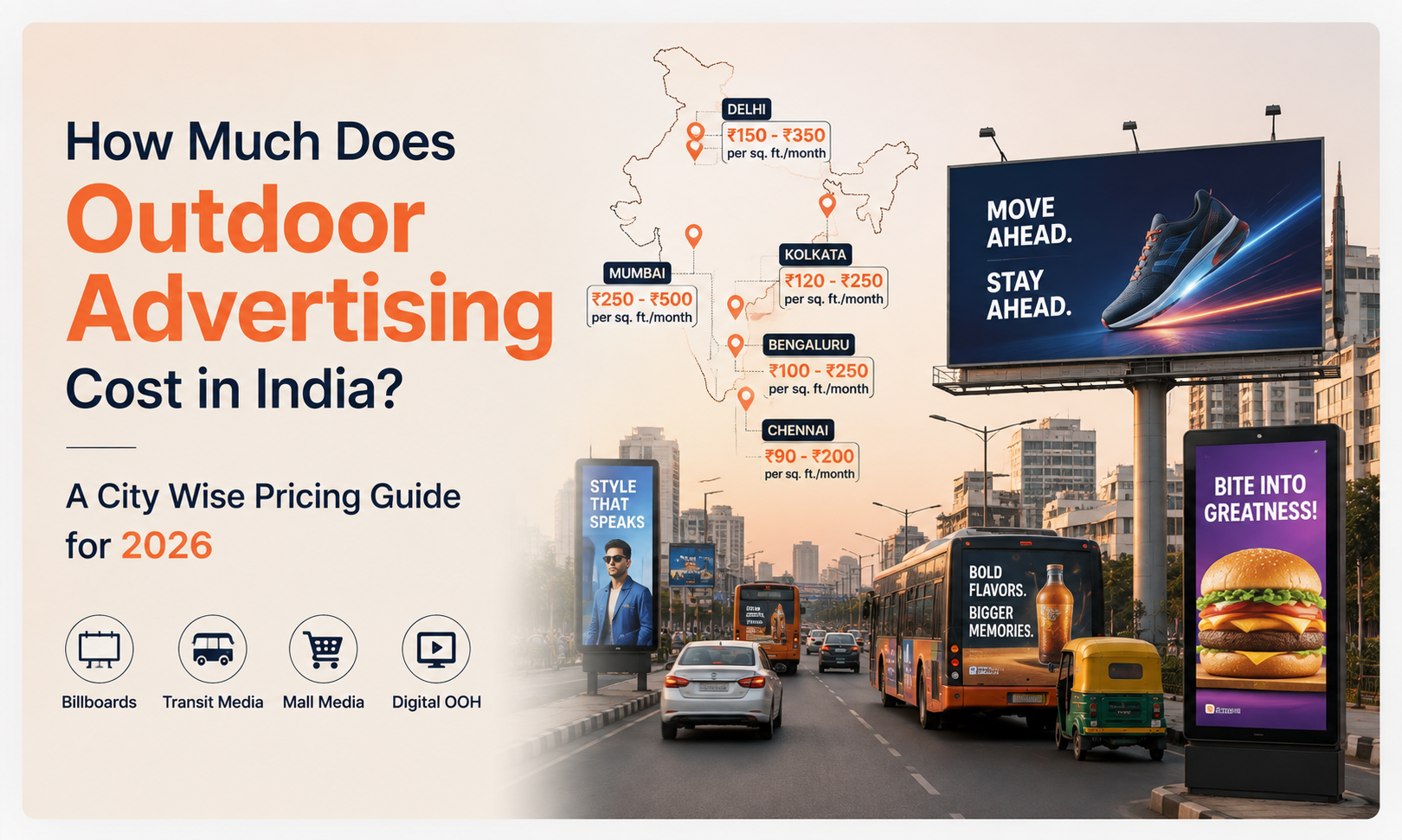

With the AI scenario today, everything has turned digital. Start-up and small business owners, get advice on investing in Meta ads and Instagram campaigns, and let your audience find you. But when you move out, you still see highly successful brands invest in billboards and hoardings. If you see clearly, you will also see local businesses investing in outdoor advertising and getting the desired results.
So, is outdoor advertising still valid for your brand advertising, or is it outdated in this digital world? Let us find out the answer in the blog below.
What Is Outdoor Advertising and How Does It Work?
Outdoor advertising, often called OOH or Out-of-Home advertising, covers any brand message placed in public spaces where people naturally spend time, including hoardings, bus shelters, auto rickshaws, kiosks, and digital screens among them.
In OOH, it puts your brand directly into a commuter's daily route, a shopper's walk to the market, or a resident's view from their balcony.
Why Does Outdoor Advertising Work for Small Businesses?
For a small business, the biggest hurdle comes with marketing their product. Outdoor advertising solves this by putting your name in front of the exact neighbourhood you serve, repeatedly and consistently. It does not matter if your customer base is walking to the market, waiting for a bus, or stuck at a traffic signal; you get visibility and reach.
These hoardings and billboards remain present in front of the audience for a very long time; hence, they generate more visibility and brand recall. Continuous exposure also builds familiarity with the brand.
That repetition builds the kind of trust that turns a passerby into a walk-in customer. There is also a subtle credibility effect: a business that appears on a hoarding, a bus, or a cluster of autos in the neighbourhood feels more established and reliable than one that exists only online. This matters a great deal when a customer is choosing between a known name and an unfamiliar one.
Outdoor Advertising vs Digital Advertising for Small Businesses
Digital advertising offers precise targeting and instant analytics, but it also comes with rising costs per click and constant competition for attention. But outdoor advertising, by contrast, offers an unavoidable, always physical presence in a specific location. The two are not really competitors.
A small business that pairs a local hoarding or auto campaign with a modest digital budget often sees stronger results than either channel alone, since the outdoor ad builds recognition that makes the digital ad feel familiar rather than intrusive.
Best Outdoor Advertising Formats for Small Businesses
Outdoor advertisements come in wide varieties, but not every format is suitable for your brand. Here are the options small businesses turn to most often.
Local Hoardings and Billboards
A single, well-placed hoarding near your shop, market, or main road can anchor local recognition, especially in Tier 2 and Tier 3 cities where rates start far lower than in metro areas.
Bus Shelter Advertising
Bus shelters offer high dwell time, since commuters wait nearby for several minutes at a stretch, making them ideal for building steady, affordable recall in a specific area.
Auto Rickshaw Advertising
Among the most budget-friendly formats available, auto branding lets a small business put its message on dozens of vehicles moving through markets and residential lanes every day.
Transit Advertising
Bus and cab branding extends your reach across an entire city corridor, useful for small businesses with multiple outlets or a wider service area.
Pole Kiosks and Street Furniture Advertising
Kiosks placed at market junctions and busy intersections offer a low-cost way to build visibility exactly where footfall is highest.
Digital Out-of-Home (DOOH) Advertising
DOOH screens let small businesses run rotating ads at a fraction of the cost of owning an entire hoarding, with the flexibility to update creative for sales or seasonal offers.
Shopfront and Local Area Branding
Signage, banners, and branding around your own shopfront and immediate neighbourhood reinforce every other outdoor format, ensuring customers recognise your brand the moment they arrive.
Which Types of Small Businesses Benefit Most from Outdoor Advertising?
Local retail stores, restaurants, clinics, gyms, coaching centres, and real estate agents see some of the strongest results, since their customers are almost always drawn from a defined, nearby radius rather than an entire city.
Service businesses like salons, repair shops, and diagnostic centres also benefit, particularly when outdoor ads are placed along the exact routes their target customers travel daily, near a residential society, a school, or a busy market road.
Seasonal and event-driven businesses, from festive sweet shops to exam season coaching centres, also find outdoor advertising effective for short, high-intensity bursts of visibility timed to when local demand is highest.
How Much Does Outdoor Advertising Cost for Small Businesses?
Outdoor advertising has many criteria and formats as well. Let us look into the price range for different types of outdoor advertising formats:
|
Outdoor Advertising Format |
Typical Monthly Cost | Best Suited For |
|---|---|---|
|
Auto Rickshaw Branding |
Starts from a few hundred rupees per vehicle |
Hyperlocal campaigns, neighbourhood visibility, and frequent local exposure |
|
Pole Kiosks / Kiosk Clusters |
₹5,000 – ₹25,000 per unit |
Budget-friendly branding in busy markets, intersections, and commercial areas |
| Bus Shelter Advertising |
Starts from ₹5,000 (smaller cities) |
Reaching daily commuters and pedestrians with prolonged visibility |
|
Local Hoardings (Tier 2 & Tier 3 Cities) |
₹15,000 – ₹40,000 |
Building strong local brand awareness and dominating a specific geographic market |
How to Plan an Outdoor Advertising Campaign for a Small Business?
Start with your radius, not your city. Identify the specific market, colony, or route your customers actually travel through, then choose a format that covers that ground without wasting budget on areas outside your reach. Commit to at least two to three months, since outdoor advertising builds recall gradually rather than overnight, and keep your message simple: a clear offer, a memorable number, or a short, benefit-led line works far better than a crowded design.
Common Outdoor Advertising Mistakes Small Businesses Should Avoid
You might be a seasoned player, but still, it is not the same thing to run ads for different outdoor formatting that too for brands belonging to different industries. You need an expert to guide you properly. Let us look at a few of the common mistakes almost every start-up-based business owner commits:
- The most common mistake is choosing a location because it looks impressive rather than because it actually reaches the right audience; a striking hoarding on a highway does little good if your customers never drive that route.
- Other frequent missteps include running a campaign for too short a duration to build recall, cramming too much text onto a small format that people only glance at for a few seconds.
- Skipping any way to track results, such as a dedicated phone number or simple offer code, makes it impossible to know what worked.
How to Measure the ROI of Outdoor Advertising?
Small businesses can track results without expensive tools or agencies. A unique phone number, a specific promo code printed on the creative, or simply asking new customers how they heard about you can reveal exactly how much footfall your campaign is driving.
Comparing sales or enquiries before and during the campaign period also gives a clear, practical read on whether the investment is paying off, and tracking this consistently over a few campaigns helps you identify which formats and locations work best for your business specifically.
Success Factors That Make Outdoor Advertising Work for Small Businesses
The businesses that see the strongest results share a few habits. Having a close look will make the concept much clearer:
- They choose locations based on actual customer routes
- Keep their creative simple and legible
- Commit to a campaign long enough to build recall
- Combine outdoor with a light digital presence so customers who spot the ad offline can find it online just as easily.
Emerging Outdoor Advertising Opportunities for Small Businesses
E-rickshaw branding, hyperlocal kiosk clusters, and affordable DOOH slots are opening up outdoor advertising to businesses that once considered it out of reach. As more of this inventory becomes available at small business-friendly prices, the gap between what a large brand and a local business can afford on the street is narrowing fast.
So, is outdoor advertising worth it for small businesses in India? For a business that knows its neighbourhood and wants to be remembered by the people who live and work in it, the answer is a clear yes.
At Excellent Publicity, we help small businesses plan focused, affordable outdoor campaigns across formats and cities. Get in touch with our team to build a campaign that fits your budget and your neighbourhood.