

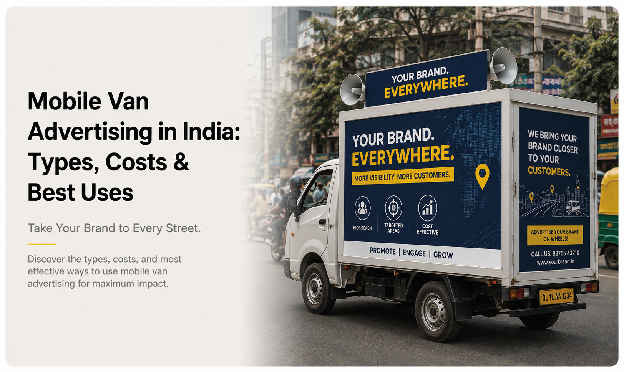

Mobile van advertising allows brands to take their message directly to the places where their target audience spends time. This flexibility has made it a popular outdoor advertising format in India, used by everyone from FMCG brands running nationwide campaigns to local coaching centres promoting admissions across nearby neighbourhoods.
This blog explains what mobile van advertising is, the formats available, typical costs across different city tiers, how to plan effective routes, and which businesses can benefit most from this advertising format.
What Is Mobile Van Advertising?
Mobile van advertising, also called mobile billboard advertising or canter van branding, uses branded vehicles to promote a business across planned routes. Vehicles can carry printed flex or vinyl panels, LED screens, or audio visual displays, making mobile van advertising a flexible way to reach audiences across different areas. Mobile vans can cover multiple localities in a day and be redirected based on campaign needs.
Types of Mobile Van Advertising Available in India
These are the following types of mobile van advertising available in India:
Static display vans (Tata Ace, mini tempo)
Compact vehicles with printed flex or vinyl panels in T-shape or L-shape layouts. The most nimble and affordable format, ideal for narrow lanes and dense markets.
Canter vans
Built on larger chassis like Eicher 609 or Tata 407, offering 14-16 foot side panels for hoarding-like impact. Best suited for product launches, election campaigns, and large-format statements.
LED and digital vans
Equipped with high-brightness LED screens showing video or animated creative, effective after dark and in visually cluttered areas. These command a premium due to screen and operational costs.
Audio-visual and roadshow vans
Combine branding with PA systems, promoters, or a small stage for direct engagement. Well suited to product sampling and live activations, especially in smaller markets.
Customised and activation vans
Purpose-built with screens, lighting, or demonstration space, designed to be an experiential destination rather than just a passing visual.
How to Choose the Right Mobile Van Format?
The right format depends less on budget alone and more on what the campaign actually needs the van to do.
Choose static flex vans (Tata Ace or T/L-shape) when the objective is broad, sustained visibility across many neighbourhoods on a controlled budget, and the creative is a single, stable message that does not need to change during the campaign.
Choose Canter vans when scale and visual dominance matter more than manoeuvrability, large-format launches, election campaigns, or any campaign where the vehicle needs to command attention comparable to a hoarding while still moving.
Choose LED or digital vans when the campaign needs dynamic content, video, rotating messages, or daypart-specific creative, or when visibility after dark and in crowded, cluttered environments is a priority.
Choose audio-visual or roadshow vans when the goal is direct engagement rather than passive awareness, product sampling, live demonstrations, or campaigns where a promoter needs to interact with the crowd directly.
Where Mobile Van Advertising Works Best?
Mobile van advertising performs strongly in dense urban markets, residential colonies, and commercial corridors, but its real structural advantage shows up outside the biggest metros. In tier 2 and tier 3 cities, where the inventory of premium hoarding sites is limited and static outdoor advertising options are comparatively thin, a single well-routed van can achieve in a week what would otherwise require twenty or thirty fixed hoarding sites to replicate in geographic coverage, at a fraction of the cost.
Metro markets like Delhi, Mumbai, Bengaluru, and Hyderabad remain the most active markets in absolute volume, given their scale and traffic density, but route planning matters more there: a van stuck in heavy Mumbai traffic on the wrong corridor during rush hour can waste hours of deployment time.
Compact, grid-like cities and mid-sized tier-2 markets, Lucknow, Coimbatore, Nashik, Rajkot, Surat, often deliver more efficient coverage per rupee, since a single van can realistically touch every significant commercial and residential pocket within a matter of days. As a transit advertising format, mobile vans also offer greater flexibility to move between different neighbourhoods and high-footfall areas based on campaign requirements.
The format also works particularly well around events, festival grounds, markets on peak days, and election constituencies, anywhere a large, receptive audience gathers in a specific place at a specific time that a fixed billboard cannot follow.
What Are the Best Uses of Mobile Van Advertising?
Here are the best uses of mobile van advertising:
Product launches and sampling: A mobile presence that drives footfall and puts samples directly in customers' hands.
Admissions and education season: Reaches parents and students across residential belts exactly when admission decisions are being made.
Real estate and retail promotions: Builds local awareness while a QR code converts viewers into direct enquiries.
Elections and public awareness: Covers specific constituencies with high-frequency visual and audio messaging.
Events and festival activations: Turns a gathered crowd into a captive, engaged audience in one location.
Mobile Van Advertising Cost by Format
Indicative day rates vary meaningfully across vendors and cities, but a reasonable planning range looks like this:
| Van Type | Metro City Day Rate | Tier 2/3 City Day Rate | Notes |
|---|---|---|---|
| Static Mini Van (Tata Ace, T/L-Shape) | Rs 2,000 to Rs 5,500 | Rs 1,500 to Rs 3,500 | Most nimble, best for narrow lanes and dense markets |
| Canter Van (Static Flex) | Rs 6,000 to Rs 12,000 | Rs 3,000 to Rs 7,000 | Larger surface area, closer to hoarding-level visual impact |
| LED / Digital Van | Rs 8,000 to Rs 25,000 | Rs 5,000 to Rs 15,000 | Premium pricing reflects screen hardware and content flexibility |
Most quotes include the vehicle, driver, fuel, GPS tracking, and route reporting, with GST charged separately. A one-time setup cost for design, printing, and installation, typically in the range of Rs 12,000 to Rs 20,000 per van depending on format, is usually charged once regardless of campaign length.
Most vendors set a minimum booking of around three days for LED vans and five to seven days for static formats, since the fixed setup cost is not economical over a shorter run.
Planning Routes for Better Local Reach
Most of a mobile van campaign's actual value is determined by the route plan, not the creative. A van driving without a deliberate plan wastes its core advantage; one routed to match where the target audience actually moves concentrates that same spend into meaningful impressions.
Map routes to the target audience's daily movement: Plan routes around residential areas, markets, commercial streets, and event locations based on when your audience is most active.
Mix driving with parked dwell time: Park the van at high footfall locations to give people enough time to notice and read the message.
Use GPS tracking to confirm coverage: Use GPS logs and geo tagged photos to verify that the van covered the planned route.
Review and adjust routes mid campaign: Monitor engagement and response to shift the van toward locations that perform better.
How Long Should a Mobile Van Campaign Run?
Duration should follow the campaign's actual goal rather than a default booking length.
- Short campaigns (one to seven days) suit a single event, a launch day, or a festival activation, where the objective is concentrated presence around a specific occasion rather than sustained recall over time.
- Medium campaigns (two to four weeks) work well for admission seasons, retail sales, or a store launch that needs continued visibility through the weeks immediately surrounding the key date, not just the day itself.
- Longer or PAN-India campaigns (a month or more, often across multiple cities) suit brand-building objectives or national product launches, where sustained, wide geographic coverage is the goal rather than a single, time-bound moment.
A useful general principle: short, high-frequency bursts around a specific occasion tend to outperform the same total van-days spread thinly and continuously over a long period, since the format earns most when it is concentrated at a time and place that genuinely matters to the audience.
Designing a Mobile Van Advertisement That People Can Understand Quickly
A van is read in a few seconds by someone walking past or glancing over from another vehicle, so the design has to communicate almost instantly.
Lead with one message: A single, clear idea, the brand, an offer, or an event works far better than a crowded panel trying to communicate several things at once.
Use bold, high-contrast visuals: Strong colour contrast and large, simple typography remain legible from a distance and hold up against a moving background of traffic and street clutter.
Size elements for distance, not close inspection: The core message and brand name need to be readable well before the van is directly alongside the viewer, so text sized for a printed flyer will simply not work here.
Include a clear, simple call to action: A QR code, a short phone number, or a specific offer gives an interested viewer something concrete to act on, more effective than a vague brand impression alone.
Use local language where relevant: Messaging in the regional language, alongside Hindi or English, builds a more immediate connection with a hyperlocal audience than English-only creative.
Which Businesses Can Benefit From Mobile Van Advertising?
Here are the businesses benefiting from mobile van advertising:
FMCG and consumer goods brands are the single largest category using the format, since it puts brand messaging directly into the markets and residential areas where purchase decisions are made, and doubles easily as a product sampling vehicle.
Real estate developers use vans to build awareness for new projects across residential localities and office corridors, particularly effective in tier 2 cities where digital reach alone often falls short of the target buyer base.
Education and coaching institutes rely on vans during admission season to reach parents and students across specific residential belts and student hubs.
Healthcare providers, including hospitals, clinics, and pharmaceutical brands, use the format for health awareness drives and service promotion, particularly in tier 2 and tier 3 markets.
Political campaigns use vans intensively during election periods to cover constituencies with high-frequency visual and audio messaging.
Retail brands and local businesses use vans to drive footfall to nearby stores and build hyperlocal presence without the cost of sustained digital advertising.
E-commerce and tech startups increasingly use mobile van campaigns, often paired with a QR code, to drive app downloads and first-purchase behaviour in markets where digital advertising alone has not broken through.
Getting More From Your Mobile Van Campaign
Mobile van advertising earns its cost through deliberate planning, not simply by putting a wrapped vehicle on the road. The format that reaches over a hundred thousand people a day and the one that reaches a fraction of that, at the same daily rate, are separated almost entirely by route quality, format choice matched to the actual objective, and a design that can be read and understood in the few seconds a passerby actually gives it. Get those decisions right, and a mobile van becomes one of the most flexible and cost-efficient ways to put a brand physically in front of the exact audience, in the exact place that matters most to a specific campaign. To plan a mobile van campaign that fits your target audience and locations, reach out to us for further details on available options.
Frequently Asked Questions
What is the minimum booking for mobile van advertising?
Most vendors set a minimum of three days for LED or digital vans and five to seven days for static flex vans, since the one-time setup cost for design, printing, and installation is not economical over a shorter run.
How many impressions does a mobile van generate per day?
This varies widely by city, route, and hours of operation, but a reasonable range is roughly 15,000 to over 100,000 impressions per day, with denser metro routes and longer shifts generating impressions toward the higher end of that range.
Is an LED van advertising worth the extra cost over a static flex van?
It depends on the objective. LED vans are worth the premium when dynamic content, video, or evening visibility genuinely matters to the campaign. For sustained, broad-coverage awareness campaigns on a controlled budget, static flex vans generally deliver better overall value.
Do mobile van advertising campaigns need permits in India?
Yes. Requirements vary by city, generally involving a commercial vehicle permit from the state RTO and, in many cities, a separate moving advertisement permit from the municipal corporation or traffic authority. Most professional vendors handle this process as part of campaign setup, typically taking a few days to a couple of weeks.
Can mobile van advertising run across multiple cities at once?
Yes. PAN-India and multi-city campaigns are common, particularly for FMCG and national brand launches, and typically achieve meaningful cost savings per city compared to booking each market independently.
Which is better for a small local business, a mobile van or a hoarding?
For a business with a genuinely local, geographically specific audience and a limited budget, mobile van advertising generally offers better flexibility and cost efficiency than committing to a single fixed hoarding location.
How is a mobile van advertising campaign measured?
Common measurement methods include GPS route tracking and geo-tagged photographic proof of coverage, QR code scan rates, dedicated phone numbers or promo codes, and, for larger campaigns, pre- and post-campaign brand recall surveys comparing campaign markets against a control market.
Should the same van run the same route every day?
Not necessarily. Reviewing early performance data and reallocating time toward routes or localities showing stronger engagement, rather than running a fixed route for the entire campaign, typically improves the overall return from the same total spend.