
Industry-Specific OOH Advertising Guide: FMCG, EdTech, Real Estate, D2C and Retail

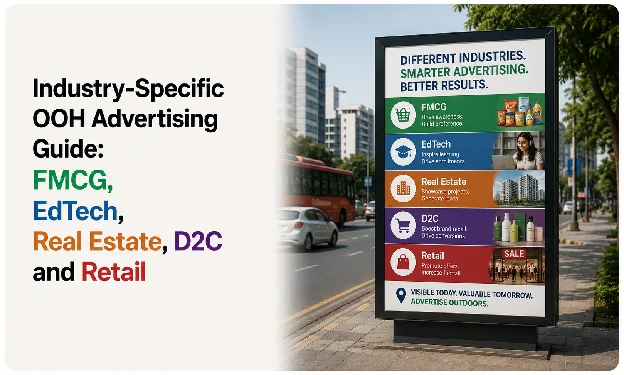

A hoarding near a college works brilliantly for an EdTech brand chasing admissions and does almost nothing for a real estate developer trying to reach high-net-worth buyers. A digital screen inside a mall converts a retail brand's shopper instantly, but wastes the budget for a D2C brand whose customer was always buying online. Out-of-home advertising is not one strategy applied to different logos. It is a format and location decision that should look genuinely different depending on the industry behind it.
This guide breaks down how OOH strategy should change across five categories that dominate Indian outdoor spend: FMCG, EdTech, real estate, D2C and retail, covering placement, format, creative and budgeting for each.
Why Should OOH Advertising Strategy Change by Industry?
Every industry has a different buying cycle, a different decision-maker and a different relationship between seeing an ad and acting on it. FMCG purchases happen on impulse, often within metres of the ad itself. Real estate and EdTech purchases are considered decisions made over weeks or months, often by more than one person in a household. D2C brands need the ad to bridge into a digital purchase that happens later, on a phone. Retail sits in between, close to the point of purchase but rarely an instant decision.
Applying the same format, location and creative template across all of these wastes budget in a specific, avoidable way: you reach people who are technically in your target demographic but standing in the wrong place, at the wrong moment in their decision process, seeing a message built for someone else's buying cycle. This is why choosing the right outdoor advertising approach based on the industry and customer journey is essential.
Quick Comparison: OOH Strategy Across Industries
| Industry | Core Goal | Best Locations | Key Metric |
|---|---|---|---|
| FMCG | Impulse purchase, top-of-mind recall | Near retail points, transit hubs, and residential markets | Sales lift, footfall near retail |
| EdTech | Trust building, dual audience (parent and student) | Residential areas, school zones, transit routes, tech parks | App downloads, lead generation |
| Real Estate | High-intent inquiry, premium positioning | Affluent neighbourhoods, approach roads to the project, and airports | Site visits, enquiry calls |
| D2C | Bridge offline visibility to online conversion | Urban youth corridors, metro and transit networks | Promo code use, direct website traffic |
| Retail | Immediate footfall, seasonal promotion | Within a few kilometres of the store | In-store footfall, coupon redemption |
OOH Advertising for FMCG Brands
FMCG brands succeed with OOH when the ad sits close enough to the purchase moment to influence a decision made in seconds. The goal is rarely deep consideration; it is staying top of mind at the exact point someone decides what to pick up.
Placement: Concentrate on kirana stores, supermarkets, local markets, transit hubs and residential routes with regular consumer movement. Bus shelters, pole kiosks and hoardings near retail clusters deliver repeated exposure shortly before a purchase decision.
Format choice: Frequency and proximity to purchase are usually worth more than one large premium site. A network of hoardings, bus shelters and pole kiosks across key retail corridors gives the brand consistent visibility among its actual buyers.
Creative: Lead with the product, the packaging, strong visuals and a clear brand message. Keep the copy short enough to read at a glance. Unlike D2C or EdTech, FMCG advertising rarely needs detailed messaging or a QR code, because the objective is quick recognition and recall.
OOH Advertising for EdTech Brands
EdTech is one of the more complex OOH categories because the campaign speaks to two audiences at once: the parent making and paying for the decision, and the student who will actually use the product. Trust matters more here than in almost any other category, since the purchase is a bet on outcomes months or years away.
Placement: Focus on residential areas, school zones, commuter routes and tech parks, particularly during admission seasons. For higher education and professional skilling products, metro and train advertising works well because commuters have time to engage with detailed messaging.
Format choice: Larger hoardings and transit wraps suit broad, parent-focused awareness, while digital screens in metro stations and residential lift lobbies support more detail. These formats can carry exam results, success stories, course benefits and QR codes for free trials or demos.
Creative: Lead with credibility, results and specific value propositions rather than generic aspiration. Include a clear QR code or short link to a trial, demo or course page so interested viewers have an easy next step.
OOH Advertising for Real Estate Brands
Real estate OOH does two things at once: it projects scale and credibility, and it drives a specific, high-intent inquiry from someone who can actually afford the property. The balance shifts depending on whether the campaign targets a broad launch audience or a narrow luxury segment.
Placement: Focus on affluent neighbourhoods, financial and business districts, and roads leading directly to the project site. Hoardings along approach roads build awareness while helping buyers locate the development. For premium projects, airport advertising delivers visibility among affluent, frequent travellers.
Format choice: Premium static hoardings and digital spectaculars in high-visibility locations suit real estate particularly well. The quality, size and positioning of the site reinforce the project's premium positioning, while cluttered or low-quality locations quietly undercut the credibility the campaign is trying to build.
Creative: Use high-quality renderings, lifestyle visuals and clear project details such as starting price, possession date, location and project name. Because the consideration process is long, the creative can carry more information and a clear call to action to enquire or book a site visit.
OOH Advertising for D2C Brands
D2C brands face a structural challenge no other category here fully shares: the purchase almost never happens at the site of the ad. The entire job of a D2C OOH campaign is to build enough recognition and trust that the viewer completes the purchase later, on their phone, often after searching the brand name.
Placement: Concentrate on the urban neighbourhoods and transit corridors where the brand's actual digital customer base already lives and commutes. Trendy commercial districts, metro networks and youth-heavy zones typically outperform broad citywide coverage for an audience that skews younger and more urban.
Format choice: Digital OOH earns its place here because D2C brands often need to refresh creative around specific offers or drops in a way static hoardings booked for months cannot accommodate. Street furniture and transit media also work well, delivering repeated exposure to the same commuter base.
Creative: Be bold, minimal and built around a single product or offer, with a QR code or promo code doing the real work of connecting the physical ad to an online purchase. Witty, minimalist copy tends to outperform detail here, since conversion happens later, on a screen the ad cannot control.
OOH Advertising for Retail Brands
Retail OOH sits closest to FMCG, since the goal is driving physical footfall to a specific nearby location. Still, it has more room for detailed, seasonal and promotional messaging than an FMCG impulse ad.
Placement: Stay tightly concentrated within a realistic footfall radius of the store, typically a few kilometres, prioritising the routes that lead toward it rather than broad citywide coverage that dilutes a local goal.
Format choice: Favour directional and proximity-driven formats: hoardings and pole kiosks along the approach route, mall directory and digital screens for brands inside a shopping centre, and local bus shelter or bench advertising within the immediate catchment.
Creative: Include a clear directional cue, distance markers or turn instructions, alongside urgent, time-bound messaging such as sale dates, limited offers and opening hours. Retail creative earns more licence to be promotional than most other categories here, because footfall and immediate conversion are the explicit goals.
How OOH Location Strategy Changes by Industry?
The underlying question is the same for every industry: where does my actual customer make their decision? The answers differ enough to change the entire location plan.
FMCG and retail need proximity to the purchase itself, sites within walking or short driving distance of where the transaction happens.
EdTech needs proximity to where the decision-making household spends time, residential routes and school zones, plus visibility to working professionals for skilling and higher-ed products.
Real estate needs a mix of aspirational placement in premium zones and practical placement on the roads leading to the actual project.
D2C needs proximity to its digital customer base's physical movement: urban, younger, transit-using neighbourhoods, since the purchase happens elsewhere, later, online.
Getting this wrong is the single most common way OOH budget gets wasted: a technically high-traffic site that does not match the specific audience or decision moment the brand actually needs.
How to Create Industry-Specific OOH Creative?
Here are the ways you can create industry-specific OOH creative:
Match message length to decision speed. FMCG and retail creative should be readable at a glance: a handful of words and a strong visual. Real estate and EdTech can carry more detail, since their viewers are often moving slower or are more invested in the decision.
Match the call to action to the conversion path. D2C and EdTech creative should almost always carry a QR code, promo code or short link, since conversion happens through a later digital action. Retail benefits from a directional cue or store address. FMCG and premium real estate often need no explicit CTA at all.
Match emotional register to the purchase. FMCG creative can be playful and product-forward. Real estate should be aspirational but credible. EdTech should lead with proof and outcomes rather than pure aspiration. D2C can afford to be witty and stylised, matching the tone its customers already expect online.
How to Plan an OOH Campaign Budget by Industry?
Here is a plan to execute an OOH campaign budget according to the industry:
FMCG: Spread budget across a larger number of lower-cost sites, bus shelters, pole kiosks and secondary hoardings, since repetition and proximity to purchase matter more than any single premium placement.
EdTech: Concentrate budget around admission seasons, front-loading spend into the weeks when decisions are actually being made, mixing broad hoarding coverage with targeted transit or digital placements.
Real estate: Skew toward fewer, more premium placements, since the category depends on the credibility a high-quality site signals. A cluttered spread of cheap sites undercuts the exact positioning a premium project needs.
D2C: Weight toward digital OOH and transit formats over long static bookings, given how often creative changes, and hold back a meaningful share for the retargeting and digital campaigns that complete the sale the OOH ad starts.
Retail: Keep the smallest geographic scope but the most concentrated timing. Seasonal sales, launches and promotional windows deserve disproportionate spend relative to steady-state presence.
Across every category, Tier 1 city hoarding rates typically range from roughly Rs 50,000 to Rs 5,00,000 or more per month for prime locations, with bus shelters, pole kiosks and transit formats generally available from Rs 8,000 to Rs 50,000 per month. Weigh these figures against the placement logic above rather than treating them as a flat cost-per-site comparison.
Build an OOH Strategy Around Your Industry, Not Just Your Budget
The instinct to default to whatever format a media owner has available, or whatever a competitor is running, is understandable, but it usually leaves real performance on the table. FMCG, EdTech, real estate, D2C and retail all draw on the same toolkit- hoardings, transit media, digital screens and street furniture- yet the right combination and the right creative discipline differ meaningfully across each.
Building a plan around the actual decision journey of your customer, rather than the available inventory or the biggest visible site, is what separates an OOH campaign that drives business outcomes from one that achieves visibility. To plan an OOH campaign that matches your industry's audience, locations and objectives, contact Excellent Publicity.
Frequently Asked Questions
Which OOH format works best for FMCG brands in India?
A network of bus shelters, pole kiosks, and hoardings concentrated near retail points and residential markets generally outperforms a single premium site for FMCG, since frequency and proximity to purchase matter more than scale for impulse-driven categories.
Should EdTech brands use digital or static OOH?
Both have a role. Large-format static hoardings and transit wraps work well for broad, parent-facing awareness, while digital screens in metro stations or residential complexes suit more detailed messaging, results, testimonials, and QR-driven trial sign-ups.
Why does real estate OOH cost more than other categories?
Real estate relies heavily on premium, high-visibility placements because the site quality itself signals project credibility and scale, which is a core part of what the campaign is trying to communicate, not just an awareness mechanism.
How do D2C brands measure OOH effectiveness if the purchase happens online?
Through promo code redemptions, QR code scans, branded search volume increases during the campaign period, and direct website traffic spikes in the geographies where the OOH campaign ran.
What is the biggest OOH mistake retail brands make?
Spreading the budget too broadly across a city instead of concentrating it within a realistic footfall radius of the actual store dilutes the local, footfall-driven purpose retail OOH is best suited for.
Can one OOH campaign serve multiple industries' goals at once?
Generally, no, and trying to do so usually weakens the campaign for every goal at once. A hoarding built for FMCG-style quick recognition will underperform for a real estate audience that needs more detail, and vice versa, which is why industry-specific planning outperforms a generic, one-size-fits-all OOH template.
Do EdTech and real estate campaigns need longer OOH bookings than FMCG?
Often yes. Both categories involve longer consideration periods, so sustained presence across several months tends to build the credibility and repeated exposure these decisions require, while FMCG can see meaningful impact from shorter, high-frequency local bursts tied to specific retail cycles.