

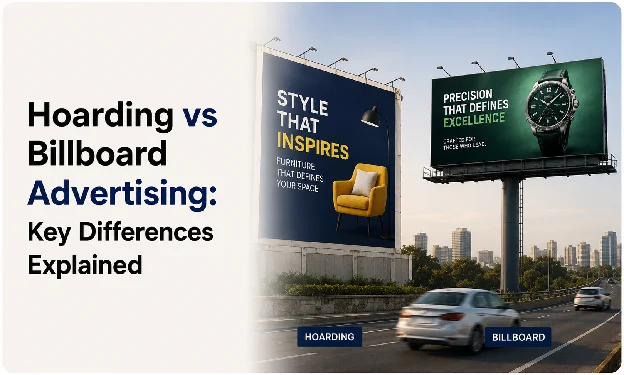

Ask five outdoor advertising vendors in India to define "hoarding" and "billboard," and usage still varies by city and agency. The reason is historical. "Hoarding" traces back to colonial English, where it described the temporary fencing around construction sites, which happened to be prime advertising real estate. "Billboard" became the standard term in the US, while India kept the British word for large outdoor advertising.
A growing number of Indian agencies now draw a functional line between the two: hoarding for static, local, urban panels, and billboard for larger, elevated or digital formats built for mass commuter reach. This guide follows that distinction so you can plan around the structure you need rather than the label on a quote.
What Is Hoarding Advertising?
A hoarding advertising placement is a large-format, static printed panel, typically flex or vinyl, mounted on a metal frame, wall, scaffold, or construction barrier. It is the most widely used out-of-home format across Indian cities, towns, and highways. India has more than 500,000 registered hoarding sites, contributing over 40 percent of the country's roughly Rs 4,500 crore OOH industry.
The format has evolved considerably. Hand-painted boards dominated through the 1970s and 1980s. Printed vinyl and flex took over in the 1990s, bringing sharper colour and easier production, and backlit hoardings became common by the early 2000s. Today, a hoarding near a busy market or above a retail strip still delivers consistent daily impressions at a fraction of premium media costs.
What Is Billboard Advertising?
In India, "billboard" increasingly refers to larger, elevated, and often digital formats: unipoles on highways, LED screens at premium city junctions, illuminated panels on airport approach roads, and rotating displays along metro corridors. Billboards are built for mass reach and commuter traffic rather than hyperlocal footfall, and they command higher visibility and longer dwell time than a street-level hoarding.
Digital billboards add flexibility static formats cannot match: real-time creative updates, dayparting, and multiple brand rotations on one structure. That makes billboard advertising, particularly digital formats, a common choice for brands running national or citywide campaigns that need scale over local precision.
Hoarding vs Billboard: Key Differences at a Glance
| Factor | Hoarding | Billboard |
|---|---|---|
| Display type | Static printed flex or vinyl | Static or digital (LED, DOOH) |
| Typical locations | Urban streets, markets, residential areas, construction zones | Highways, expressways, premium junctions, airports |
| Structure | Wall-mounted, scaffold, gantry, construction barrier | Elevated unipole or standalone tower structure |
| Audience reach | Hyperlocal, neighbourhood, and catchment level | Mass reach, commuter traffic, city-wide, or highway corridor |
| Best for | SMBs, local retail, events, real estate, political campaigns | National brands, product launches, brand-building campaigns |
| Campaign duration | Short to medium term, one to three months | Medium to long term, three to twelve months |
| Creative updates | Requires physical reprinting | Instant, for digital billboards |
| Targeting precision | Pincode or locality level | City corridor or highway stretch level |
How Hoardings and Billboards Differ in Size and Format?
Hoarding sizes in India vary considerably, because they depend on municipal permissions and available space rather than a fixed standard. Mumbai's BMC limits hoarding size to 40 by 20 feet in non-premium zones, while other cities and premium locations allow larger structures. Internationally, billboards are more standardised, commonly 14 by 48 feet or 10 by 30 feet in the US, a consistency Indian hoardings do not share.
Indian outdoor formats break down into several types worth knowing before you book:
- Traditional static billboards, printed on vinyl or flex, remain the most common format for long-term visibility.
- Digital billboards (DOOH) display video, animation, or rotating creative, with real-time updates and dayparting.
- Mobile billboards, mounted on trucks or buses, take the message to specific locations instead of waiting for the audience.
- Wallscapes and building wraps cover large sections of a building exterior, a premium format associated with category leaders.
- Construction hoardings wrap the barriers around active sites, growing alongside fast-expanding tier-2 markets.
- Backlit and frontlit hoardings stay visible after dark, extending impressions into the evening.
- Unipole hoardings, on a single elevated pole, stand above traffic and buildings on highways and ring roads.
- Gantry hoardings span the road, putting creative elements in the sightline of every vehicle passing underneath.
Where Are Hoardings and Billboards Usually Placed?
Hoardings go where local footfall concentrates: busy market streets, near hospitals, above retail strips, around construction sites and at residential colony entrances. Billboards go where traffic moves at volume and speed: highways, expressways, ring roads, flyover approaches and premium junctions, plus airport approach roads and metro corridors.
Beyond format, the strongest campaigns come down to matching the site to the audience. Metro cities, highways, areas near malls and traffic-heavy junctions deliver the strongest impact regardless of which term the vendor uses.
For more information on billboard formats, costs, and campaign planning, see our complete guide to billboard advertising.
Which Gives Better Brand Visibility?
The honest answer depends on what kind of visibility your campaign needs, and the evidence supports both.
Hoardings win on density and local domination. Oppo has used this approach during smartphone launches, in one Diwali campaign booking over 3,000 hoarding spots across tier-1 and tier-2 cities, producing a documented 27 percent uplift in unaided brand recall. That comes from saturation within a defined geography, not from one premium site.
Billboards win on scale and spectacle. Vivo's 3D LED billboard at DLF Cyber Hub in Gurugram, built for the X80 Series launch and described as India's first, used animation and immersive visuals to create a standout moment in one high-traffic location rather than spreading across many sites.
Both work because the outdoors competes against a cluttered digital environment. The average consumer sees between 6,000 and 10,000 digital ads a day and is expert at tuning most of them out. A hoarding or billboard carries no such filter. It exists in physical space whether or not the viewer wants to engage, which is a large part of why outdoor recall so often beats digital recall.
Hoarding vs Billboard Cost in India
Costs vary by city tier, location quality and structure type, and agencies quote different ranges depending on inventory. A consolidated view looks like this:
By city tier (hoardings, general)
| City Tier | Indicative Monthly Rate |
|---|---|
| Tier 3 cities and small towns | Rs 5,000 to Rs 25,000 |
| Tier 2 cities (Surat, Nagpur, Indore, Coimbatore) | Rs 20,000 to Rs 1,00,000 |
| Metro cities, standard locations | Rs 50,000 to Rs 5,00,000 |
| Metro cities, premium locations (arterial roads, airports, flyovers) | Rs 5,00,000 to Rs 25,00,000 plus |
| Digital LED hoardings (DOOH) | Rs 30,000 to Rs 10,00,000 plus |
By format (premium billboard categories)
| Format | Indicative Monthly Rate |
|---|---|
| Premium city billboard (metro intersections, urban corridors) | Rs 2.5 lakh to Rs 15 lakh |
| Highway hoarding (national and state highway corridors) | Rs 50,000 to Rs 5 lakh |
| Unipole (elevated sites on expressways) | Rs 1 lakh to Rs 15 lakh |
| Gantry (above-road placements at key intersections) | Rs 2 lakh to Rs 12 lakh |
| Digital billboard (DOOH, LED screens) | Rs 1.5 lakh to Rs 20 lakh |
On a cost-per-thousand-impressions basis, hoardings in India typically run between roughly Rs 2 and Rs 10, which compares favourably against Western markets, where billboard CPMs run higher. Printing, fabrication and installation are usually quoted separately from site rental, and all figures exclude taxes. Rates depend on availability, site quality and negotiation, so compare quotes from more than one agency before committing.
When Should a Brand Choose Hoarding Advertising?
Hoardings deliver the strongest return when precision matters more than scale.
- Local retail and franchise expansion, driving footfall to a store within a defined catchment
- Real estate projects, building awareness in the buyer's actual locality or IT corridor
- Educational institutions, targeting families in specific neighbourhoods
- Healthcare and diagnostics, building recall within a genuine service radius
- FMCG and D2C brands, high-frequency impressions near kirana stores and purchase touchpoints
- Event and activation marketing, short campaigns needing fast turnaround
- Political and civic campaigns, ward-level visibility at scale
The advantage is straightforward: 10 to 15 well-chosen hoardings across a target area can outperform a single premium billboard on recall frequency within that geography, at a far more accessible combined cost.
When Is Billboard Advertising a Better Choice?
Billboards earn their higher cost when scale, prestige, or commuter reach is the objective.
- National and regional brand launches, establishing broad visibility in a new market
- Automotive, BFSI and premium brands, where high-visibility placements reinforce positioning
- Highway and inter-city targeting, reaching travellers between major metros
- Airport and transit advertising, reaching a higher-income, decision-making audience
- Digital and tech brands, where DOOH supports QR engagement and attribution
- Time-sensitive B2B campaigns, using digital billboards near business districts
B2B categories have a real reason to take billboards seriously in 2026\. Decision-makers spend meaningful time commuting on Indian highways and through business districts, so a billboard near a business park or airport approach becomes a genuine touchpoint with CXOs and procurement heads who are otherwise hard to reach outdoors.
Hoarding vs Billboard for Different Campaign Goals
Rather than picking one format outright, most effective strategies map the format to the stage of the customer journey being targeted.
| Campaign Goal | Better Fit | Why |
|---|---|---|
| Building broad brand awareness across a city | Billboard | Commuter scale and reach across a wide, diverse audience |
| Driving footfall to a specific store or site | Hoarding | Local, repeated visibility near the actual point of purchase |
| National product launch | Billboard | Establishes immediate, wide-reaching visibility in a new market |
| Hyperlocal event or store opening | Hoarding | Multiple, affordable touchpoints concentrated in one area |
| Reaching highway or inter-city travellers | Billboard | Direct placement on the actual travel corridor |
| Ward-level political or civic messaging | Hoarding | Precise geographic targeting at an accessible cost |
A layered approach often works best. A highway billboard creates the first impression as commuters enter a city, junction hoardings reinforce it as they move into commercial areas, and locality-level hoardings near the point of purchase convert awareness into footfall, mirroring a digital funnel applied to physical media.
How to Choose the Right Outdoor Advertising Format?
A handful of practical questions narrow the decision for any campaign.
What is the primary objective?
Broad awareness points toward billboards; local footfall points toward hoardings.
Where does the audience actually move?
Map their commute and shopping routes. The best sites sit at the intersection of those paths, not wherever inventory is free.
What does traffic quality look like, not just volume?
A hoarding at a premium market junction can beat one on a busier but less relevant arterial road.
How much creative flexibility is needed?
Campaigns needing frequent updates benefit from digital billboards, since static hoardings require a full reprint for any change.
Is the location cluttered with competitors?
Avoid sites crowded with rivals unless competitive conquest is deliberate.
Are illumination and maintenance handled?
Backlit sites deliver real night-time impressions, but only with an ongoing maintenance commitment.
Are permissions in order?
All installations require municipal or highway authority permission, and a licensed agency protects against fines or removal mid-campaign.
How will the campaign be measured?
Footfall uplift, branded search growth, QR scans, and recall surveys all work, but decide before launch.
Making the Right Choice for Your Outdoor Campaign
Hoardings and billboards are not competing options so much as tools built for different jobs. A hoarding earns its keep by putting a brand repeatedly in front of the local audience that can walk through its door. A billboard earns its keep by reaching the broad, moving population that builds citywide recognition. Both remain effective in 2026 precisely because they sit outside the digital clutter that limits online advertising.
So look past the label on a quote and confirm the actual structure, size, location, and traffic type being offered. Whether an agency calls it a hoarding or a billboard matters far less than whether it reaches the right audience, in the right place, at a cost that matches your objective.
To choose the right sites and formats for your campaign, contact Excellent Publicity for a tailored outdoor media plan.
Frequently Asked Questions
Is hoarding the same as a billboard in India?
They serve the same underlying advertising function, but usage varies. In India, "hoarding" is the traditional, broadly used term, while "billboard" is more common globally and, within a growing part of India's own outdoor industry, increasingly describes larger, elevated, or digital formats specifically. It is worth confirming the actual structure a vendor means before booking.
Why is it called "hoarding" in India rather than "billboard"?
The term traces back to colonial-era British English, where "hoarding" referred to the temporary fencing used around construction sites, spaces that doubled as advertising real estate. India inherited the British term, while the United States and much of the global industry standardised on "billboard."
Are hoardings cheaper than billboards?
Generally, yes, particularly for premium highway, digital, or gantry billboard placements, which cost more due to structural engineering, elevated positioning, and, for digital formats, screen hardware. A well-placed hoarding in a strong local market can still command a meaningful price in premium metro locations, but the higher end of billboard pricing typically exceeds standard hoarding costs.
How much does hoarding advertising cost in India?
Rates range from roughly Rs 5,000 to Rs 25,000 per month in tier-3 towns, Rs 20,000 to Rs 1,00,000 in tier-2 cities, and Rs 50,000 up to Rs 25,00,000 or more per month in metro cities depending on location quality, with digital LED hoardings commanding a further premium.
Which format delivers stronger brand recall?
Both can deliver strong recall through different mechanisms. Hoardings build recall through density and repetition across a local area; documented campaigns have shown recall uplifts in the 20 to 30 percent range. Billboards build recall through scale and visual impact at a single high-traffic site, particularly with digital or 3D formats designed to create a standout moment.
Can a campaign use both hoardings and billboards together?
Yes, and larger campaigns often do. A common structure uses billboards for broad, city-level awareness and hoardings for locality-level reinforcement closer to the actual point of purchase, mirroring a funnel from awareness to conversion.
What permissions are needed for hoarding or billboard advertising in India?
Both formats require municipal or highway authority approval, and specific rules vary by city; for example, Mumbai's BMC limits hoarding size to 40 by 20 feet in non-premium zones. Working with a licensed, experienced agency is the most reliable way to ensure compliance and avoid fines or forced removal.
How long should a hoarding or billboard campaign run?
Most campaigns need a minimum of one month to build any meaningful recall, with two to three months generally recommended for stronger results. Hoardings typically run shorter- to medium-term bookings suited to tactical or seasonal campaigns, while billboards, particularly highway and premium formats, are more often booked for three to twelve months to justify their higher setup cost and sustained recall-building objective.