
Car & Cab Advertising in India: The Complete Guide to Cost, Formats, and Benefits

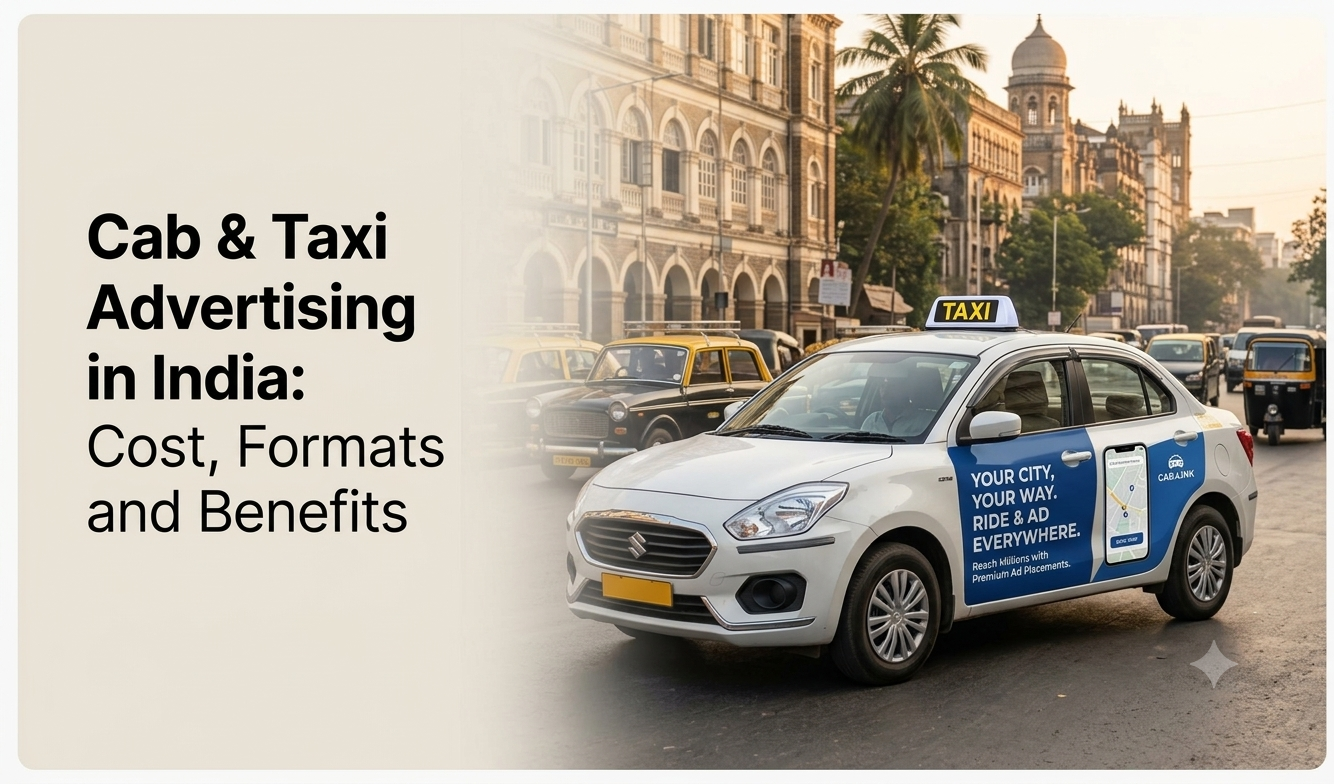

Every day, millions of people in India step onto the road to work, to the airport, to college, to the market, and your potential customers are almost certainly among them. You can put your brand on the vehicles that follow them everywhere they go.
That is what car and cab advertising does. It turns the taxis, cabs, and ride-hailing vehicles already moving through your city into a fleet of branded, mobile billboards, reaching commuters, pedestrians, and motorists all across the city.
With app-based platforms like Ola, Uber, and Rapido operating across hundreds of cities, alongside local taxi fleets, cabs now give brands a ready-made canvas in metro and tier-2 markets alike.
If you are evaluating cab advertising for the first time, the most useful question is what each format delivers for your goal. A door panel and a full wrap both fall under "cab advertising," and each one serves a different purpose. This guide covers what cab advertising is, why it is growing, which format fits which goal, what actually drives the cost, how it compares to other outdoor formats, and how to measure whether a campaign worked.
At Excellent Publicity, we help brands of every size turn this opportunity into results by planning, executing, and reporting on cab branding campaigns from the first conversation to the final proof of performance.
What Is Car & Cab Advertising, and Why Is It Growing So Fast?
Car advertising, also called cab advertising or cab branding, is a form of transit media where your brand's message is displayed on or inside commercial cabs and ride-hailing vehicles. Ads can appear on the exterior (full-body wraps, door panels, rear windshields, bonnets), on the rooftop (printed, illuminated, or digital LED displays), or inside the cabin (seat-back posters, QR codes, branded stickers).
A cab is always on the move. It travels through commercial districts, railway stations, airports, and residential neighbourhoods, all in a single day. A fleet of 20 branded cabs spreads across 20 different routes, so your brand appears in many locations through a single media booking.
Three things keep demand for the format rising. First, app-based ride-hailing has grown the number of cabs on the road in every major market, giving advertisers a large fleet to choose from. Second, city commutes give an in-cab ad a seated audience for the length of the ride. Third, cabs go where people are going: an airport terminal, a wedding venue, a corporate park at 9 AM. That puts your brand in front of people at the moments they are out and about.
Choosing the Right Format for Your Goal
Rather than treating formats as a menu, it helps to map each one against what you are actually trying to achieve.
| Your Goal | The Format That Fits | Why |
|---|---|---|
| Fast, citywide brand recognition (a launch) | Full cab wrap | Maximum exterior surface and visual impact, works even when glimpsed briefly |
| Strong visibility on a tighter budget | Door and side panel branding | Eye-level visibility for pedestrians and nearby traffic |
| Standing out after dark or in dense traffic | LED and digital cab-top | Illuminated, animated content cuts through low light and stationary traffic |
| A message that needs explaining (an offer, a QR code) | Interior seat-back advertising | Passenger attention for the length of the ride, with time to read and act |
| Long-distance visibility across a wide area | Rooftop or cab-top display | Visible above surrounding traffic, especially strong at intersections |
Rear windshield and bonnet branding sits between these options. It performs well in heavy traffic, where the vehicle behind and pedestrians nearby have extended time to notice it.
The pattern worth remembering is this: exterior formats sell reach, built to be seen briefly by as many people as possible, many times over. Interior advertising sells attention, a smaller audience held for much longer, which is why it is almost always the format paired with a QR code or a call to action rather than a logo alone. Most well-planned campaigns combine the two, using an exterior wrap or panel to build recognition and an interior seat-back panel to actually capture the scan or the call.
What Drives the Cost of Cab Advertising?
Cab advertising is charged per cab, per month, and four things shape the quote. Format comes first: a seat-back poster is a print job, while a full wrap is a design, print, and precision-installation job built to last through weather and months of road use. Fleet size comes next, since design and route-planning work is shared across more vehicles as the fleet grows. City matters too: metro markets like Mumbai, Delhi NCR, Bangalore, and Hyderabad offer greater route variety and audience density than tier-2 cities. Finally, campaign duration plays a part, since two- to three-month bookings give recall time to build.
Campaigns usually take one of three shapes.
- A local test covers a small fleet of cabs with interior branding in one city. It suits a business trying the format before scaling, since interior ads generate measurable scans or calls even from a small fleet.
- A city-wide awareness push combines exterior and interior branding across a larger fleet in a metro or a couple of tier-2 cities, the scale at which city-wide recall builds.
- A multi-city or premium campaign brings in full wraps, rooftop LED, or coordinated activity across three or more cities, often for national launches or festival campaigns.
Rates are confirmed with the fleet partner for your cities, formats, and campaign dates, and are shared with your campaign plan.
The Benefits That Make Cab Advertising Work
Branded cabs travel through the busiest parts of any city, including marketplaces, airports, IT corridors, and residential zones, carrying your brand to many neighbourhoods in a single day. Cab advertising reinforces brand visibility as commuters see the same branded vehicles again and again during their daily routines.
A branded cab is also always on: visible all day and always in motion, which makes it a reliable engine for sustained, long-term brand building. Because fleets can start small and scale up, it works for brands at nearly any budget level.
How Cab Advertising Works With Other Formats
Alongside a billboard or hoarding, which gives your brand size and a permanent presence at a key spot, cab advertising adds geographic spread, carrying the same message across many routes. Alongside bus or metro branding, which delivers dependable reach along set routes every day, cabs add flexibility, following demand to airports, business districts, and event venues. Alongside digital and social ads, which target precise audiences online, a branded cab adds a physical presence on the street.
Each format plays its own role. The strongest campaigns typically use cab advertising alongside digital or other OOH, letting the physical presence of branded vehicles reinforce a message the same audience is also encountering online.
Which Industries Get the Most From It, and How the Process Works
Cab advertising performs well across almost any consumer-facing category, but it does particularly heavy lifting for e-commerce and delivery apps chasing downloads, FMCG brands wanting repeated exposure among urban shoppers, real estate companies targeting high-net-worth buyers in premium localities, restaurants and food delivery services reaching hungry commuters at the right moment, and startups needing large-scale awareness on a limited budget. Healthcare, edtech, and travel and hospitality brands round out the categories that consistently see strong results.
At Excellent Publicity, the process is built to move quickly with minimal back-and-forth. You share your target cities, budget, formats, and goals; we return a tailored plan with recommended routes, formats, and estimated reach, alongside rate quotes that set out exactly what is included. Once you share your creative, our team converts it to a print-ready format at no extra cost and shares a proof for approval. Approved campaigns typically go live within 7 to 10 working days, extending to 10 to 15 days for larger, multi-city, or full-wrap campaigns, and every campaign closes with geotagged, date-stamped photographic proof and full reporting.
Legal Compliance and Measuring Results
Vehicle-based advertising in India is regulated, and every campaign we run has the correct permissions in place before it goes on the road, so it runs smoothly for its full duration. Depending on the market and format, approvals may be needed from the Regional Transport Office to confirm the wrap complies with motor vehicle regulations, from traffic authorities to confirm the branding does not obstruct the driver's view, and from local municipal bodies for outdoor advertising permissions and applicable taxes. We handle every one of these on your behalf, so you can focus on campaign goals rather than paperwork.
Once a campaign is live, its value only becomes clear if you can measure it. Two categories of indicators matter here.
- Reach indicators, estimated impressions, route coverage, and the number of distinct zones covered, confirmed through GPS tracking and geotagged photo proof, are the right yardsticks for a pure-awareness campaign like a launch or a rebrand.
- Response indicators, QR scans, calls, and promo code redemptions matter more for a performance-oriented campaign built around an offer. Matching the indicator to the campaign goal from the start gives you a clear read on results when the campaign ends.
Beyond these direct signals, indirect indicators like increases in website traffic, app downloads, store footfall, and social engagement during and after the campaign round out a fuller ROI picture.
Why Choose Excellent Publicity
We have spent over a decade planning and executing advertising campaigns across formats, and cab advertising is one of the areas where that experience shows most clearly: pan-India coverage across 100+ cities backed by a strong network of cab fleet partners, end-to-end management from design through installation and reporting handled by one team, complete geotagged proof of execution on every campaign, full legal compliance handled on your behalf, and the ability to fold your cab campaign into a larger 360-degree strategy through our radio, cinema, outdoor, digital, and BTL capabilities. Whether you need a small fleet in a single city like Ahmedabad or a large multi-city national rollout, we execute with the same transparency and attention to detail either way.
Ready to put your brand on the road? Contact our team for a customised cab advertising plan for your city and goals.
Frequently Asked Questions
How many cabs do I need for a noticeable campaign?
Most brands see meaningful visibility starting around 15 to 20 cabs in a single city, with city-wide recall campaigns typically using 40 or more. A well-targeted fleet on high-traffic routes makes every cab count, so route planning matters as much as fleet size.
Should I choose exterior or interior advertising?
Choose exterior formats for pure visibility and awareness goals, and interior formats when your message needs more than a glance, an offer, a QR code, or a call to action. Many well-planned campaigns use both together.
Can I choose the areas my branded cabs cover?
Yes. Your campaign plan sets out recommended routes and zones based on where your audience lives, works, and travels, such as business districts, airports, or residential areas. GPS tracking and geotagged photos then confirm the coverage.
How quickly can I tell if a campaign is working?
Response-driven metrics like scans and calls can show results within days. Reach and recall effects take a few weeks of sustained visibility to become measurable, since brand recognition builds through repetition rather than a single sighting.
What creative files do you need from us?
For external branding like door panels and full wraps, a CDR (CorelDRAW) file is preferred, which we convert into a high-resolution, print-ready format at no extra cost. For interior branding, standard print sizes are shared during planning.
Is cab advertising available outside the major metros?
Yes. We cover all major metro cities, Mumbai, Delhi, Bangalore, Hyderabad, Chennai, Kolkata, Pune, and Ahmedabad, as well as fast-growing tier-2 and tier-3 markets like Jaipur, Lucknow, Chandigarh, Indore, Surat, and Kochi.