
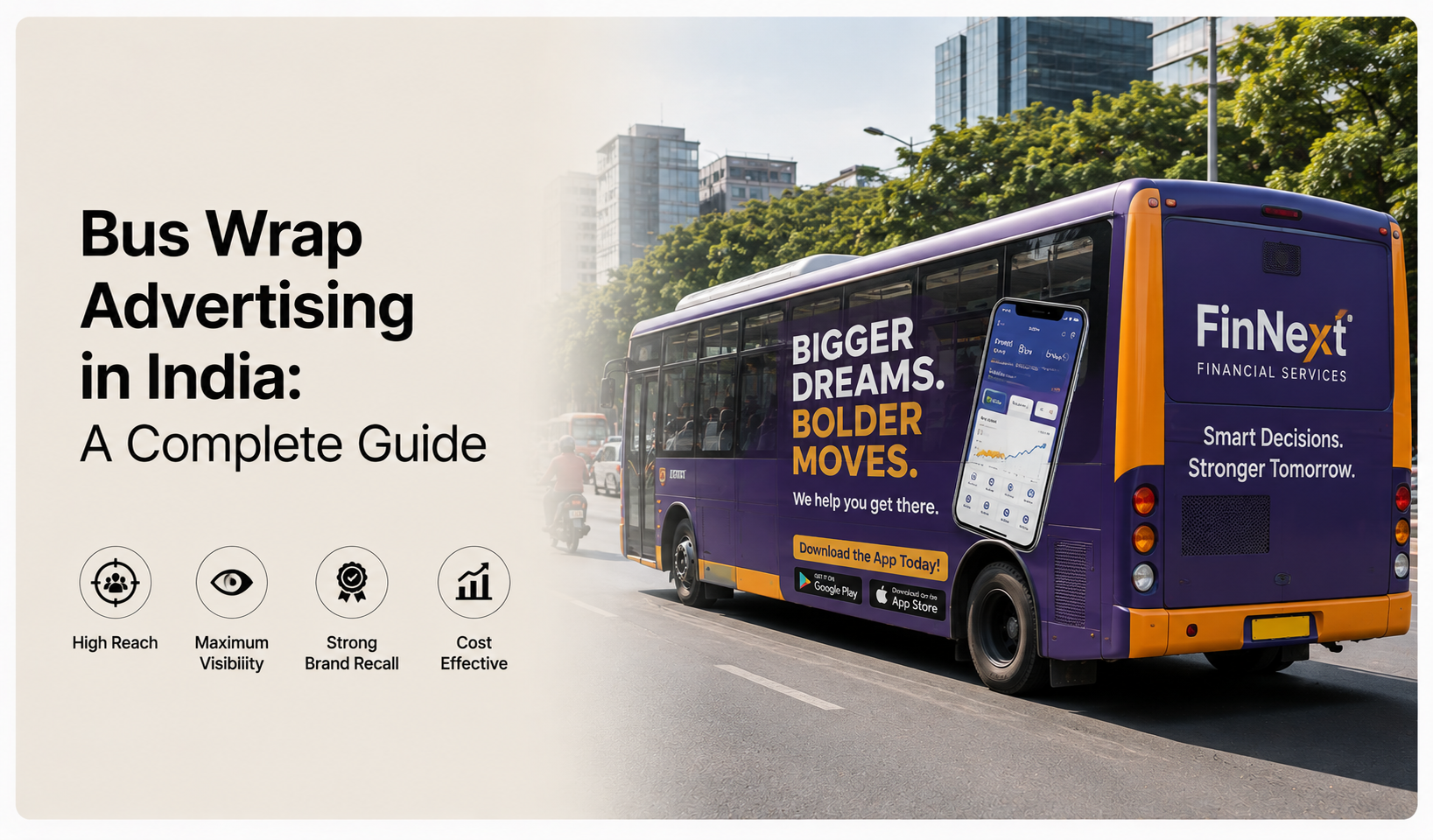

Every day, thousands of buses move through Indian cities carrying millions of commuters past markets, offices, colleges, and residential streets. For brands, each of those buses is also a moving surface that can carry a message across an entire city, all day, at a fraction of what television, digital, or large-format hoardings typically cost.
This is bus wrap advertising that covers all or part of a bus exterior with branded graphics so it functions as a mobile billboard. This guide covers what it is, what it costs across Indian cities in 2026, how to choose between a full and partial wrap, how the campaign process works, and how to plan one that actually performs.
What Is Bus Wrap Advertising?
Bus wrap advertising is a form of outdoor advertising in which promotional graphics are printed on high-quality vinyl and applied to the exterior of a bus, either covering the entire vehicle (full wrap) or select sections such as the sides, back, or windows (partial wrap).
Unlike a hoarding fixed to one location, a wrapped bus travels through dozens of neighbourhoods, commercial districts, and traffic corridors in a single day. That constant movement is what makes bus wraps one of the most cost-efficient formats in Indian outdoor advertising: a single wrapped bus can generate tens of thousands of impressions daily, at a monthly cost that's often a fraction of a comparable hoarding or digital display campaign.
Brands across categories, from e-commerce and FMCG to real estate, OTT platforms, and financial services, use bus wraps for product launches, festival promotions, and long-term brand-building campaigns across Indian metros and tier-2 cities. This makes bus advertising an effective way for brands to build visibility across busy urban areas.
Types of Bus Wrap Advertising in India
Bus wrap campaigns in India generally fall into a few formats, each suited to a different budget and objective.
Full Bus Wrap
The entire exterior, including windows, sides, back, and sometimes the rooftop, is covered in branded graphics. This delivers 360-degree visibility and the strongest visual impact of any bus format, making it the format of choice for product launches, festival campaigns, and category leaders wanting maximum buzz.
Partial Wrap (Window and Side)
Covers the side panels and window areas but leaves other sections of the bus untouched. This is a cost-effective middle ground that still delivers strong roadside visibility without the full production cost of a complete wrap.
Back Panel Advertising
Back panel ads are placed on the rear of the bus. Because vehicles behind a bus spend extended time viewing the back panel, especially in slow-moving traffic, this format performs well for brand recall at a comparatively low cost.
Side Panel Advertising
Displayed along one or both sides of the bus. This offers a large display area and strong visibility to pedestrians and roadside traffic in crowded commercial areas.
Interior Bus Advertising
Includes seat branding, handle branding, poster displays, and digital screens inside the bus. Interior formats hold a passenger's attention for the length of the ride, making them effective for detailed messaging, QR codes, and informational campaigns.
How Much Does Bus Wrap Advertising Cost in India?
Bus wrap advertising costs in India vary by city, format, route, and campaign duration. Here are indicative 2026 monthly rates across major markets:
| City | Side Panel | Back Panel | Full Wrap (per bus) |
|---|---|---|---|
| Mumbai | Rs 20,000 to Rs 40,000 | Rs 15,000 to Rs 30,000 | Rs 1,20,000 to Rs 2,50,000 |
| Delhi NCR | Rs 18,000 to Rs 35,000 | Rs 12,000 to Rs 28,000 | Rs 1,00,000 to Rs 2,25,000 |
| Bengaluru | Rs 15,000 to Rs 28,000 | Rs 10,000 to Rs 22,000 | Rs 90,000 to Rs 2,00,000 |
| Pune | Rs 12,000 to Rs 25,000 | Rs 8,000 to Rs 20,000 | Rs 75,000 to Rs 1,75,000 |
| Tier 2/3 City | Rs 8,000 to Rs 15,000 | Rs 5,000 to Rs 10,000 | Rs 50,000 to Rs 1,00,000 |
Partial wraps, which cover the windows and side sections without the full exterior, typically range from Rs 40,000 to Rs 1,20,000 per month, while a complete full wrap runs from roughly Rs 75,000 in smaller cities up to Rs 2,50,000 per month in metro markets.
A few factors move these numbers up or down:
City tier: Metro cities command a premium over tier-2 and tier-3 markets, in exchange for significantly higher commuter density and route variety.
Route: Premium routes, such as airport shuttles or corridors through major business districts, often carry an additional 10 to 25 percent charge over standard routes.
Format complexity: A full wrap involves more vinyl, more precise installation, and more production time than a back or side panel, which is reflected in the price.
Campaign duration: Most operators offer better per-month rates on longer bookings, typically three months or more, compared with a single-month trial.
Fleet size: Booking multiple buses in a single campaign usually brings down the per-bus cost through volume discounts.
Benefits of Bus Wrap Advertising for Brands
Massive, City-Wide Visibility: A single wrapped bus is seen by pedestrians, motorists, and other commuters across every route it travels, delivering exposure that a fixed hoarding simply cannot replicate within the same budget.
Mobility Advantage: Unlike a static billboard confined to one location, a bus wrap moves through commercial hubs in the morning, marketplaces in the afternoon, and residential neighbourhoods by evening, reaching different audiences throughout a single day.
High Frequency and Recall: Commuters and residents along a bus route tend to see the same branded vehicle repeatedly. This repeated exposure is what drives recognition and recall over time, often more effectively than a single, isolated ad placement.
Cost-Effective Reach: Compared with television, large digital campaigns, or premium hoardings, bus wrap advertising delivers a strong volume of daily impressions at a comparatively low monthly cost, especially on panel and partial-wrap formats.
Strong Local and Regional Targeting: As the routes are fixed and predictable, brands can select buses that pass through specific commercial zones, IT corridors, educational belts, or residential pockets that match their target audience.
Non-Intrusive, Ad-Block-Proof Exposure: A bus wrap cannot be skipped, muted, or blocked the way a digital ad can. It exists in physical space, which keeps it visible to an audience that increasingly avoids online advertising.
Builds Brand Trust: Large-scale outdoor campaigns tend to signal establishment and credibility to consumers, which is particularly useful for new businesses, expanding companies, and brands entering a competitive market.
Full Bus Wrap vs Partial Bus Wrap: Which Is Better?
Neither format is universally better. The right choice depends on the campaign's goal, timeline, and budget.
| Factor | Full Bus Wrap | Partial Wrap |
|---|---|---|
| Coverage | Entire exterior, 360-degree | Side panels and windows only |
| Visual impact | Maximum | Strong but limited |
| Typical monthly cost | Rs 75,000 to Rs 2,50,000 | Rs 40,000 to Rs 1,20,000 |
| Best for | Launches, festivals, category leaders | Quick promotions, tighter budgets |
| Production time | Longer | Shorter |
| Campaign length | Suited to 2 to 3 months or more | Works for shorter bursts too |
A full wrap makes sense when a brand wants to dominate public attention during a launch, a major sale, or a festival period like Diwali or Ganesh Chaturthi. A partial wrap is a practical choice for brands testing the format, running a shorter promotional campaign, or working with a leaner budget while still wanting strong roadside visibility.
How Does Bus Wrap Advertising Work?
A bus wrap campaign follows a fairly consistent process from the first conversation to the buses hitting the road.
1. Define the Campaign Goal: Every campaign starts with a clear objective, whether it is brand awareness, a product launch, local footfall, or lead generation. The goal shapes every decision that follows, including format, routes, and duration.
2. Select the Target Area: Brands identify the zones that matter most to them, such as commercial markets, IT hubs, educational belts, airport routes, or residential neighbourhoods, based on where their audience actually spends time.
3. Choose the Bus Routes: Since buses travel fixed daily routes, route selection determines exactly who sees the ad and how often. This step should account for traffic volume, audience demographics, and peak commuter movement.
4. Choose the Format: Based on budget and objective, brands select between a full wrap, partial wrap, back panel, side panel, or interior branding, or a combination of formats for layered visibility.
5. Design the Creative: The advertisement is designed for visibility from a distance and at speed, since most viewers only have a few seconds to register the message.
6. Print and Install: The design is printed on weather-resistant vinyl and applied by trained installers, followed by a quality inspection to confirm the wrap is properly fitted and durable.
7. Run and Monitor the Campaign: Once live, the campaign runs for its planned duration, commonly one, three, six, or twelve months, with longer durations generally producing stronger recall and familiarity.
How to Design an Effective Bus Wrap?
A bus wrap typically has only a few seconds to register with a passerby, whether they are standing at a signal or glancing over from another vehicle. Good design accounts for that constraint from the start.
- Keep it bold and simple: Use a handful of large words in a thick, easy-to-read font, with strong colour contrast so the message is legible from a distance, even in bright sunlight or heavy traffic.
- Use the whole bus as a canvas: Place a strong visual hook near the front to catch attention early, build the story along the side, and end with a clear call to action on the back panel, where following traffic has the most time to read it.
- Choose durable, weather-resistant materials: India's climate ranges from intense heat to monsoon rains, so UV-protected vinyl and fade-resistant ink matter for keeping the wrap looking sharp for the full campaign duration.
- Add a clear next step: A QR code, short URL, or simple offer like a discount code gives viewers something to act on, turning a passive glance into an active engagement, particularly useful for interior and back-panel placements.
- Make it locally relevant: A Hindi-English mix, festival-themed visuals during Diwali or Holi, or messaging tailored to a specific route's audience, such as student offers near colleges or lunch deals near office parks, tends to perform better than generic, one-size-fits-all creative.
- Test before full rollout: Reviewing mockups from multiple angles and, where possible, testing a small print run help catch legibility or durability issues before committing to a full fleet.
Best Cities for Bus Wrap Advertising in India
Bus wrap advertising performs strongly across India's major metros and an expanding list of tier-2 cities, each offering distinct advantages.
- Mumbai has one of the country's largest bus fleets and dense commuter traffic across business districts like Lower Parel, Andheri-BKC, and the Western Express Highway, making it a strong market for both mass-reach and targeted campaigns.
- Delhi NCR offers extensive coverage across Delhi, Noida, Gurugram, Ghaziabad, and Faridabad, with DTC and other operators providing wide route networks through commercial and residential zones alike.
- Bengaluru is particularly effective for brands targeting IT professionals, with routes through corridors like Whitefield and Electronic City reaching a large working population daily.
- Hyderabad, Chennai, Kolkata, Pune, and Ahmedabad round out the major metro markets, each with strong public transport usage and established bus advertising infrastructure.
- Growing tier-2 markets, including Jaipur, Lucknow, Surat, Kochi, Indore, Nagpur, Chandigarh, and Coimbatore, are increasingly popular for brands seeking lower-cost, high-visibility campaigns as public transport ridership continues to expand in these cities.
How to Choose the Right Bus Routes for Your Campaign?
Route selection has as much influence on a campaign's success as the creative itself, since it determines exactly which audience sees the ad and how often.
Match routes to your audience: Buses through commercial centres and business districts reach working professionals. Residential routes reach families and local consumers. Routes near colleges and universities reach students. Airport and railway corridors reach travellers from other regions.
Blend trunk and feeder routes: Trunk routes through major arteries deliver broad, city-wide reach, while feeder routes through specific neighbourhoods add hyperlocal precision. A mix of both often performs better than relying on one alone.
Account for route premiums: High-footfall or longer routes, such as those serving airports or major business corridors, typically carry a 10 to 25 percent premium over standard city routes, reflecting their higher audience value.
Avoid mismatched targeting: A premium product is unlikely to perform well on routes through low-income areas, just as a student-focused campaign will underperform on routes that mostly serve office commuters. Aligning the route with the actual buyer avoids wasted spend.
How to Plan a Successful Bus Wrap Advertising Campaign?
Bringing everything together, a well-planned campaign typically follows this sequence:
1. Set a clear objective. Awareness, footfall, launch buzz, or lead generation each calls for a different format and route strategy.
2. Set a realistic budget, accounting for city tier, format, fleet size, and campaign duration using the cost ranges above.
3. Select cities and routes that genuinely match where the target audience lives, works, studies, or travels.
4. Choose the right format, weighing a full wrap against a partial wrap or panel format based on the objective and budget.
5. Design creative that reads clearly at a glance and includes a next step, whether that's a QR code, a phone number, or a simple offer.
6. Work with an experienced bus advertising partner who can manage route selection, transit authority permissions, printing, and installation.
7. Track performance using QR scans, website traffic spikes, promo code redemptions, and footfall data where relevant, comparing results against the original objective.
8. Review and extend or adjust the campaign based on what the data shows, since recall tends to strengthen with sustained, repeated exposure over several months.
Take Your Brand Further with Bus Wrap Advertising
Few advertising formats in India combine the reach, frequency, and affordability that bus wraps offer. A single campaign puts a brand in front of commuters, pedestrians, and motorists across an entire city, day after day, without the recurring cost structure of digital media or the fixed limitations of a hoarding.
Whether the goal is a citywide product launch, a festival campaign, or steady local brand building, a well-planned bus wrap campaign, built on the right routes, the right format, and clear creative, can deliver visibility that few other outdoor formats match at a comparable cost.
Working with an experienced bus advertising agency for route intelligence, transit permissions, and professional installation makes it considerably easier to get the planning and execution right from the start.
Frequently Asked Questions
How much does bus wrap advertising cost in India?
Costs vary by city and format. Side and back panels generally range from Rs 5,000 to Rs 40,000 per month depending on the city, while full wraps range from roughly Rs 50,000 in tier 2/3 cities to Rs 2,50,000 per month in metros like Mumbai and Delhi NCR.
What is the difference between a full wrap and a partial wrap?
A full wrap covers the entire exterior of the bus for maximum visibility and impact, while a partial wrap covers select sections such as the side panels and windows at a lower cost, making it suitable for shorter or smaller-budget campaigns.
Which Indian cities are best for bus wrap advertising?
Mumbai, Delhi NCR, Bengaluru, Hyderabad, Chennai, Kolkata, Pune, and Ahmedabad are the strongest metro markets, while tier-2 cities like Jaipur, Lucknow, Indore, Chandigarh, Surat, and Coimbatore offer growing, cost-effective opportunities.
How long should a bus wrap campaign run?
Campaigns typically run for one, three, six, or twelve months. Longer durations of three months or more generally produce stronger brand recall, since repeated exposure over time is what builds familiarity.
How quickly can a bus wrap campaign be launched?
Most campaigns can be launched within one to two weeks of creative approval, covering design finalisation, printing, and installation, though larger multi-city or multi-bus campaigns may take slightly longer.
How is bus wrap advertising effectiveness measured?
Common measurement methods include estimated daily impressions, QR code scan rates, promo code redemptions, website traffic increases during the campaign window, and pre- and post-campaign brand recall surveys.
Do I need permission to run a bus wrap campaign in India?
Yes. Bus wrap campaigns typically require approval from the relevant transit authority or bus operator, along with compliance with local advertising and vehicle branding regulations. Most experienced bus advertising agencies handle these approvals as part of the campaign process.
Is bus wrap advertising suitable for small businesses?
Yes. Partial wraps, back panels, and side panels offer strong local visibility at a lower cost than a full wrap, making bus advertising accessible even for smaller budgets, particularly for businesses targeting a specific city or neighbourhood.