

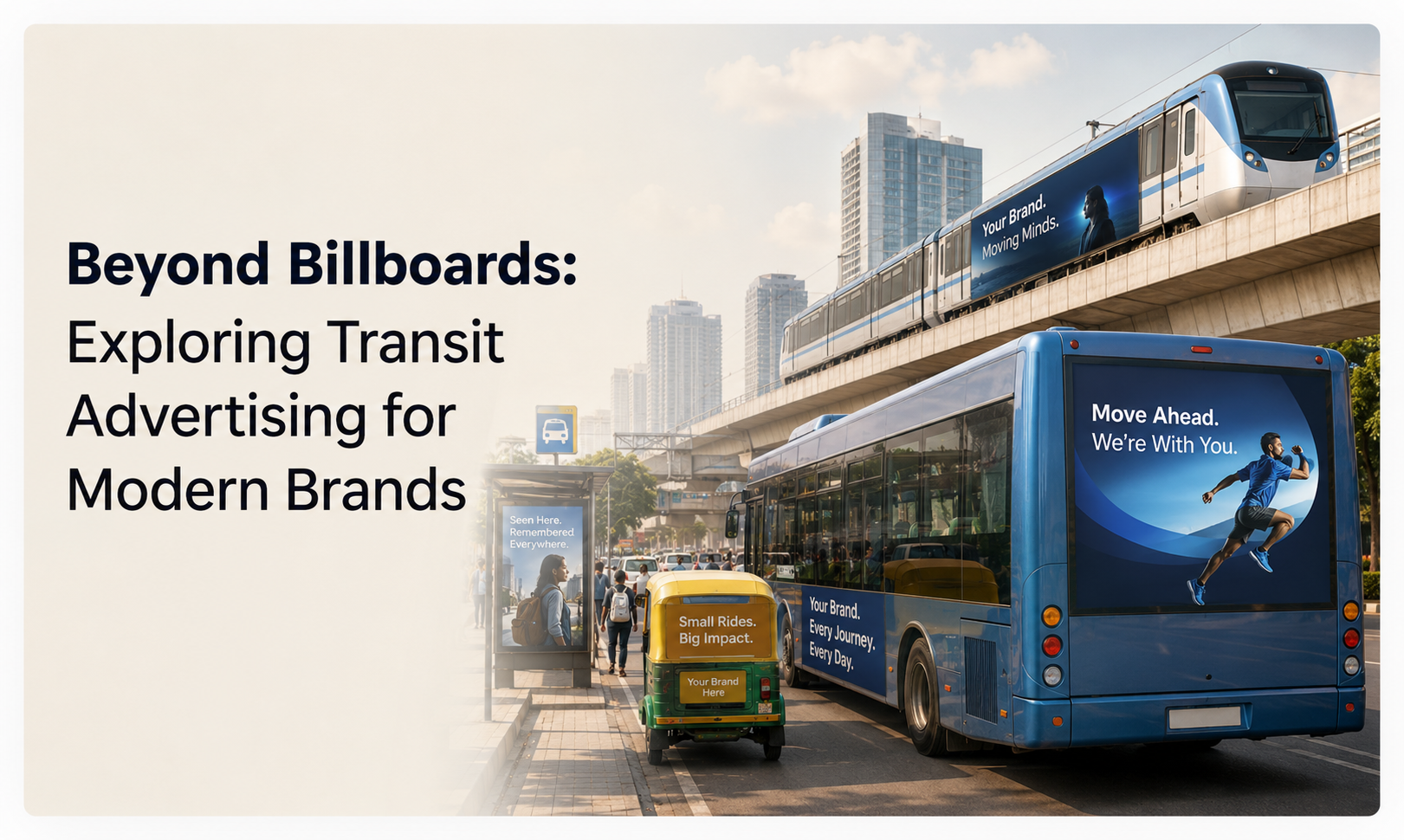

The advertising market is at its peak now. The older methods, like pamphlet distributions, public announcements, and every other way, were designed so that the public would come to you. But times have changed, brands these days do not rely completely on gathering the audience. Instead, they go to their target audience now.
Hoardings on busy highways, advertising on buses, cabs, autos, tricycles, metros and trains are the newer formats of advertising. The strategy is simple: go where your audience is already present. Within today’s busy schedules, people hardly have time for a peaceful meal, so in that case, one of the best ways to advertise is to find your audience. Hence, Transit Advertising is reshaping how modern brands think about visibility.
Why Traditional Outdoor Advertising Alone Is No Longer Enough?
Static billboards depend on people passing by a fixed location, but urban audiences today are fragmented across routes, neighbourhoods, and commute patterns. A single hoarding cannot follow a customer from their home to their office, and in a city like Mumbai or Bengaluru, that daily journey often crosses several distinct micro markets, each with its own character and audience.
Transit media closes that gap by moving with the audience, delivering repeated exposure across the exact areas your customers travel through every day. A commuter who takes the same bus or metro route five days a week will see the same brand message dozens of times a month.
The Evolution of Outdoor Advertising
Outdoor advertising in India has moved from static hoardings and painted walls to a far more dynamic mix. Buses, autos, and metro trains have become mobile canvases. At the same time, digital screens at stations and malls have added a programmatic, real-time layer to what was once a purely physical medium. This shift reflects a simple truth: brands need to be visible wherever their audience gathers, not just at one fixed point on a map.
Understanding Transit Advertising in Today's Media Landscape
Transit advertising places brand messages directly on vehicles and transit infrastructure, such as buses, metro trains, auto rickshaws, cabs, e-rickshaws, and railway hubs. These travel through dozens of micro markets in a single day, generating impressions among commuters who are already engaged with their surroundings.
The messages become more clear and stick in the brains of the audience because they see the advertisement every day and during every commute.
The Transit Advertising Ecosystem in India
India's transit advertising landscape is genuinely diverse, and each format serves a distinct purpose and audience.
Metro Advertising
Metro advertising reaches a young, urban, working professional audience across train exteriors, station panels, and digital screens, with dwell times that can stretch past twenty minutes per journey. This transit medium is perfect for premium and tech-forward brands.
Bus Advertising
Bus branding remains one of the largest moving canvases available, covering long city corridors from morning to night. A single wrapped bus can generate tens of thousands of daily impressions, making it a strong choice for mass market brands.
Auto Rickshaw Advertising
Auto rickshaws navigate narrow lanes and residential colonies that larger vehicles cannot reach, offering some of the most affordable, hyperlocal advertising available, particularly effective in Tier 2 and Tier 3 cities.
Cab Advertising
Cab branding blends urban mobility with a premium audience, since ride-hailing vehicles regularly travel to offices, airports, and business districts, making it well-suited to finance, travel, and lifestyle brands.
E-Rickshaw Advertising
E-rickshaws cover the final, hyperlocal stretch of a commuter's journey, connecting metro stations, markets, and housing societies. This makes e-rickshaw advertising a highly cost-effective format for brands targeting a specific neighbourhood.
Railway and Transit Hub Advertising
Passenger Trains
General, express, and suburban passenger trains carry a broad, high-volume, mixed-income audience across thousands of daily services. Branding here typically takes the form of exterior wraps, door panels, and window decals, ideal for mass-market and regional brands chasing sheer reach across Tier 2 and Tier 3 routes at a lower cost per impression.
Premium Trains
Premium train services such as Rajdhani, Shatabdi, Duronto, Tejas, and Vande Bharat carry a smaller, more affluent, largely business and leisure travelling audience in air-conditioned, reserved seating. Interior branding on seat backs, tray tables, and headrests, along with full exterior wraps, works well here for BFSI, real estate, and premium consumer brands looking for longer dwell time and stronger brand association.
Why Are Modern Brands Increasingly Investing in Transit Advertising?
Brands are shifting budgets toward transit media because it delivers measurable reach at a lower cost per impression than television or premium digital placements. Industry estimates suggest transit media's share of India's OOH market has grown from roughly 25 percent to 35 percent in recent years, and is projected to touch 40 percent by 2026, a clear signal of where marketing budgets are heading.
How Different Transit Formats Serve Different Marketing Objectives?
You will find a lot many varieties in the world of transit media because every medium is made for a particular marketing objective. Bus branding suits brands chasing citywide awareness; metro advertising works best for premium positioning among working professionals.
In contrast, auto and e-rickshaw branding are built for hyperlocal, high-frequency campaigns. Matching the format to your objective, rather than choosing the most visible option, is what separates an effective campaign from a wasted budget.
Choosing the Right Transit Advertising Medium
The right medium depends on your audience, city, and campaign goal. A real estate brand launching a project might lean into e-rickshaw and auto branding around the specific micro market surrounding the site. In contrast, a fintech brand targeting working professionals may prioritise metro and cab advertising near business districts and IT parks.
Budget also plays a role. Brands that have concentrated on auto or e-rickshaw fleets in one city see much better results than from a thin, scattered presence across every format at once. Working with an established transit advertising partner helps match the format to the objective, city, and budget, rather than choosing a medium simply because it seems the most visible on paper.
Transit Advertising and the Rise of Hyperlocal Marketing
As digital advertising costs climb and audiences fragment across platforms, brands are rediscovering the value of hyperlocal, physical presence. Transit advertising lets a brand dominate a specific neighbourhood, market, or transit corridor at a fraction of what a citywide digital campaign would cost, making it especially valuable for regional and D2C brands entering new markets.
The Integration of Transit Advertising with Digital Marketing
Modern marketing campaigns follow a new fashion of integrating QR codes, short URLs, and digital screens. This format now bridges physical exposure with online action, letting brands track scans, visits, and conversions tied directly to specific routes or vehicles. Pairing transit media with digital retargeting, reaching the same commuters online who saw the ad offline, is quickly becoming standard practice for performance-focused brands.
Emerging Trends Shaping the Future of Transit Advertising
Digital Out of Home screens are expanding across metro stations and bus shelters, GPS-backed route data is making impressions measurable, and sustainability messaging is gaining ground as more fleets turn electric. Hyperlocal targeting is also becoming more precise, with brands using route and time-of-day data to change creative by neighbourhood, showing a lunch offer near office corridors and a festive message in residential markets on the same day.
Together, these trends are turning transit advertising from a purely visual medium into a data-backed, accountable channel that fits naturally into an integrated media plan alongside television, digital, and social.
Common Mistakes Brands Make When Using Transit Advertisings
Here are a few of the very common mistakes brands make when using transit advertisements:
- The most frequent mistake is treating transit media as a one-size-fits-all format and running the same creative across every vehicle type, without adjusting for the different dwell times and audiences each format offers.
- Other common missteps include ignoring route relevance and booking a fleet without checking whether it actually passes through the target audience's daily path.
- Choosing formats based on price alone rather than audience fit, and skipping measurement tools like QR codes or landing pages that make results easy to track and justify to stakeholders.
- Underestimating campaign duration is another frequent issue, since a short one-or two-week burst rarely builds the repetition needed for strong recall.
Why Transit Advertising Deserves a Place in Every Modern Media Plan?
Billboards will always have a place in outdoor advertising, but carrying a campaign alone might not deliver the desired output. Transit advertising puts your brand directly into the daily routines of your audience, across buses, metros, autos, cabs, and e-rickshaws, with the flexibility and measurability that modern marketing demands.
Transit advertising rewards brands that plan by route and audience rather than simply buying the biggest surface available, and it rewards patience, since the strongest recall comes from campaigns that run long enough to build genuine repetition.
At Excellent Publicity, we help brands build transit campaigns across every format and city, backed by real route planning, driver relationships, and years of on ground experience across Tier 1, Tier 2, and Tier 3 markets. If you are ready to move your brand beyond the billboard, get in touch with our transit media team and let us build a plan around where your audience actually travels.