

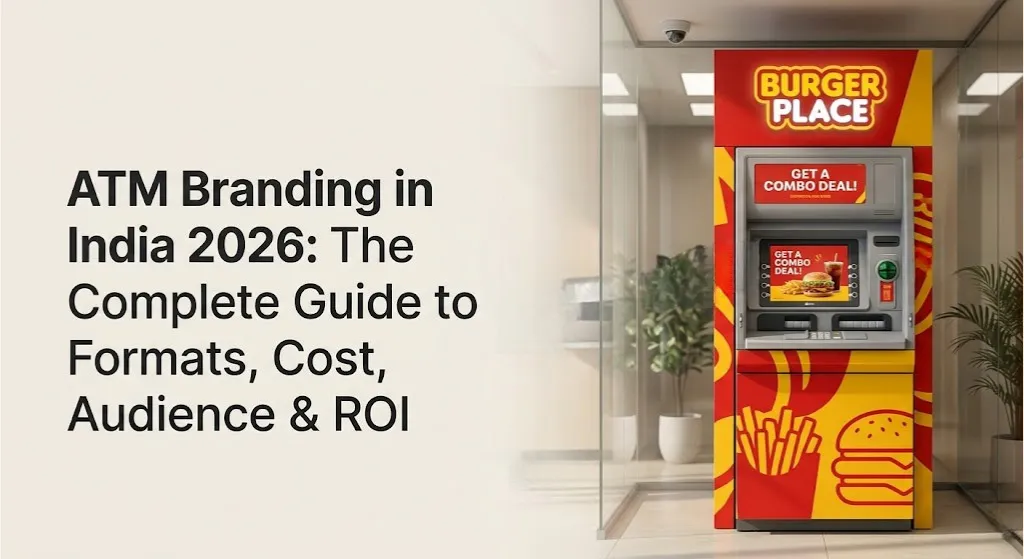

There are 2.51 lakh ATMs spread across every corner of India, from the gleaming malls of Mumbai and Delhi to the market lanes of Jaipur and the semi-urban streets of tier-2 towns. Every single one of them receives hundreds of visitors a day. And every single one of them holds those visitors' undivided attention for 45 to 120 seconds at a stretch, during one of the most focused moments of their day, the moment they handle their money.
Yet, ATM branding remains one of the most underutilised, most misunderstood, and most underpriced advertising media in India. While brands scramble to outbid each other for premium hoardings, airport walls, and metro panels, the ATM quietly delivers something none of those formats can: a one-on-one conversation with a financially active consumer, in a clutter-free space, at precisely the moment they are thinking about spending.
This guide, developed by The Excellent Publicity, one of India's leading OOH advertising agencies, covers everything a brand or marketing team needs to know about ATM branding in 2026: what it is, why it works, every format available, how to price and plan a campaign, which industries benefit most, and how to book end-to-end execution.
Quick Facts - ATM Branding in India 2026
2.51L+: ATMs across India (RBI, FY25) (QTY 30K for advertising )
24×7: Availability, zero downtime
45–120s: Undivided audience dwell time
74%: Ad recall rate at ATMs (ATM Marketplace)
Zero: Competing ads in the same space
₹500–₹5K: Entry-level cost per ATM/month
What Is ATM Branding? Definition, Scope & Why It Matters
ATM branding, also called ATM advertising or ATM marketing, refers to the use of Automated Teller Machine surfaces (Whenever available), screens, vestibules, and associated touchpoints as advertising real estate for brands. It is a subset of Out-of-Home (OOH) advertising but with a fundamentally different dynamic from billboards, hoardings, or transit ads.
A hoarding on a flyover gets 2–3 seconds of eye contact from a moving vehicle. A metro panel gets a glancing look from a commuter in motion. An ATM gets something far rarer: a stationary, focused adult who is not looking at their phone, is not distracted, and is engaged in a financial transaction that has their full cognitive attention. Every advertiser wants this moment. ATM branding delivers it.
The Origin: From Bank-Only to Brand-Open Medium
Historically, ATM branding meant a bank placing its own logo, colours, and service messages on its machines, a functional identity exercise, not a media channel. That changed as independent white-label ATM operators entered India and began monetising machine surfaces for third-party advertising. Today, ATM branding is open to virtually any brand that wants to reach a specific, financially active, location-defined audience.
India's white-label ATM count stood at 36,216 as of March 2025, and nearly 79% of these are in rural and semi-urban centres, giving brands unprecedented access to Bharat audiences that urban-focused media consistently misses.
What Makes ATM Branding Categorically Different from Other OOH
Three structural characteristics separate ATM branding from every other form of outdoor advertising:
- Captive, focused attention: The user cannot walk away, scroll past, or skip the ad. They are physically engaged with the machine for the duration of their transaction.
- Point-of-spend proximity: The user has just withdrawn cash and is, in most cases, about to make a purchase. No other advertising medium intercepts the consumer this close to the spending decision.
- Zero ad clutter: There is one brand on one ATM at any given time. No competing ads, no visual noise, no attention dilution.
The Excellent Publicity Perspective: Of all the OOH formats we plan and execute, ATM branding is the one that most consistently surprises clients with its recall performance. The combination of captive attention, financial mindset, and zero clutter creates a brand impression that outlasts most traditional outdoor placements.
Why ATM Branding Works - The Psychology & The Data
Understanding why ATM branding outperforms its perceived status requires looking at both the psychology of the medium and the hard data on recall and engagement.
The Financial Mindset Effect
When a person stands at an ATM, they are in an unusually conscious relationship with money. They are withdrawing a specific amount, often for a specific purpose, such as groceries, a restaurant visit, paying a bill, or shopping. Research consistently shows that people in a "spending mindset" are significantly more receptive to brand messages and product information than they are in neutral or unrelated environments. An ad for a home loan, a new FMCG product, or a telecom plan encountered at the exact moment the viewer is handling money registers with contextual relevance that a highway billboard simply cannot replicate.
The 74% Recall Advantage
Studies on ATM advertising (cited by ATM Marketplace) have recorded ad recall rates as high as 74% among ATM users exposed to screen-based advertising. For context, average recall for digital banner ads is in the range of 3–8%, and even premium OOH formats like airport advertising typically benchmark at 40–55% recall. The ATM's structural advantage - captive, undistracted, physically present audience - is the primary driver of this outsized recall figure.
The Earning Member Filter
ATMs are predominantly used by the primary earning members of a household, salaried professionals, business owners, and self-employed individuals who withdraw cash for household expenses and personal purchases. This natural demographic filter means that virtually every impression an ATM brand generates is delivered to a financially independent, purchase-decision-capable adult. This is a self-selecting quality that mass media formats cannot pre-sort for.
Frequency and Repetition Without Fatigue
The average ATM user visits the same machine 4–8 times per month. If a brand's creative is placed on that machine, it achieves repeated exposure with the same individual across multiple visits, building the frequency and familiarity that brand recall requires, without the diminishing returns of digital retargeting or the banner blindness that digital ads suffer. The physical nature of the medium keeps it fresh in a way a repeated online ad cannot.
The Purchase Proximity Principle
Research from the retail sector shows that customers who withdraw cash from an in-store ATM spend 20–25% more during that visit than customers who arrive with cash already in hand. The ATM visit itself is a psychological "spending trigger." For brands - particularly FMCG, retail, and consumer services, placing an ad at this precise trigger point is like advertising on the shelf in a supermarket: you are reaching the consumer in a state of active purchase readiness.
ATM Branding Formats - Every Option Explained
ATM branding is not a single format; it encompasses a range of placements, each with distinct visibility profiles, audience interactions, and cost structures. Here is a complete breakdown.
Full Machine Wrap (Whenever Available)
The entire ATM cabinet - front, sides, and top- is covered with branded vinyl graphics. The machine itself becomes the brand asset. Unmissable from a distance, highly Instagrammable, and effective for brand launches or bold identity statements.
Glass Façade Branding (Whenever Available)
Branded vinyl or mesh is applied to the glass panels of the ATM vestibule or enclosure. Visible from outside the ATM cabin, creating dual visibility, both to incoming pedestrians and to the user inside. Very cost-effective for reach campaigns.
Digital Screen Advertising
Video or animated ads are displayed on the ATM's digital screen during idle time or transaction wait screens. Full-motion video captures attention during the 15–45 seconds of "please wait" time. Extremely high recall due to screen proximity, typically 30–60 cm from the viewer's eyes.
ATM Topper / Header Branding (Whenever Available)
A branded panel is placed on top of the ATM. Visible above the machine in indoor or semi-outdoor settings, it acts as a persistent brand flag. Often backlit for 24×7 visibility. Cost-effective for sustained brand presence.
ATM Receipt / Back-of-Receipt Advertising (Needs to check availability)
Brand logo, offer, or message printed on the back of the ATM transaction receipt. The receipt travels home with the user, creating post-visit brand recall and acting as a take-home coupon or offer reminder. Ideal for FMCG promotions and retail discounts.
In-Cabin Display & Sticker Branding
Branded stickers, panels, and backlit displays positioned inside the ATM vestibule, at eye level, behind the machine, or on the side walls. Users are in the enclosed cabin for 45–120 seconds with nothing else to look at. Extremely effective for message-heavy creatives.
ATM Kiosk & Enclosure Full Branding
For standalone ATM kiosks in malls, airports, or commercial spaces, brands can take over the full enclosure, floor graphics, ceiling panels, door wraps, and digital screens, creating a total brand environment around the machine. The strongest format for immersive brand experiences.
| Format | Visibility Type | Dwell / Exposure | Approx. Cost (per ATM/month) | Best For |
|---|---|---|---|---|
| Full Machine Wrap | Exterior + Pedestrian | Continuous 24×7 | ₹1,500 – ₹4,000 | Brand launches, bold identity |
| Glass Façade Branding | Exterior - passersby | Continuous 24×7 | ₹500 – ₹2,500 | Reach campaigns, local awareness |
| Digital Screen Ad | Captive user - screen | 15–45 sec per transaction | ₹2,000 – ₹6,000 | Recall, video storytelling offers |
| ATM Topper / Header | Overhead - ambient | Continuous 24×7 | ₹800 – ₹3,000 | Brand name recall, sustained presence |
| In-Cabin Sticker / Panel | Interior - captive | 45–120 sec captive | ₹700 – ₹2,500 | Message-heavy, finance, insurance |
| QR / SMS Activation | Interactive | User-initiated | ₹1,000 – ₹3,000+ | App installs, lead generation |
| Full Kiosk Takeover | 360° immersive | Continuous + captive | ₹5,000 – ₹15,000+ | Premium brand experiences, launches |
* Rates are indicative and vary by city tier, location type, operator network, and campaign volume. Contact The Excellent Publicity for an accurate quote based on your campaign requirements.
ATM Branding Cost in India 2026 - Honest Breakdown
ATM branding is one of the most cost-accessible premium OOH formats in India. Here is a frank, transparent breakdown of what drives the cost and what to realistically budget.
Entry-Level to Premium: The Full Cost Spectrum
At the entry level, basic glass façade sticker branding on a single ATM in a Tier-2 city can cost as little as ₹500–₹2000 per month. At the premium end, a full digital screen + full machine wrap campaign across 500+ ATMs in metro cities over three months can run into ₹15–₹25 lakhs or more. Between these poles, there is enormous flexibility, and that flexibility is ATM branding's biggest commercial advantage over other OOH formats.
Key Factors That Influence ATM Branding Rates
- City tier: Metro ATMs (Mumbai, Delhi, Bengaluru) cost 2–3× more than equivalent formats in Tier-2 or Tier-3 cities.
- Location type: ATMs inside malls, airports, railway stations, and hospital complexes command significant premiums over street-side or residential colony machines.
- Format: Digital screen advertising and full wraps cost more than sticker or panel formats.
- Scale: Campaigns across 50+ ATMs typically attract volume discounts of 15–25%.
- Duration: Monthly campaigns are standard; 3–6 month bookings often come with negotiated reductions.
- Network operator: White-label ATM networks, bank-owned ATMs, and brown-label operators each have different rate structures and availability policies.
The Cost-Per-Impression Advantage
Here is where ATM branding's financial case becomes compelling. A mid-tier ATM in a busy urban market receives roughly 200–400 transactions per day, meaning an in-cabin sticker or screen ad generates 200–400 captive impressions every 24 hours. At ₹1,000/month for the placement, that works out to approximately ₹0.08–₹0.17 per impression, a figure that challenges even the cheapest digital CPMs for quality and attention intensity.
Budget Planning Guidance: For a meaningful pilot campaign, The Excellent Publicity recommends starting with 20–50 ATMs across a single city or corridor, combining a glass façade sticker (awareness) with digital screen advertising (recall). This gives you enough reach to measure brand lift while keeping the initial spend manageable. Total monthly campaign budgets for such a pilot typically range from ₹1–₹5 lakhs.
ATM Branding Locations & Reach - Where Your Brand Shows Up
India's 2.51 lakh ATMs are not randomly distributed. They are placed strategically where people need cash, which means where people congregate, shop, travel, and live. This geographic pattern maps almost perfectly onto the locations where brands want to build visibility.
High-Footfall Urban Locations
The richest advertising environments for ATM branding in urban India include:
- Shopping malls and market complexes - ATMs here serve shoppers in active spend mode, typically with disposable income and purchase intent.
- Petrol pumps and highway stops - High dwell time, diverse demographic, frequency of transit travellers.
- Railway stations and metro interchanges - Millions of commuters interact with these ATMs daily. Ideal for mass awareness campaigns.
- Hospital and healthcare campus ATMs - Highly targeted for healthcare, pharmaceutical, and insurance brands.
- Corporate parks and IT hubs - Premium professional audience; ideal for banking, fintech, real estate, and B2B-adjacent campaigns.
- University and college campuses - Student-focused brands, EdTech, affordable banking products, and telecom can reach younger demographics effectively.
The Rural and Semi-Urban Opportunity: White Label ATMs
This is the ATM branding story that most urban marketers miss entirely. India's white-label ATM network, 36,216 machines, nearly 79% located in rural and semi-urban centres, is a largely untapped advertising channel reaching the Bharat consumer that mass media routinely struggles to penetrate.
For FMCG brands, agri-businesses, government awareness campaigns, rural fintech products, and insurance providers targeting first-time buyers, white-label ATM advertising in Tier-3 towns and rural markets offers reach that is genuinely difficult to achieve through any other single physical medium.
| Location Type | Audience Profile | Best Brand Categories | Footfall Level |
|---|---|---|---|
| Mall / Market Complex | Shoppers, urban families | Retail, FMCG, Lifestyle, Finance | Very High |
| Railway / Metro Station | Commuters, travellers | Mass awareness, Telecom, FMCG | Very High |
| Corporate / IT Park | Salaried professionals | Fintech, Real Estate, Insurance | High |
| Hospital / Healthcare Hub | Patients, families, staff | Healthcare, Pharma, Insurance | High |
| University / College Campus | Students, faculty | EdTech, Telecom, Youth Banking | High |
| Petrol Pump / Highway | Travellers, vehicle owners | Auto, FMCG, Insurance, Hotels | Moderate–High |
| White Label ATM, Rural/Semi-Urban | Bharat consumers, first-time banked | FMCG, Agri, Govt. PSU, Rural Fintech | High within locality |
Who Uses ATMs? Audience Profile & Targeting Insights
Demographics: The Financially Active Core
The ATM user base in India is primarily adults aged 22–55, with a strong skew toward the 25–45 age group, the segment with the highest active earning and spending power. The self-selection mechanism of ATM usage (you need a debit or credit card, a PIN, and a specific intent to withdraw cash) pre-qualifies the audience as financially included, actively banking adults. This is a significant and often underappreciated audience quality filter.
Three Core ATM User Personas
The Urban Working Professional - Uses ATMs near their office or residential colony. Withdraws cash for daily expenses, dining, and transport. Exposed to ATM ads during weekday lunch hours and post-work visits. Responsive to banking products, fintech, insurance, and lifestyle brands.
The Active Household Manager - Visits market or colony ATMs on weekends for household purchases. Pre-purchase mindset: they are withdrawing cash to shop, pay for services, or cover household bills. Highly receptive to FMCG, home goods, education services, and health products.
The Semi-Urban / Rural Cash Economy User - Dependent on ATMs for salary withdrawals, government benefit access, and everyday transactions. Less exposed to digital or mass media advertising. Extremely receptive to brand messages at ATMs because it is one of the few branded touchpoints they regularly encounter. Critical audience for FMCG, agri-input, telecom, and government schemes.
The Hyperlocal Targeting Superpower
Unlike a billboard that delivers the same message to everyone on a road, ATM branding can be planned at a micro-level. Want to target salaried IT professionals in Whitefield, Bengaluru? Book the ATMs in the corporate parks and residential complexes in that specific pin code. Want to reach families in a residential neighbourhood of Pune before Diwali? Book the colony ATMs within a 2-km radius. This pin-code-level precision is why ATM branding is increasingly described not as OOH advertising but as hyperlocal activation, and it is impossible to replicate with any other physical medium.
The Hyperlocal Advantage No Other OOH Medium Offers
We've planned and executed ATM campaigns for real estate developers that specifically targeted ATMs within a 1–2 km radius of their project sites, reaching potential buyers who were already living in the neighbourhood and could physically walk to the sample flat. No digital geo-targeting, no programmatic DSP, and no billboard could deliver that level of precision at comparable cost.
Hyperlocal ATM campaigns consistently outperform broad-reach OOH for brands where the purchase decision is location-specific - property, local retail, neighbourhood services, and franchise businesses.
Best Industries for ATM Branding - Sector-by-Sector Analysis
ATM branding's unique combination of financial context, captive attention, and hyperlocal precision makes it especially powerful for certain categories.
Banking, Fintech & Insurance
The most natural fit. Users are in an active financial mindset. Cross-selling savings accounts, credit cards, loans, or insurance products at the ATM moment is contextually perfect, and brands in this category have documented proof of uplift in product enquiries from ATM screen campaigns.
FMCG & Consumer Goods
Cash-in-hand consumers who just withdrew at an ATM in or near a retail market are heading to buy. FMCG brands, especially new launches, can intercept this consumer with product messaging and a take-home coupon at exactly the right moment.
Real Estate & Housing
Hyperlocal ATM campaigns around project micro-markets reach potential buyers in the immediate catchment. For builder launches, ATMs in residential colonies near the project site deliver a quality of neighbourhood-targeted reach that no other medium can match.
Telecom & Internet Services
New SIM activations, broadband connections, and prepaid top-up offers work exceptionally well in ATM environments, particularly in Tier-2 and Tier-3 cities where telecom brand preference is still forming. Receipt advertising with QR-linked offers bridges ATM exposure to digital acquisition.
Healthcare & Diagnostics
Hospital campus ATMs and clinic-area machines deliver brand messages to patients, caregivers, and medical professionals. Diagnostic chain expansions, pharmacy networks, and health insurance brands can build precise micro-market awareness through careful location selection.
Education & EdTech
ATMs near schools, colleges, and coaching centres target parents and students at a location-relevant moment. Admission season campaigns for schools, universities, and coaching institutes can use ATM glass façade or screen advertising to drive awareness directly in their catchment areas.
Retail & E-commerce
Retail brands with physical stores can drive footfall by placing ATM ads near their locations. E-commerce brands can use receipt QR codes to drive app installs and first purchases from cash-holding consumers who are demonstrably comfortable spending.
Government & Public Awareness
ATMs, especially white-label networks in rural India, offer government bodies and PSUs an unmatched channel for awareness campaigns on schemes, subsidies, health programmes, and financial inclusion messaging. Pan-India white-label ATM advertising ensures reach in regions where print, TV, and digital penetration remain uneven.
ATM Branding vs. Other OOH Formats: A Comparative Analysis
For media planners evaluating ATM branding against other outdoor options, here is an objective side-by-side comparison across the metrics that matter.
The data reveals ATM branding's defining competitive position: it is the only format that simultaneously delivers zero clutter, pin-code hyperlocal precision, captive financial-mindset audience, and low entry cost. No other single OOH format ticks all four boxes at once. Vande Bharat wins on dwell time and premium audience; airports win on affluence, but neither approaches ATM branding on cost-accessibility and hyperlocal control.
ATM Branding with Excellent Publicity, What We Offer
India's Most Trusted Partner for ATM Branding Campaigns
The Excellent Publicity is a full-service OOH advertising agency with deep expertise in ATM branding across India's Tier-1, Tier-2, and Tier-3 markets. We don't just book locations, we architect hyperlocal campaigns that match your brand's audience profile to the right ATM network, at the right locations, with creatives that perform.
What we bring to your ATM branding campaign:
- Pan-India ATM Network Access - We work with multiple ATM operators, including white label networks, bank-owned ATMs, and brown label machines, giving us access to 10,000+ advertisable ATMs across the country.
- Hyperlocal Planning Expertise - Our campaign planning team maps your target audience to specific pin codes, neighbourhoods, and micro-markets, and recommends the exact ATM locations that maximise relevant exposure.
- End-to-End Execution - From creative compliance and artwork production to installation coordination, site verification, and photographic proof of execution, we manage every step.
- Multi-Format Campaign Architecture - We combine formats strategically: exterior glass façade for awareness + in-cabin sticker for recall + receipt coupon for conversion. This layered approach maximises campaign ROI.
- Campaign Measurement - We integrate QR tracking, SMS opt-in analytics, and pre/post brand recall surveys to give you a defensible view of what your ATM campaign delivered.
- Scalable Budgets - Whether your campaign spans 20 ATMs or 2,000, we tailor a plan that fits your budget and objectives.
How to Book an ATM Branding Campaign: Step-by-Step
The ATM branding booking process is more structured than it appears. Here is exactly how a well-executed campaign comes together.
1. Define Your Objective, Budget, and Audience
Start with clarity on what the campaign needs to achieve: awareness, recall, lead generation, or in-store traffic. Define your target audience by age, income, and geography. Establish a realistic monthly budget range. These three parameters drive every subsequent decision.
2. Location Mapping and ATM Selection
The Excellent Publicity's planning team cross-references your audience profile against available ATM inventory in your target geographies. We shortlist ATMs by location type (mall, street, corporate park, rural market), footfall data, and network availability, providing a recommended location list with rationale for each selection.
3. Format Selection and Creative Briefing
Based on your budget and objective, we recommend the optimal format mix. We then brief the creative requirements for each selected format, size specifications, file types, content guidelines, and any restrictions imposed by the ATM operator or network. Creatives must comply with operator policies before production begins.
4. Creative Production and Approval
Once creatives are finalised, we manage the production of print materials (vinyl, stickers, panels) and digital assets (video, animation files) as required. For digital screen campaigns, we submit content to the ATM operator's content management system for approval and scheduling. This stage typically takes 1–3 weeks.
5. Installation, Go-Live, and Site Verification
Our ground team coordinates installation across all selected ATM locations within the agreed launch window. For each ATM, photographic proof of installation is captured and shared with you. For digital screen campaigns, go-live scheduling is verified through the operator's reporting dashboard.
6. Campaign Monitoring and Post-Campaign Reporting
During the campaign, we conduct periodic site audits to verify creative compliance and conditions. For QR or SMS campaigns, we provide regular engagement data. At campaign close, we deliver a comprehensive post-campaign report covering confirmed locations, estimated impressions, engagement metrics, and a brand recall assessment if applicable.
Timeline Guidance: A typical ATM branding campaign from brief to go-live takes 2–4 weeks, significantly faster than railway or airport advertising approvals. For festive season campaigns (Diwali, New Year, summer), plan 6–8 weeks ahead to secure premium locations and avoid inventory shortage.
Challenges & Limitations: What to Know Before You Book
A transparent guide must address the real limitations of ATM branding alongside its strengths.
Variable ATM Condition
Not all ATMs are well-maintained. Creative installed on a poorly-kept machine can reflect negatively on the brand. Site audit and location pre-approval are essential.
✓ Pre-campaign site inspection by The Excellent Publicity team.
UPI Reducing ATM Footfall
RBI data shows a marginal decline in ATM count (2.53L to 2.51L in FY25) as digital payments grow. High-footfall, well-placed ATMs still see strong usage, especially in semi-urban and rural markets.
✓ Focus on high-usage ATMs with footfall data validation.
Operator Restrictions
Not all ATM operators allow third-party advertising, and those that do have varying content guidelines and approval processes. Network selection matters.
✓ We work exclusively with advertising-enabled networks.
Creative Wear in Outdoor Conditions
Vinyl wraps and stickers on exterior-facing ATMs can show wear within 3–6 months, particularly in monsoon conditions or high-footfall areas where surfaces are touched frequently.
✓ Weather-grade materials + mid-campaign replacement policy.
Attribution Complexity
Like all physical OOH, ATM advertising lacks built-in impression tracking unless digital or QR elements are embedded. Pure physical formats rely on estimated footfall data.
✓ Include QR codes or unique URLs to create a measurable digital trail.
Premium Location Competition
ATMs in malls, airports, and premium commercial hubs have limited advertising slots with high competition. These locations sell out fast around key seasons.
✓ Book 6–8 weeks ahead for the festive period inventory.
Conclusion: Why ATM Branding Deserves a Place in Every Indian Brand's OOH Plan
India's 2.51 lakh ATMs collectively represent one of the most underexploited advertising opportunities in the country. While marketers pour budgets into crowded digital feeds, cluttered hoardings, and expensive airport panels, the humble ATM quietly delivers something none of those can: a financially active, captive, undistracted adult at precisely the moment they are most receptive to a brand message about money, products, and purchases.
The medium's structural advantages, zero ad clutter, 74% recall potential, pin-code-level hyperlocal precision, 24×7 availability, and a remarkably accessible entry-level cost make it one of the most compelling value propositions in OOH advertising. Add the emerging rural white-label ATM network for Bharat-market reach, and you have a format that works equally well for a premium fintech brand in Bengaluru and a government health scheme in rural Rajasthan.
The brands that recognise ATM branding's unique position, as the intersection of financial mindset, physical proximity, and captive attention, and invest in it intelligently in 2026, will build recall and hyperlocal brand presence that outlasts and outperforms campaigns spending five to ten times more on conventional OOH.
ATM branding is a form of Out-of-Home (OOH) advertising where brands place their creative messaging on or inside Automated Teller Machines, through full machine wraps, glass facade stickers, digital screen ads, receipt printing, in-cabin panels, and kiosk takeovers. It targets a captive, financially active audience during the 45–120 seconds they spend completing a transaction at the ATM. The Excellent Publicity plans and executes ATM branding campaigns across India's Tier-1, Tier-2, and Tier-3 markets.
ATM branding in India is one of the most cost-accessible OOH formats available. Entry-level formats like glass façade stickers start at ₹500–₹700 per ATM per month in Tier-2 cities. Digital screen advertising ranges from ₹2,000 to ₹6,000 per ATM per month in metro markets. Full machine wraps in premium locations can reach ₹4,000–₹15,000 per ATM per month. For a pilot campaign across 20–50 ATMs in a single city, total monthly budgets typically range from ₹1–₹5 lakhs. Contact The Excellent Publicity for a custom quote.
The best locations depend on your target audience. For premium urban reach, ATMs in malls, corporate parks, hospital campuses, and railway stations in Metro cities (Mumbai, Delhi, Bengaluru, Hyderabad, Chennai) deliver the highest quality impressions. For mass reach at lower cost, Tier-2 and Tier-3 city market ATMs and white-label ATMs in semi-urban and rural areas are highly effective. The Excellent Publicity's planning team maps your audience profile to specific pin codes and recommends optimal locations.
Banking, fintech, and insurance brands have the most natural contextual fit given the financial environment of ATM usage. FMCG, retail, telecom, real estate, healthcare, education, and government awareness campaigns also benefit strongly, particularly when using hyperlocal targeting. ATMs near hospitals work for pharma brands; ATMs in corporate parks work for premium banking products; ATMs in residential colonies work for local retail and real estate developers.
The three key differences are captivity, clutter, and context. A billboard gets 2–4 seconds from a moving vehicle, in a cluttered visual environment, from an audience with no particular mindset. An ATM gets 45–120 seconds from a stationary, focused individual, in a zero-clutter one-brand environment, from an audience that is actively engaged with their finances. Ad recall studies record rates up to 74% for ATM screen advertising, compared to 20–35% for traditional billboards. ATM branding is also uniquely hyperlocal, pin-code precise, in a way no billboard can achieve.
Start by contacting The Excellent Publicity with your target city, budget range, and campaign objective. Our team will prepare a location-mapped media plan within 48–72 hours, covering recommended ATM networks, formats, locations, cost estimate, and campaign timeline. Once approved, we manage creative compliance, production, installation, and post-campaign reporting end-to-end. Typical lead time from brief to campaign go-live is 2–4 weeks. Visit excellentpublicity.com/contact or call our media planning team to get started.