
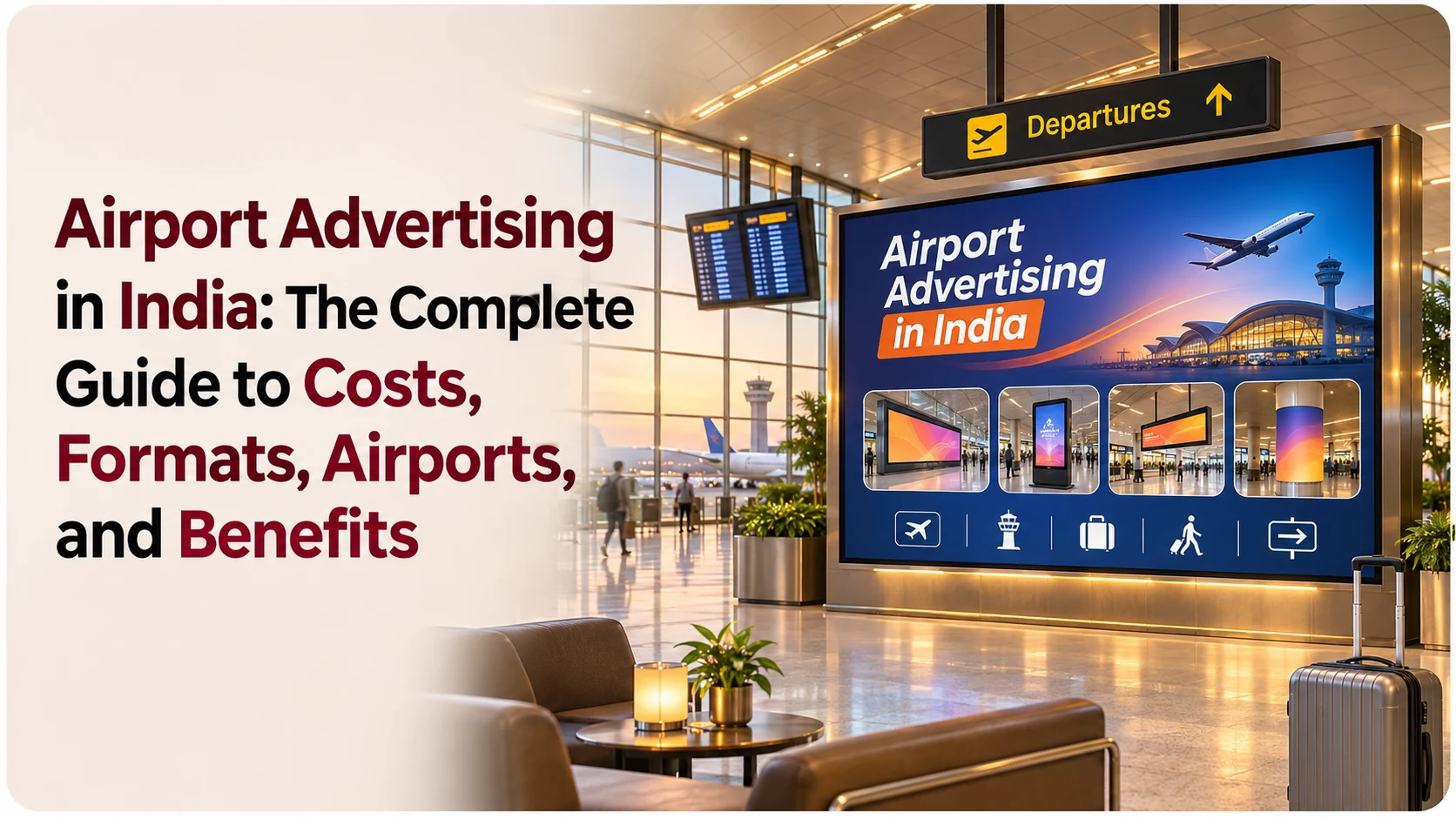

Airport advertising in India is paid brand placement inside or around an airport terminal: digital screens, backlit panels, jet bridges, baggage areas, lounges, branded activations and landside hoardings. Indicative rates run from about ₹25,000 a month for a pillar wrap at a tier-2 airport to ₹15 lakh a month for a large LED wall at a top-four airport. The airport, the exact zone and the booking window change the final cost more than the format's headline price.
A pillar wrap in Jaipur and an LED wall in Delhi share a category name and little else. This guide covers what each format costs, which airports suit which brands, who sells the space and the booking steps that delay first-time advertisers. To check live inventory at a specific airport, see our airport advertising services or go straight to the quote checklist near the end.
What is airport advertising?
Airport advertising is an out-of-home (OOH) medium that places brand messages in airport spaces approved by the airport operator or its advertising concessionaire. These spaces include departure and arrival halls, check-in zones, security-hold areas, boarding gates, aerobridges, baggage belts, lounges, car parks and the approach roads to the terminal (landside media). Advertising inside the aircraft, such as seatback screens, boarding passes and in-flight magazines, is a separate medium sold by airlines; see in-flight advertising.
Who sells airport advertising space
Most airport media is sold through the operator's advertising concessionaire, not by the airport itself. The seller you negotiate with sets the price, approval timeline and creative rules.
| Airport | Advertising concessionaire |
|---|---|
| Delhi (IGI) | TIM Delhi Airport Advertising Pvt Ltd, a joint venture of Delhi International Airport Ltd and Times Innovative Media |
| Hyderabad (RGIA) | Laqshya Hyderabad Airport Media Pvt Ltd (Laqshya Media with GMR) |
| Goa (Mopa) | Times OOH |
| Kochi, Noida (Jewar), Visakhapatnam (Bhogapuram) | Laqshya Media Group |
Other airports use their own concessionaires or the operator directly. A media agency can request availability and quotes from each seller and compare them for you.
Why brands use airports in India
Passengers wait in departure halls, security-hold areas, gates and baggage belts, so a panel at eye level is read while the viewer is stationary rather than scrolling or driving. Real estate, banking, automobile, luxury, hospitality and B2B brands are the most frequent airport advertisers.
Indian airports handled 420.09 million passengers in FY26, according to Airports Authority of India data reported by IBEF. Growth slowed to about 2% that year, and ICRA expects 1% to 3% growth in FY27, to 424 to 432 million passengers. The audience is concentrated in the large hubs: GMR reports more than 8.5 million monthly footfalls across its Delhi, Hyderabad and Goa airports.
Airport advertising cost in India
No official rate card applies across airports. Price depends on the airport, the exact position in the terminal, the format, the campaign length and, for digital, the share of the screen loop you buy. The table gives indicative monthly ranges for planning, not a quote.
| Format | Top four airports (Delhi, Mumbai, Bengaluru, Hyderabad) | Tier-2 airports |
|---|---|---|
| Large LED wall or digital display | ₹5,00,000 to ₹15,00,000 | ₹1,50,000 to ₹5,00,000 |
| Backlit panel (arrival or departure) | ₹2,00,000 to ₹8,00,000 | ₹80,000 to ₹3,00,000 |
| Boarding gate or jet bridge | ₹3,00,000 to ₹10,00,000 | ₹1,00,000 to ₹3,00,000 |
| Lounge branding | ₹2,00,000 to ₹5,00,000 | ₹1,00,000 to ₹2,50,000 |
| Baggage trolley branding | ₹1,00,000 to ₹2,50,000 | ₹50,000 to ₹1,00,000 |
| Pillar wrap or floor branding | ₹50,000 to ₹2,00,000 | ₹25,000 to ₹80,000 |
Indicative ranges per month, excluding 18% GST, production and installation. Source: Shub India Adworks, Airport Advertising India: Rates and Formats 2026. Actual rates vary by site and availability.
Worked example: one month at a tier-2 airport with a backlit panel (₹80,000 to ₹3,00,000) plus baggage trolley branding (₹50,000 to ₹1,00,000) costs ₹1,30,000 to ₹4,00,000 before GST and production. Three months of the same plan cost ₹3,90,000 to ₹12,00,000. To size a wider media budget around an airport campaign, use our advertising budget estimator.
What moves the price
- Terminal and zone. International departures after immigration cost more than a domestic arrival corridor. Two positions in the same terminal can differ in price by a multiple.
- Share of screen time. On digital media you buy a slot in a loop, such as 10 seconds every few minutes, not the whole screen. Ask for the loop length and the number of advertisers sharing it.
- Contract length. Concessionaires prefer longer commitments. Short bookings often carry a premium or exclude the best sites.
- Production and installation. Printing, fabrication, lighting and installation are billed separately from media rent. Two quotes that look 30% apart can differ only on this line.
- Season. Festive months and the winter travel peak have less inventory and higher rates.
How to compare two quotes
Compare five lines side by side: media rent, production, installation, GST and the proof of display included. Compare cost per month for the same zone, not cost per site.
Airport advertising formats
Format availability changes by airport; a format sold at Delhi may not exist at a smaller regional airport.
Digital screens and LED walls
Video or animated creative shown in a loop. Suited to launches, offers and campaigns that rotate several creatives or change the message weekly. Confirm screen size, resolution, loop length, spot duration and playout reporting.
Backlit panels and static displays
Illuminated printed panels in departure halls, arrival corridors and connecting walkways. Lower cost than digital and visible all day; suited to simple visual messages. Choose the site by panel size, viewing angle and walking-pace passenger flow, not by price.
Jet bridges and boarding gates
Branding on the aerobridge or gate area, seen while passengers queue and wait to board. Suited to premium and travel-linked brands. Inventory is limited and often sold per gate cluster.
Baggage belt and trolley branding
Arriving passengers stand beside the belt for several minutes, which suits hotels, taxis, local services, city real estate and tourism. Trolleys add repeated exposure across arrival and departure.
Lounge branding
Placements inside paid or card-access lounges reach a smaller, more affluent audience. Suited to financial services, luxury, automobile and premium consumer brands.
Pillars, floor graphics and ambient media
Repeated branding along passenger routes. Works when the message is short and the creative is consistent across pillars. Confirm how many pillars are included and where.
Experiential zones and activations
Kiosks, product displays and branded installations in approved spaces. These need the longest lead time because of safety, power, staffing and content approvals.
Landside and car park media
Hoardings on the approach road and in car parks reach drivers and pick-up traffic, including people not flying that day. Useful when the target customer is local rather than only travellers.
Airport-by-airport guide
Choose the airport before the format. Brands often default to Delhi and Mumbai when a regional airport matches their customers better.
| Airport | Best for | What to know |
|---|---|---|
| Delhi (IGI) | National and B2B campaigns, policy-linked messaging, premium brands | Sold by TIM Delhi Airport Advertising. Rates sit in the top-four band. |
| Mumbai (CSMIA) | Finance, luxury, entertainment, real estate, international travellers | Book well ahead of festive months, when premium positions sell out. |
| Bengaluru (KIA) | Tech, startups, B2B SaaS, education, automobile | Business-traveller profile; digital formats are widely used. |
| Hyderabad (RGIA) | Pharma, IT services, real estate, consumer brands | Sold by Laqshya Hyderabad Airport Media. |
| Ahmedabad (SVPIA) | Gujarat brands, textile, pharma, diamond, NRI-facing campaigns, real estate | Excellent Publicity is headquartered in Ahmedabad. |
| Chennai, Kolkata | Regional consumer, education, healthcare, FMCG | Lower rates than the top four; suited to regional-language creative. |
| Pune, Goa, Kochi, Jaipur, Lucknow | Hospitality, tourism, local services, regional launches | Lower cost and simpler approvals; often the right first airport for a smaller budget. |
Rule of thumb: if 60% of your customers are in one state, buy that state's main airport and one feeder city before paying for Delhi. Owning the whole visible zone at a smaller airport is worth more than one slot in a crowded loop at a large one.
How to choose the right format
| Your goal | Start with |
|---|---|
| Broad brand awareness | Backlit panels plus a digital loop at one main airport |
| Product launch with a date | Digital screens, with a large display at the entrance zone |
| Premium positioning | Lounges, jet bridges or exclusive gate branding |
| Hotel, taxi or city service | Baggage belt and arrival corridor |
| Leads | Any format with a QR code to a landing page and a tracked number |
| Direct interaction | Approved kiosk or activation |
Give each placement one job. If you cannot state in one sentence why a placement is in the plan, remove it.
How to book airport advertising in India
- Set the objective and budget. Awareness, launch, leads or positioning. Write down the target audience, cities, dates and monthly budget range.
- Shortlist two or three airports. Choose by where your customers fly, not by airport size.
- Request live inventory. Ask for site photos, dimensions, location maps, loop details for digital and available dates.
- Compare quotes line by line. Media rent, production, installation, GST and reporting.
- Submit creative for approval. The operator reviews content, size, lighting and safety. Rejections for wording or specification are common, so submit early.
- Confirm in writing. The airport, exact site, format, dates, rate and the proof of display you will receive.
- Verify the display. Collect dated photographs for static media and playout logs for digital. For multi-month campaigns, ask for periodic verification.
Allow a few weeks from enquiry to go-live for static media, and longer for large formats, fabrication and activations.
What to send for a quote
- Brand, product and the single goal of the campaign
- Preferred airports or cities
- Preferred formats, or "open to suggestions"
- Campaign start date and duration
- Monthly budget range
- Whether creative is ready or needs design
Email these details to [email protected] or contact our team, and we will reply with available sites, indicative pricing and a recommended plan.
Mistakes we see most often
- Buying the biggest airport by default. For a brand selling mainly in Gujarat, Ahmedabad often delivers more for less than Delhi.
- Ignoring creative rules. Airports reject artwork for size, brightness, claims and sensitive content. A rejection a week before launch costs the start date.
- Treating media rent as the whole cost. Production and installation can be a large share of a short campaign's budget.
- Expecting direct sales attribution. Airport media builds familiarity; measurable response needs a QR code and landing page.
- Skipping proof of display. If the contract does not specify photographs or playout logs, you cannot confirm what you paid for.
Plan your airport campaign with Excellent Publicity
Excellent Publicity is a media planning and buying agency headquartered in Ahmedabad, with offices in Mumbai, Delhi, Pune and Dubai. We plan and buy airport media alongside outdoor, print and digital channels, and we built Atlas, our OOH tracking and verification product, to confirm that paid sites are on display.
Send your goal, cities and budget range and we will shortlist available airport sites with indicative pricing, or hire a media planner to build the full plan.
Frequently asked questions
How much does airport advertising cost in India?
Indicative rates range from about ₹25,000 a month for a pillar wrap at a tier-2 airport to ₹15 lakh a month for a large LED wall at a top-four airport. Production, installation and 18% GST are extra.
Which airport is best for advertising in India?
The airport that matches where your customers live and fly. Delhi and Mumbai have the largest audiences and the highest rates; for many regional brands, the state's main airport gives better value.
Who sells airport advertising space in India?
The airport operator's advertising concessionaire: TIM Delhi Airport Advertising at Delhi, Laqshya Hyderabad Airport Media at Hyderabad, Times OOH at Goa Mopa and Laqshya Media Group at Kochi and Noida.
What are the main airport advertising formats?
Digital screens and LED walls, backlit panels, jet bridges and gates, baggage belt and trolley branding, lounge branding, pillars and floor graphics, activations and landside hoardings.
Can small businesses advertise at airports?
Yes. Pillar wraps, trolleys or a single backlit panel at a tier-2 airport cost far less than a metro LED wall. Minimum contract length depends on the operator.
How long does it take to launch an airport campaign?
Several weeks for static media and longer for large formats, fabrication and activations. Creative approval is the step that most often delays go-live.
What approvals are needed?
The operator or concessionaire reviews artwork for content, size, technical specification and safety. Activations also need operational and safety clearance.
How long should an airport campaign run?
One to three months is typical for awareness, because repeated exposure builds recall. Launches may run shorter, and longer commitments usually get better rates.
Can I advertise at several airports in one campaign?
Yes. Brands often combine one metro airport with feeder cities on the routes their customers fly. Compare combined cost and creative specifications before booking.
How do I measure airport advertising?
Collect dated photographs and playout logs as proof of display, and track responses through a QR code, landing page or unique number. Footfall figures show opportunity to see, not sales.